Welcome to the David Victor Vector Blog

Welcome to the David Victor Vector blog. This is blog that covers religious observances around the world international affairs and global business. This blog describes religious holidays for most major religions as well as raising issues dealing with globalization, international business ethics, cross-cultural business communication and political events affecting business in an integrated world economy. I look forward your discussion and commentary on these articles and subjects. Enjoy!

Saturday, May 26, 2012

Pentecost


INTRODUCTION
Pentecost is the last holiday in the Christian Moveable Feast Cycle, and celebrates the descent of the Holy Spirit among the followers of Jesus in general and of the Apostles in particular. For 2023,  Pentecost falls on Sunday May 28 for the Roman Catholic and Protestant traditions; and on June 4 for the Eastern Orthodox, Oriental Orthodox and Coptic traditions.

Pentecost is a major feast day in the Roman Catholic, Coptic and Eastern Orthodox traditions. Some Protestant denominations – including the Anglican, Episcopalian, United Methodist, Dutch Reformed and Lutheran Churches – celebrate Pentecost in varying degrees. Other Protestant denominations --  Baptists and Presbyterians -- are mixed in their practice from congregation to congregation as to how much they observe Pentecost or even whether or not they observe the holiday at all. Many other Protestant denominations do not observe Pentecost at all; this includes most Pentecostal Protestant denominations (although ironically the name Pentecostal comes from the name of the holiday).

DATING PENTECOST

Pentecost comes 50 days after Easter and the name in English comes directly from the Greek (Πεντηκοστή) meaning “fiftieth.” Because the Western and Eastern Orthodox traditions vary in the calendar used for dating holidays, the dates for the holiday differ. In both cases, though, Pentecost comes 50 days after Easter.

In several traditions, the holiday lasts for three days, with the following Monday (Whit Monday) and Tuesday (second Whitsun)  recognized as part of the holiday. In 29 nations, Pentecost Monday is a national holiday: Andorra, Antigua & Barbuda, Anguilla, Austria, the Bahamas, Belgium, Benin, Congo-Brazzaville, Côte d'Ivoire, Cyprus, Denmark, Dominica, France, Gabon, Germany, Greece, Hungary, Iceland, Luxembourg, Madagascar, Monaco, the Netherlands, Norway, Romania, Saint Lucia, Senegal, Solomon Islands, Switzerland, and Togo. The Monday after Pentecost is also the secular Spring Bank Holiday in the United Kingdom (having formerly been a national religious holiday until 1967). Whit Monday, however, remains a holiday in the UK territories of British Virgin Islands, Saint Helena,  


OTHER NAMES FOR PENTECOST

In the Western tradition the names for Pentecost derive from some version of either the Greek or German for “fiftieth.” Thus, the holiday is called Pentecostés in Spanish, Pentecôte in French, Pfinngsten in German, Pinksteren in Dutch and so on.

In England, the holiday is known as Whitsun or Whitsunday, with the three-day period through the following Tuesday known as Whitsuntide. This comes from the shortening over time of the original “White Sunday,” with “white” symbolizing the dove of the Holy Spirit. As noted above, Whit Monday was an official holiday in the United Kingdom until 1967 when the holiday was officially secularized and renamed the Spring Bank Holiday.

In the Orthodox tradition, the holiday is frequently called some version of “Trinity Sunday” with the following days known by some variant of this such as Spirit Monday and (for the following Tuesday) Third Day of the Trinity. The entire week following Trinity Sunday is considered an Eastern Orthodox Afterfeast in which fasting is not allowed.

RELIGIOUS SIGNIFICANCE

Pentecost is closely associated with the Jewish holiday of Shavuot. Indeed, some Christians actually refer to the Old Testament references to Shavuot as Pentecost. This is never done by Jews themselves though.

The close association between Shavuot and Pentecost is because the first Pentecost occurred while the Apostles were celebrating Shavuot for the time following the Crucifixion.  The religious parallel of the two holidays is often emphasized with Shavuot representing the giving of the Torah to the children of Israel at Mount Sinai and with Pentecost representing the Descent of the Holy Spirit to the Apostles gathered to celebrate Shavuot 50 days following the Resurrection of Jesus. For more on the Jewish holiday of Shavuot, please see my earlier blog at


Giotto, Pentecost, 1304-06
Scrovegni Chapel, Padua
In the Book of Acts, the Apostles and followers of Jesus are described gathered in one place at which time the Holy Spirit descended about them:  
 When the day of Pentecost came, they were all together in one place. 
 Suddenly a sound like the blowing of a might wind came from heaven and filled the whole house where they were sitting.
El Greco, Pentecost, 1596-1600
The Prado, Madrid
They saw what seemed to be tongues of fire that separated and came to rest on each of them.
 All of them were filled with the Holy Spirit and began to speak in other tongues as the Spirit enabled them. Acts 2:1-4 

Of notable importance is the theme of descent of the Holy Spirit on the first Pentecost as a major subject for Christian art for centuries into the present day.. Notable paintings include those by Giotto, Maestà, Anthony van Dyck, El Greco, Joseph Ignaz Mildorfer, Fernando Gallego, Mikhail Vrubel and Peter Paul Rubens, among others.

In more modern art, the first Pentecost has been a subject for the Expressionist period artist Emil Nolde and the Japanese Naive School artist Sadao Watanabe.
Left - Emil Nolde, The Pentecost, 1909, Staatliche Museen, Berlin
Right - Sadao Watanabe, 1975,  print 


The Book of Acts describes a specific event at a specific time, a belief that Christians of all sects and denominations share. What is much more subject to argument, though, is whether or not the descent of the Holy Spirit described there is about a one-time event or is something that is possible for others at other times. As Dennis Bratcher explains:
There is much debate in some circles about exactly what happened at Pentecost, whether it is a repeatable event or only for the early church, or whether it should or should not become a paradigm for personal religious experience. Those who advocate it as a paradigm are sometimes termed Pentecostals, although that term usually refers more specifically to church traditions who advocate speaking in "tongues" or a special Spirit-inspired prayer or praise language.http://www.crivoice.org/cypentecost.html
 
OBSERVANCES
Priest wearing
a red chasuble
for Pentecost
In the Western Roman Catholic, Anglican and Episcopalian traditions, special prayers are recited on Pentecost. Priest wear red vestments (and some congregants wear red as well). This because red symbolizes the fire of the Holy Spirit.

Church decorated
with red flames
for Pentecost
Many churches hang red decoratons, especially depicting flames. Other red decorations are also common, including red flowers, red fans, red scarves and handkerchiefs, and (more recently) red helium-filled balloons.

In the Anglican and Episcopalian tradition, Pentecost is one of the days set aside for baptisms. Those being baptized traditionally dress in white to symbolize purity. It is for this reason that in the Anglican tradition the holiday is traditionally called Whitsun (or “white Sunday”).

In many traditions, banners are hung as decorations to symbolize the “mighty wind” described in Acts 2:2. In some national traditions (notably those in Germany and Austria), the “mighty wind” is symbolized through playing brass instruments. The playing of organ music or choral pieces also takes this role, and Johann Sebastian Bach wrote several cantatas for the holiday, including the famous Gelobet sei der Herr, mein Gott (Praised be the Lord, my God), which was first performed in Leipzig Cathedral on Pentecost Sunday, 1726.

In Italy (and especially in Sicily) rose petals are scattered about and dropped from above on congregants during specific times.

The dove representing
the Holy Spirit is a common
Pentecost symbol
In both Roman Catholic and Protestant traditions, churches are decorated with images of doves, as the dove is the symbol of the Holy Spirit. In some traditions (especially in Italy), giant wooden doves are lowered over the congregation. Much more commonly worldwide, dove decorations are placed around the church and home.

In some Protestant churches and especially in Lutheran tradition, Martin Luther’s Komm Heiliger Geist Herre Gott (Come Holy Spirit, God and Lord) is sung. Similarly in some Protestant churches and especially the Methodist tradition, Charles Wesley’s two hymns “Spirit of Faith Come Down” and “Come Holy Ghosts Our Hearts Inspire” are sung.

Pentecost birthday cake
Both Protestant and Roman Catholic traditions recognize Pentecost as the "birthday of the church." In some Protestant traditions, particularly in North America, believers bake a birthday cake for the holiday. It should be noted that the Eastern Orthodox strongly disagrees with this concept, believing that the Church as an institution exists outside of time and therefore could not have a birthday.

Given particular significance in both Roman Catholic and Protestant practice, are the following lines from the Book of Acts:

Now there were staying in Jerusalem God-fearing Jews from every nation under heaven. When they heard this sound, a crowd came together in bewilderment, because each one heard their own language being spoken. Acts 2:5-6

Emphasizing the many languages
highlighted at Pentecost, this
Pentecost decoration says
Jesus in many languages
Because of this, it is traditional in both Roman Catholic and Protestant traditions to read this line from Acts 2:6 in as many languages as possible, particularly highlighting the languages spoken already by those present.

In the Eastern Orthodox tradition, the holiday is, as noted above, called Trinity Sunday. Its formal name is actually “The Solemnity of the Most Holy Trinity.”  They recite the Liturgy of Saint John Chrysostom and sing several special prayers. On Sunday evening at what is called the Great Vespers, worshippers have a prolonged service in which they kneel for the first time since Pascha (Orthodox Easter). In some practices, this includes fully prostrating oneself on the ground. During the kneeling worship, three prayers are highlighted: one for repentance, a second  asking for the Holy Spirit to provide guidance, and the last in remembrance of those who have passed away.

Tree branches for Pentecost
 St. Andrew's Cathedral
St. Petersburg, Russia
Eastern Orthodoxy has several traditions that intentionally echo that of Jewish Shavuot observances. Eastern Orthodox traditionally hold an all-night vigil which parallels the Jewish all-night study session of Tikkun Leil on Shavuot.

Similarly, it is traditional in many Eastern Orthodox traditions to decorate with tree branches and foliage, intentionally done to recall the Jewish practice of decoration with trees and flowers at Shavuot (which they believe Pentecost supplants).

                          CLOSING WORDS

As with all of the blogs on religious observance, this blog post is meant only as one person's understanding of religious holidays and attendant observances. This is not meant as a guide to practice or as a stance on what is acceptable or unacceptable practice. Observances vary.

As always, if you would like to comment on your own observances or add more information, I welcome you do to do so.

Blessed Pentecost!


WANT TO LEARN MORE?

Kristen Birkey-Abbot, "Pentecost Promises: Let's Not Forget This Church Holiday," The Lutheran, Evangelical Lutheran Church in America: http://www.thelutheran.org/article/article.cfm?article_id=9905

Dennis Bratcher, “The Church Year: Pentecost,” The Voice: Biblical and Theological Resources for Growing Christians of the Christian Resource Institute,

Sergei Bulgakov, "Pentecost: Explanation of the Feast," Handbook for Church Servers, p. 608: http://www.orthodox.net/ustav/bulgakov-pentecost.html
Catholic Encyclopedia, "Pentecost (Whitsunday)," http://www.catholic.org/encyclopedia/view.php?id=9145

David Koll, "Resources for Pentecost Sunday," http://www.reformedworship.org/article/march-1998/resources-pentecost-sunday

Scott P. Richert, "Pentecost 101: Everything You Need to Know About Pentecost in the Catholic Church," About.com - Catholicism: http://catholicism.about.com/od/holydaysandholidays/tp/Pentecost_101.htm

Fr. Alexander Schmemann, "Holy Pentecost," Orthodox Church in America website: http://ocafs.oca.org/FeastSaintsLife.asp?FSID=45

Ralph W. Wilson, "Artwork and Paintings of the Day of Pentecost," Joyful Heart Ministries: http://www.joyfulheart.com/pentecost/pentecost-artwork.htm

Jack Zavada, "Day of Pentecost," About.com - Christianity: http://christianity.about.com/od/biblestorysummaries/a/Day-Of-Pentecost.htm

CLIP ART SOURCES

Pentecost Sunday opening clip art: http://stjohnsgoshen.com/calendar

Passion to Pentecost, Ruver of Life Church, Muncie, Indiana:  http://sphotos-a.xx.fbcdn.net/hphotos-ash3/p480x480/536694_10150639574147344_1427645328_n.jpg


Church decorated with red flames for Pentecost: http://www.spirit-too.com/images/Pentecost_flame.jpg


Giotto's The Pentecost (1304-06): Olga's Gallery: http://www.abcgallery.com/G/giotto/giotto123.html

El Greco's The Pentecost, 1596-1600, The Prado: http://www.joyfulheart.com/pentecost/pentecost-artwork.htm

Emil Nolde, The Pentecost, 1909, Staatliche Museen, Berlin: http://www.allpaintings.org/d/152483-2/Emil+Nolde+-+Pentecost.jpg

Sadao Watanabe The Pentecost, 1975, print: http://images.acswebnetworks.com/1/1455/pentacost1.jpg


Tree branches in St. Andrew's Cathedral, St. Petersburg, Russia: http://en.wikipedia.org/wiki/File:The_interior_of_St._Andrew%27s_cathedral_St._Petersburg.jpg

Pentecost Sunday closing clip art:  http://www.newsletternewsletter.com/Months/May02/may02.asp

Wednesday, May 23, 2012

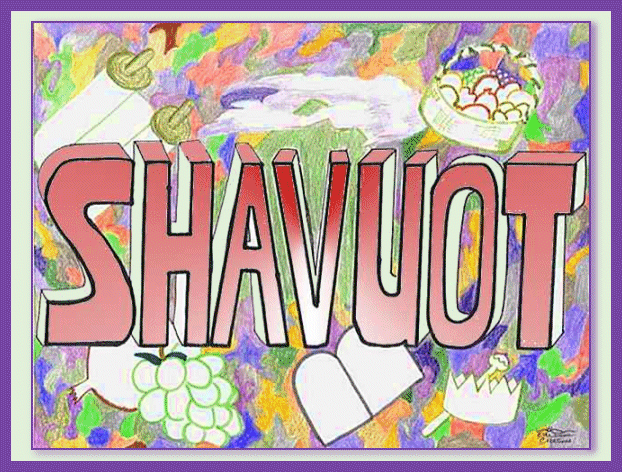
Shavuot 2023

Introduction

 For 2023, Shavuot (or Shavuos) begins at sunset Thursday, May 25 and ends for (most) Reform and Reconstructionist Jews at sunset Friday May 26 and ends at sunset Saturday, May 27 for Conservative and Orthodox Jews.  This is a major holiday for Jews and employees, students, and others should be accommodated for religious observance.

Shavuot is determined by counting from Passover.  This is reflected in the name as the word “Shavuot” in Hebrew simply means “Weeks.” In English translations of the Bible, the holiday is usually translated as the “Festival of Weeks.”

Jews believe that Shavuot is the day in which the Lord gave the Torah (literally “the Law”, which refers to the first five books of the Bible) to Moses on Mount Sinai.  An alternative name for Shavuot  -- Hag Matan Torateinu (The Festival of the Giving of the Torah) – recognizes this. One point emphasized here is that the Torah was given on this day rather than received.  The Jewish belief is that even though God gave the Torah on Mount Sinai on Shavuot, it is up to every Jew to receive the Torah (that is to accept it and follow its teachings) anew with every day.

In Christianity, Shavuot is associated with the Christian holiday of Pentecost (the Descent of the Holy Spirit). This is because the first Christian Pentecost occurred when the followers of Jesus (who were Jewish) were celebrating Shavuot. While some Christians refer to the Jewish Shavuot as Pentecost, this is never done by Jews (and is viewed as offensive generally). For more on the Christian holiday of Pentecost, please see

http://davidvictorvector.blogspot.com/2012/05/pentecost.html
Shavuot is one of the three festivals in Judaism linked to the harvest (the other two are Passover and Sukkot).  Unlike the other two harvest festivals, though, Shavuot has no ritual that would correspond, say, to the Passover Seder service or the building of a sukkah at Sukkot. For more on these two holidays, please refer to the earlier blog posts for


One explanation for why Shavuot has no similar ritual associated with it is sometimes attributed to the enormity of the event of the giving of the Torah.  As Michael Strassfeld in his book The Jewish Holidays puts it:

the Revelation at Sinai can be viewed as an experience so cosmic and mysterious that no ritual could encompass it, just as the Torah itself is so multifaceted that it eludes any attempt to delineate it. Like God who cannot be described, His Torah cannot be limited by a specific ritual or symbol other than the Torah scroll itself. (p. 72)


In the days of the Jewish Temple in Jerusalem, Shavout celebrated the offering of the first fruits of the harvest.   It is for this reason that the holiday has yet another name: Yom ha-Bikkurim (Day of the First Fruits).

Observances

It is traditional for Jews – especially in the Orthodox tradition – to stay awake all night at the synagogue and to pray at the very break of sunrise.  The night is usually spent in Torah study groups called Tikkun Leil Shavuot.

Jews worshipping at the Kotel
on Shavuot
In Jerusalem, thousands of pilgrims crowd the Kotel (the so-called Wailing or Western Wall, which is the only surviving remnant of the Temple) as dawn breaks to pray.

In addition to the shared studying of the Torah, Jews read two works aloud that are not from the Torah at this time: the Akdamut prayer and the Book of Ruth.

The first is the Akdamut prayer.  The Akdamut is a song of praise for the Torah written by Rabbi Meir of Worms at some point in the 1090's before his death in 1095.  Late in his life Crusaders killed Rabbi Meir’s son (the killing of Jews in Europe was a common occurence among Crusaders en route to fight the Moslem Turks. After his son's death, Rabbi Meir was forced to explain in a public debate with the Church leaders responsible for his son’s death why he still believed in Judaism. His defense was apparently strong enough that he was not only allowed to live, but was allowed to continue to practice Judaism.  Following the public debate, Rabbi Meir wrote the Akdamut that is read on Shavuot.

Ruth gathering sheaves
The other reading is the Book of Ruth.  This book, though part of the Bible, is not part of the Torah.  Much debate as to why the book is read exists, but two of the more common explanations are that it takes place at the harvest of the first fruits and that Ruth (who is a convert to Judaism) accepted the Torah by choice. 

Finally, Shavuot is one of the days in which Jews say Yizkor, the traditional remembrance observance for loved ones who have passed away.


Traditional Shavuot Decorations 

Harvest decoration
(the Hebrew letters here
are the word "Shavout")
Shavuot is a harvest festival. To acknowledge this, many Jews decorate with harvest symbols, sheaves of wheat or baskets of fruit. This is particularly a practice in some kibbutzim (collective farms) in Israel where such decorations actually come from the local harvest, although Jews all over the world often use the harvest motif even if they live far from any actual harvest themselves.

Because the Bible indicates that the Israelites were told not to allow their flocks to graze on Mount Sinai, it has been traditional at Shavuot to decorate worship places and homes with plants and flowers during the holiday. This somewhat obscure association that such a warning could be made only if the area were already green with plants in the midst of the desert is nonetheless one of the oldest recorded traditions historically tied to the holiday.

Some Jewish traditions consider Shavuot a day of judgement for trees and say prayers for the trees. Even in those traditions without this belief, some Jews still decorate with trees in pots and tree branches. Because the Torah brings sweetness to people's lives, many Jewish congregations distribute sprigs of sweet-smelling myrtle to worshippers.

Finally, it is very common to decorate with flowers, and especially lilies-of-the-valley and roses. This harkens back to the harvest motif again, but has another significance.

Lilies-of-the-Valley are
a common Shavuot decoration
In the Song of Songs (2:1-2),  the beloved one (who in some Jewish interpretation is at once a lover and a metaphor for Israel) is compared to lilies-of-the-valley. Therefore, lilies-of-the-valley (and often simply lilies) are used as symbols of the Lord's love for Israel in giving the Torah.

In the Book of Esther (which is actually not related to Shavuot at all, but to Purim), a line reads "And the decree was proclaimed in Shushan" (Esther 8:14). In a rather convoluted logic, the word "decree" has been associated with the "law" or the Torah. Hence the Torah was proclaimed in Shushan. Shushan was the capital of ancient Persia, but it is very similar to the Hebrew word for rose (Shoshanah) so the pun is used as the basis of the link of roses to the Torah.


Traditional Shavuot Foods

By tradition, Jews traditionally eat a dairy meal at least once on Shavuot. 

Several traditions are associated with the eating of dairy. Among these is the belief that the Torah is as nourishing as milk is to a child. Another association with dairy is numerological in nature. All Hebrew words have numerical equivalents since Hebrew letters are used for numbering as well as for writing words. The letters of the  Hebrew word for dairy -- chalav -- add up to the number 40, which is the number of days that the Bible indicates that Moses spent on Mount Sinai receiving the Torah. Another tradition suggests that when the Israelites received the Torah, they realized that they could no longer mix milk and meat (one of the requirements of keeping kosher) so they had to eat dairy until they could make their cooking utensils kosher.

Cheese blintz
Whatever the reasons behind it, Shavuot has become a time for Jews to focus on cooking dairy dishes.  In particular, the cheese blintz is associated with the holiday among the Ashkenazi (Jews with Eastern and Central European backgrounds). A recipe for traditional cheese blintzes can be found at


Cheesecake with nuts
Another Shavuot speciality is cheesecake. Often the cheesecake is made with nuts to bring in the tradition of praying for trees, the cheesecake is made with some sort of nuts either as a topping or mixed into the cake itself. One recipe for a traditional Shavuot cheesecake with nuts can be found at


A more modern, Israeli recipe for cheesecake with nuts can be found at


Closing Comments

As with all posts on religion on this blog, these remarks are meant only as one person's understanding of religious holidays and attendant observances. This is not meant as a guide to practice or as a stance on what is acceptable or unacceptable practice. Observances vary. If you would like to comment on your own observances or add more information, I welcome you to do so.


Want To Read More?

Larry Fine, "Ruth: The Perfect Convert,"  http://www.netglimse.com/holidays/shavuot/customs_and_traditions_of_shavuot.shtml

Leslie Koppelman Ross, "Shavuot Decorations," My Jewish Learning website, http://www.myjewishlearning.com/holidays/Jewish_Holidays/Shavuot/In_the_Community/Decorations.shtml

"Shavuot," Aish.com website,  http://www.aish.com/h/sh/
:Shavuot," New South Wales Board of Jewish Education, http://www.bje.org.au/learning/judaism/kids/holydays/shavuot.html

"Shavuot: The Giving of the Torah," Chabad.org, http://www.chabad.org/holidays/shavuot/default_cdo/jewish/Shavuot.htm

"Shavuot," Jewish Virtual Library: http://www.jewishvirtuallibrary.org/jsource/Judaism/holidayc.html

Michael Strassfeld, "Shavuot" in The Jewish Holidays, Quill/Harper Collins, 1985, pp. 68-83.


Clip Art Sources

Opening Shavuot clipart: https://blogger.googleusercontent.com/img/b/R29vZ2xl/AVvXsEiVWRadzdax9N09i-jlufPYt1HBdfMdGQA3-jF8PdHj-uAXBXlAnS09ZCr3NqhumtzP79rtrhxREl1VY-sYnxKGaTYo_-OGmz6MBC_19yAysdCmkb_Hjci_Pa50rFJR6h66xvu5oWQE1HxX/s1600/shavuot.gif

Moses with the 10 Commandments: http://www.netglimse.com/holidays/shavuot/customs_and_traditions_of_shavuot.shtml

Jews at the Kotel worshipping at Shavuout: http://www.travelujah.com/media/images/userimages/7/travel_shavuot_kotel.JPG

Ruth: http://www.netglimse.com/holidays/shavuot/customs_and_traditions_of_shavuot.shtml

Harvest Shavuot decoration, Anne's Opinions blogsite: http://anneinpt.wordpress.com/2011/06/07/chag-shavuot-sameach/

Lilies-of-the-valley clip art: http://www.bje.org.au/learning/judaism/kids/holydays/shavuot.html

Cheese blintz: http://kosherfood.about.com/od/shavuot/r/blintz_cheese.htm

Cheesecake: http://jannagur.com/108704/Cheesecake-with-Assorted-Nuts

Closing Happy Shavuot clipart: http://www.jr.co.il/hotsites/j-hdaysh.htm

Friday, April 27, 2012

Vesak (Wesak)

Introduction

Buddha Altar
US Air Force Academy
Colorado Springs, Colorado
The Birthday of Lord Buddha is one of the most important holidays in Buddhist tradition. The holiday is celebrated on different days varying by religious and national tradition.  

For 2022, Vesak comes as early May 8 and as late as June 14 depending on tradition. In Mahayana (and some  traditions, Vesak is generally celebrated a week earlier (this year May than in Theravada Buddhist tradition (as explained below). This is complicated by different locational differences. The earliest date officially celebrating Vesak is in Macau and Taiwan, where May 8 it is observed as an official state holiday. The latest date officially celebrating Vesak comes in Bhutan and Mongolia, where for 2022, June 14, is observed as a national holiday.   

Below you will see listed the place and 2022 date that the birthday of the Buddha is an official public holiday 
  • May 8   South Korea, Hong Kong, Macau, Taiwan (set as second Sunday in May); in Macau and Hong Kong May 9 is an official holiday making this a long weekend. Although not officially recognized, this is the date Vesak is celebrated in much of the rest of the PRC (see note below) as well as the overseas Chinese communities in the Philippines, the United States and Canada.
  • May 14 Myanmar (recognizing the official state holiday as the Full Moon of Kasong Day)
  • May 15 Bangladesh, Cambodia, India, Indonesia, Malaysia, Singapore, Sri Lanka and Thailand and (unofficially) Laos, Myanmar and Vietnam
  • May 16 (the Monday following in lieu of Vesak falling on a weekend) is an official state holiday in Bangladesh, India (15 of 36 of India's states/union territories (explained below), Indonesia, 12 of 16 of Malaysia's states/territories (explained below), Nepal, Singapore, Sri Lanka, and Thailand
  • June 14 Bhutan, Mongolia, Sikkim (in India) and (unofficially) Tibet 
Bhutan, Mongolia and Tibet celebrate on one day the birth, the paranirvana (enlightenment) and attainment of nirvana. This national holiday, called  in Bhutanese does not combine the three events but marks the day Buddhists in this tradition believe that all three events occurred (the 15th day of the fourth month of the Tibetan/Bhutanese calendar). In Bhutanese, the holiday is called Duechen Nga Zom (nga meaning "five" and zom meaning "coincide") marking the coinciding of five events: Buddha's conception, birth, victory over evil, enlightenment and attainment of nirvana.
 
Although Vesak is not an officially recognized state holiday outside of Hong Kong and Macau, it is widely celebrated in the PRC with the date varying by which Buddhist tradition is followed (May 8 for most Chinese Buddhists; May 15 for the Dai-lue of Yunan Province, June 14 for Tibetan Buddhists)

In India and Malaysia, each individual state or territory has local jurisdiction as to whether to provide the following Monday off when Vesak falls on a Sunday. In India, 15 of the nation's states and territories provide Monday, May 16 off in lieu of Vesak falling on a Sunday. These are: Arunachal Pradesh, Assam, Chandigarh, Delhi, Himachal Pradesh, Jammu & Kashmir, Jharkhand, Madhya Pradesh, Maharashtra, Mizoram, Odisha, Tripura, Uttar Pradesh, Uttarakhand, and West Bengal. In the Indian state of Sikkim, Buddhists follow the Tibetan tradition and observe the holiday on June 14. In Malaysia, all 4 of nation's 16 states and territories will not give Monday May 16 off in lieu of Sunday. The only four Malaysian states that do not allow the following Monday off are Johor, Kedah, Kelantan and Putrajaya. 

The holiday is most widely known as Vesak or Wesak, or in religious writings as Vesākha, the original word in Pali (the language of the Buddha). Other names for the Birthday of Lord Buddha include 
  • Fó Dàn in several Chinese dialects
  • Saga Dawa in Tibetan and Sikkimese (and thus in many Vajrayan traditions)
  • Visakha Bucha or Wisakhabucha in Thai
  • Vixakha Bouxa in Lao
  • Visak Bochea in Khmer (Cambodian)
  • Phật Đản in Vietnamese
  • Hanamatsuri in Japanese
  • Seokka Tanshin-il in Korean
  • Waisak in Balinese, Javanese, Sundanese, Bahasa Malaysia and Bahasa Indonesia
  • Visakah Puja or Buddha Purnima in Nepalese
These are all names for the same holiday.

Dating Vesak

 Tian Tan Big Buddha, Hong Kong
The date assigned to Vesak depends on which of the different Buddhist lunar calendars each specific Buddhist tradition uses. Additionally, because none of these calendars parallel the Gregorian calendar, the date of Vesak appears on different days of the secular calendar; however, generally, Vesak comes in April or May.

Mahayana. Vesak is on May 8 in 2022 for most Mahayana Buddhist traditions. This is the date used in South Korea, Hong Kong, Macau and (most of) China and Taiwan, Hong Kong. 

In Mahayana tradition, Vesak falls on the eighth lunar day of the fourth month in the East Asian lunar calendar. Thus in 2022, Vesakh falls on May 8 in those traditions. In both Hong Kong and Macau, the day after Buddha's birthday is also a public holiday. 

Theravada. Vesak is on May 15 in 2022 in (most) Theravada  Buddhist traditions -- in other words, Vesakh begins a week later. In their calendar traditions, Vesak begins on the first full moon Uposatha (mind-clearing day) of the second month of their calendar.

Theravada is the dominant tradition practiced in Thailand, Vietnam, Singapore, Laos, Myanmar, Cambodia, southern India, Bangladesh and Sri Lanka.

Vajrayana. Vesak is on June 14 in 2022 in most (but not all) Vajrayana traditions. Vesak for Vajrayana Buddhists is a combined commemoration of the coinciding events of Buddha's birth, paranirvana and attainment of nirvana.  Tibetan Vajrayana Buddhism is the dominant tradition practiced in Tibet, Bhutan, Mongolia and the Buddhist Tuva and Kalmykia Republics in Russia. This is also the tradition practiced in much of northern India and is in the dominant religion of the state (and until 1975 independent monarchy) of Sikkim. Vajrayana Buddhism is also an important religious minority in Arunachal Pradesh and the Lakh district of Kashmir. It is also the tradition worldwide of the Tibetan diaspora community centered around the Dalai Lama at Dharamshala in Himachal Pradesh.   

The Newa people in Nepal (and from whom the country gets its name) follow their own Newar Buddhist tradition called Buddhamarga. The Newa people primarily live in the Katmandu Valley including Lalitpur (historically called Patan), the Buddha's place of birth, where they constitute the majority of the population. Buddhamaraga Buddism can be viewed either as a form of Vajrayana tradition or as very closely tied to Vajrayana Buddhism. 

A separate announcement on Paranirvana or Nirvana Day will go out when this holiday occurs, as other traditions celebrate this separately from the birth of Buddha.

UN Vesak Day. The Theravada traditional Vesak day (May 16 in 2022) is also the date celebrated by the United Nations for the holiday.   

Finally, in Japan, Vesak (or Hanamatsuri) is not determined by the East Asian lunar calendar but instead has been officially tied to April 8 in the Gregorian calendar since the Meiji Restoration.

As multiple interpretations of when the date fell existed based on Chinese, Hindu and other calendars, the Conference of the World Fellowship of Buddhists met in Sri Lanka in 1998 and agreed to the first full moon of May date (with a leap year built into the cycle on a complicated formula that occasionally places the date in June).

Monks celebrating Vesak
at United Nations, 2006
This resolution was the basis for the United Nations General Assembly's resolution regarding the dating of Vesak. Since 2000, the United Nations officially observes Vesakh as the first full moon of May. The official UN Resolution for Vesak observance reads:


The General Assembly,
Acknowledging the hope expressed by the International Buddhist Conference, held in Sri Lanka in
November 1998, that the Day of Vesak, the Day of the Full Moon in the month of May each year, be recognized internationally and, in particular, at United Nations Headquarters and other United Nations offices,
Recognizing that the Day of the Full Moon in the month of May each year is the day most sacred to
Buddhists, who commemorate on that day the birth of the Buddha, his attainment of enlightenment and his passing away,
Considering that international recognition at United Nations Headquarters and other United Nations offices would constitute acknowledgement of the contribution that Buddhism, one of the oldest religions in the world, has made for over two and a half millennia and continues to make to the spirituality of humanity,
Resolves that, without cost to the United Nations, appropriate arrangements shall be made for
international observances of the Day of Vesak at United Nations Headquarters and other United Nations offices, in consultation with the relevant United Nations offices and with permanent missions that also wish to be consulted.
 http://www.worldlii.org/int/other/UNGARsn/1999/192.pdf  
The Birth of the Buddha

The Gautama Buddha was born in 563 BCE in the town of Lumbini in northern India to the King Sudhodana and Queen Maya, the rulers of the kingdom of Sakya.  His parents named him Siddhartha. He is also called Sakyamuni or the Sage of Sakya.

His mother the queen had a dream of a white elephant and a white lotus entering her womb.  This was interpreted as an omen that the child she would bear would be either a great warrior or a great religious leader. It was for this reason that the young Siddhartha was shielded from the outside world by his father who wanted him to be a great warrior king and feared that exposure to the sufferings of the world would turn his son into a spiritual leader instead.


Birth of the Buddha
Panel painting, Jogyesa Temple
Seoul, South Korea
Legend has it that Queen Maya gave birth to him with no pain of childbirth and that immediately after being born, the baby Siddhartha took seven steps to represent the seven Buddhist directions (east, south, west, north, up, down and here). It is for this reason that when the Buddha is depicted as an infant, he is often shown standing while pointing with one hand up and the other down to signify the seven directions.

In the Mahayana tradition, the infant is also supposed to have immediately spoken, saying, "I alone am the World-Honored One." It is important to note that this last point is highly debated. Some Buddhists do not accept that he said these words while others interpret these words only as meaning that he was aware at birth of the Buddha nature that is present in all living beings, not simply referring to himself.

Queen Maya died one week after the birth of her son but not before the visit of the ascetic Asita who pronounced that he saw in the child the 80 signs that he would become the Enlightened One. After his mother's death, the young Siddhartha was raised by his older sister.


Traditions Where the Buddha's Death Is Celebrated With His Birth


In Theravada Buddhism, Vesak is seen as both the day of the Buddha's birth and that of his death. This remains a very happy celebration even in Theravada tradition where the Buddha's death is intermingled with his birth. This is because at the Buddha's death, the Buddha counseled the disciple Ananda not to cry or feel sad but rather to honor the Dhamma, for the teachings that the Buddha shared are -- it was taught -- the only thing that is eternal.  Buddhists interpret this, then, as celebrating Vesak by reaffirming their belief in the Eight Noble Truths, to seek enlightenment, to practice acts of love, and to try to bring peace and harmony to the world.

Mahayana Buddhism, by contrast, celebrates the day of Buddha's death as a separate holiday. Please see my blog on Paranirvana (or Nirvana Day) for more on that holiday:


Observances and Celebrations

The celebration of Vesak -- regardless of tradition -- usually centers around ceremonies at the Buddhist
temple.  Buddhists in most traditions sing prayers about the Buddha, the Buddha's teachings (called the Dhamma) and the followers of the Buddha (called the Sangha). 

It is customary to bring beautiful offerings that by intention do not last long, showing the impermanence of all things.  Thus, some people bring cut flowers or flower petals (that wither soon), decorated candles (that soon burn out) or incense sticks (that rapidly turn to ash). 

In almost all Buddhist traditions, people celebrate with items that fly, as representative of the freedom of the spirit brought by the Buddha's teachings. Among the most common of these practices comes with flying kites and with hanging paper lanterns that move in the wind. Many traditions fly special flags. Releasing birds is also practiced in many traditions.


Bathing the infant Buddha

Another common practice shared across many different traditions is the washing of an image of the Buddha as a baby standing with one hand pointing up and one hand pointing down. Worshippers place the baby Buddha statue on an raised altar inside of a basin or large bowl. They then pour water or tea from a ladle symbolically washing the baby Buddha.

Because this is a point of common misunderstanding, it should be emphasized here that images of the Buddha, though treated with great reverence, are not idols but simply representations of the Buddha. These statues and images are not seen as deities themselves.

Many Buddhists traditionally wear white as a part of the holiday as well. It is also customary to eat only vegetarian meals on Vesak for those who otherwise are not vegetarian.

An important aspect of Vesak is to express happiness and especially to bring happiness to those who may be unhappy.  This involves giving donations or doing special things for the sick and the elderly. It is also traditional to decorate the temples with things of beauty and with scenes of the life of the Buddha, which are supposed to bring happiness to all who see them.


As always, this is my own summary of a religious tradition. I welcome your input.

Happy Vesak!

Want to Learn More?


"The Birth of the Buddha: Legend and Myth," About.com Buddhism:  http://buddhism.about.com/od/buddha/a/birthofbuddha.htm


“The Life of the Buddha,” Souled Out.org., http://souledout.org/wesak/storybuddha.html
"The Significance of Vesak: Buddha Day," (The Venerable) Mahinda, Buddhanet: http://www.buddhanet.net/vesak.htm

"Lord Buddha's Parinirvana in Bhutan in 2022," Office_Holidays, https://www.officeholidays.com/holidays/bhutan/buddha-parinirvana 


"Vesak or Visakah Puja," Buddhist-tourism.com, http://www.buddhist-tourism.com/buddhist-festivals/vesak.html


"What is Vesak Day and Why Celebrate It?" James Ure, The Buddhist Blog: http://thebuddhistblog.blogspot.com/2007/04/what-is-vesak-day.html

Photo and Clip Art Credits

Buddha Altar, US Air Force Academy, Colorado Springs, Colorado: My own photo

Tian Tan Big Buddha, Hong Kong: My own photo

Monks celebrating Vesak at United Nations, 2006: http://www.worldzen.org/vesak.php

Birth of the Buddha panel painting, Jogyesa Temple, Seoul: My own photo

Bathing the infant Buddha: http://www.palyulph.org/teachings.htm