Welcome to the David Victor Vector Blog

Welcome to the David Victor Vector blog. This is blog that covers religious observances around the world international affairs and global business. This blog describes religious holidays for most major religions as well as raising issues dealing with globalization, international business ethics, cross-cultural business communication and political events affecting business in an integrated world economy. I look forward your discussion and commentary on these articles and subjects. Enjoy!
Showing posts with label Christianity. Show all posts

Thursday, March 28, 2024

Holy/Great Week and Easter/Pascha/Fasika 2025

 Introduction

As part of the ongoing updates on religious observance, I would like to share the upcoming traditions of Holy or Great Week and Easter or Pascha.

Holy (or Great) Week is the Christian set of holidays that commemorate the last week of the earthly life of Jesus Christ, beginning with Palm Sunday, running through  Jesus’ crucifixion and concluding with Holy Saturday. Holy Week is then followed by Easter.  Christians believe that Easter commemorates the date of the resurrection of Jesus Christ.  As a result, most Christians consider Easter to be the holiest day of the year. 


Dates

Easter and Pascha are what is known as moveable feasts. Moveable feasts vary in the calendar according to a fairly complex set of calculations tied to the first Sunday following the first full moon following the vernal equinox. 

For 2025, Easter for Roman Catholic and Protestant Christian as well as Pascha for the Eastern and Oriental Orthodox, Coptic, and Fasika for the Ethiopian Tewahedo Church, all coincide. For all of these Holy Week or Great Week began on Palm Sunday April 13, and culminates on Easter Sunday, April 20

In the Western traditions, these dates are figured on the Gregorian calendar (that is used in most of the secular world). In the Coptic, Oriental, and Orthodox traditions, these dates are figured on the Julian calendar. As a result, the dates for Easter in the Western tradition usually come four to five days earlier than the equivalent date for Pascha in the Eastern traditions. On rare occasions -- as with this year 2025 -- the two dates coincide, as they did in 2010, 2011 and 2017.  

However, this sharing of the same date is far from always the case Indeed, last year in 2024 saw Eastern and Oriental Orthodox, and Coptic Pascha and Ethiopian Tewahedo Fasika when at its greatest difference -- in fact, over a month later (March 31 vs. on May 5). The reason for this great difference this year is that Western Christians date Easter on a system independent of the Jewish Passover while  the Orthodox, Ethiopian Tewahedo and Coptic observance always occurs on the first Sunday following the Jewish Passover (Pascha means "Passover" in Greek). The Hebrew calendar adjusts the lunar year (on which it is based) to fall roughly within the harvest seasons (which grow to fruition according to the solar year). To accommodate this difference, the Hebrew calendar uses a complicated reckoning to add a periodic leap month. Since the Hebrew calendar had a leap month this year, the two Easters differed by the length of that extra lunar month.


Holy Week/Great Week


Palm Sunday
Entry of Christinto Jerusalem
by Maximino Cereso

The first day of Holy Week is known as Palm Sunday to Protestants (and unofficially to Roman Catholics), as Passion Sunday to Roman Catholics (at least officially so since a formal name change in 1970).

Regardless of name, the holiday celebrates the triumphal entry of Jesus into the city of Jerusalem described in all four of the canonical Gospels.  

In three of the four canonical Gospels, the crowds cut branches to herald Jesus’ entry. For example, Luke 12: 13 reads: 
They took palm branches and went out to meet him, shouting, 
"Hosanna!" 
"Blessed is he who comes in the name of the Lord!"
"Blessed is the King of Israel!"  
Many Christian traditions burn the fronds afterwards for use on Ash Wednesday of the following year. From this comes the tradition of processions with branches of some sort. 

Palm Sunday Procession
Mount of Olives, Jerusalem


Among most Roman Catholics, the processions are usually with palm fronds, although among many Italian Catholic traditions, olive branches by themselves or mixed with palms are used. 

Likewise, among the Russian and Ukrainian Orthodox, worshipers use willow branches instead of palms.  Among Ethiopian Orthodox, it is customary to wear headbands and rings made of palms and decorated with crosses. Among the various Arab Orthodox traditions, it is customary to hold candles decorated with flowers as well as palm branches. 

Greek Orthodox customarily carry crosses either made from or decorated with palm or bay leaves. Some national customs have developed around the day.

In Ireland (where palm fronds were typically unavailable), worshipers carried yew branches, which is where the holiday gets its Gaelic name of Domhnach an Iúir or "Yew Sunday."

In Latvia, pussy willows are used which is why in Latvian the holiday is known as Pupolsvetdiena or "Pussy Willow Sunday." Traditionally in Latvia, parents wake their young children up by lightly swatting them with a pussy willow branch saying "round and healthy like a pussy willow."

Some national customs have developed around the day.  In Wales and parts of England, it is customary to eat figs.  In Lebanon, Christians celebrate with the shanineh, a procession in the church in which children carry candles decorated with flowers and ribbons while sitting on their parents’ shoulders and being marched around the church.    In Italy, Palm Sunday is the traditional day for making up with those with whom one has quarreled during the year.  

Holy Thursday

The Thursday of Holy Week is known as Holy Thursday among Roman Catholics, most Orthodox traditions and the majority Protestant denominations.  It is known as Maundy Thursday among Anglican Protestants. Some Protestant churches (especially those of Scandinavian origin) use the term Sheer Thursday interchangeably with Holy Thursday.  In the Coptic Church, it is called Covenant Thursday, Regardless of name, the holiday commemorates Jesus’ Last Supper, the celebration of the Passover Seder with the disciples.  

Among Germans – both Catholic and Lutheran – eggs are also dyed on Holy Thursday, although there the color is traditionally green. 
   

Many Roman Catholics (famously the Pope), Armenian Orthodox, and some Protestant sects wash each other's feet in recognition of this act of humility performed by Jesus at the Last Supper. 

Pope Francis washing feet on Holy Thursday

Armenian Orthodox footwashing


Among Filipino Catholics, it is customary to visit several churches as a way of keeping vigil as the disciples did when Jesus prayed at the Garden of Gethsemane.   The French practice the custom of the “flying bells” in which the church bells are prohibited from ringing until Easter, while children are told that the bells have flown away carrying away all the grief people feel.

Among both Greek and Russian Orthodox, candles are lit during a portion of the church service  – often called the “Thursday Fire”; these candles are then used to light the family’s lampada (an oil lamp) either at the church itself (among Russian Orthodox) or in the family home (among Greek Orthodox).  

Good Friday / Great Friday

The Friday of Holy Week is called Good Friday among Roman Catholics and Protestants and as Passion, Holy or Great Friday among Eastern Orthodox. Regardless of name, the date marks the Crucifixion of Jesus on Golgotha (or Calvary) Hill in Jerusalem.  

This date is a very somber holiday for all Christians.  In many Roman Catholic and Protestant traditions, the cross is covered or various ornaments are removed from the church. Among many Lutherans, after Good Friday services, the congregants leave the church and seal the doors (symbolic of the entombment of Christ).  

Among some Roman Catholics, Good Friday is either a fast day or a partial fast day.  This often varies by nationality.  For example, among Catholics in Ireland (and thus many of Irish descent outside of Ireland), it is customary to fast except for three bites of bread and three sips of water (representing the Trinity).  

Bermuda kite


 Bermuda is known for its annual kite-flying tradition. The famous Bermuda kites are flown only one day a year: on Good Friday. The hexagonal Bermuda kites usually feature colorful geometric patterns. Some of the kites make buzzing noises. Others are so huge that they may take more than one person to get them aloft. All of them are made with strings going around flat sticks nailed at the center that form the spokes of a wheel, and all contain very long tails. The kite-flying are symbolic of the ascension to heaven.

Other Good Friday national customs include setting a bonfire and burning straw effigies of Judas in Portugal and covering mirrors as a sign of mourning in Poland. In many Roman Catholic countries – notably in Latin America and the Philippines, Good Friday processions centered on carrying a life-size cross are paraded through the main street or central square.

Holy Saturday 

The Saturday before Easter is called Holy Saturday by Roman Catholics and most Protestant sects, Easter Even by Anglicans, and the Great Sabbath or Great Saturday among the Eastern Orthodox, Joyous Saturday among the Coptic, Oriental Orthodox and Ethiopian Churches, and Gospel Saturday within the some Syriac Church. The holiday represents the day between the Crucifixion and the Resurrection. Among Roman Catholics and most Protestants, this is the day in which Christ died or rested in the tomb.  

Traditionally Roman Catholics abstain from meat but this tradition was stopped by the Pope in 1970. Among Roman Catholics and Anglicans, Holy Saturday is the only day in the year in which Mass is not celebrated. 

While variations exist as to the nature of what Christ did during this time, most Roman Catholic, Anglican, Calvinist (Reformed), and Latter Day Saints traditions attribute some form of Christ’s “harrowing of Hell” in which Jesus descended among the dead.  

 Święconka
Among Polish Catholics, baskets of food including a butter lamb are brought to the church for a special blessing.  This service is called Święconka or "the Blessing of the Baskets."

In Roman Catholic, Anglican, Calvinist (Reformed) and Lutheran tradition, a holy vigil is held at night as Easter approaches. 

In Orthodox tradition, the church vestments are changed from black to white, symbolizing the saving of those captive in Hell; among Greek Orthodox, flower petals and laurel leaves are traditionally spread around the church to symbolize the broken shards of the gates of Hell.  In Eastern Orthodox, Roman Catholic, Anglican and Lutheran tradition, a holy vigil is held at night as Easter approaches. 

  
Easter Vigil, Chartres Cathedral


Easter 

Easter is the most important day of the Christian year.  This is the celebration in all traditions of the resurrection of Christ. In all Christian faiths, special services are held. Among Roman Catholics, Anglicans, Lutherans and Methodists, the lighting of a Paschal candle is part of the service, representing the risen Christ.  In Eastern Orthodox tradition, many candles are lit for the same purpose. 

Opposition to National and Secular Practices

The national customs associated with Easter or Pascha are numerous.  It should be noted, though, that several fundamentalist Protestants sects such as (among others) adherents of the United Church of God International, Reform Adventism, and Jehovah’s Witness oppose national or secular practices on Easter for what they believe to be its pagan origins. This was also the official position of the Church of Scotland until the beginning of the 20th century.

Some Protestant sects object to
the Easter Bunny and Easter eggs
These Protestant groups particularly object to the fertility symbols used in many North American and British celebrations – such as the Easter Bunny,  which they assert go back to the pagan Ostara holiday with its worship of Eostre from which Easter derives its name in most Germanic language countries, including English.  

Indeed, the etymology of the word "Easter" in English deriving from the pagan holiday Ostara has led some Protestant groups to call the holiday "Resurrection Day" in place of Easter.

They also object to the easter egg (or egg-shaped substitutions such as jelly beans) and Easter egg hunts, as having derived from the Persian worship of the fertility goddess Ishtar or other pre-Christian Persian traditions such as Zoroastrianism's Naw-Rúz

For more on Ostara, please see my earlier blog post at

http://davidvictorvector.blogspot.com/2012/03/ostara.html

For more on Naw-Rúz, please see my earlier blog post at

It should be noted that those groups opposed to national and secular practices nonetheless believe in the holiday's religiously Christian subject matter, such as the crucifixion and resurrection of Christ.  Their objections are only to what they believe to be national or secular practices.

National and Secular Traditions 

For a great many Christians, Easter’s various national and secular traditions are well-loved and honored. 

The Easter Egg


In the United States, England, Wales and Canada, many secular traditions are widely practiced.
White House Easter Egg Hunt
Some of these have spread to other countries as well.  These practices include the coming of an Easter Bunny who hides or lays Easter eggs that children then collect in an Easter egg hunt.  Even the United States President has an official Easter egg hunt on the White House lawn. 

The giving of Easter baskets with small toys and candy (notably jelly beans, chocolate eggs and bunnies, and marshmallow chicks called Peeps) to children is traditional.  Sometimes, the baskets are hidden from the children who then must search to find them. 

Children meeting the Easter Bunny
Howell, Michigan Nature Center
At restaurants, children can have Easter breakfast with the Easter Bunny (a person dressed in a bunny outfit).  Children may also visit the Easter Bunny at shopping malls, museums and parks.

Many cities have official Easter parades. Some of the best-known annual Easter Parades in London, New York, Baltimore, San Francisco, Los Angeles, Louisville, New Orleans, and Toronto.

Outside of North America, one widely practiced custom is the playing of some variation of the “egg-knocking” game.  People crack their Easter eggs against other people’s Easter eggs and the last person with an unbroken egg is supposed to have a year of good luck. Variations of this practice are common in Australia, Austria, Bulgaria, Latvia, the Netherlands and Norway.

National Easter-Related Customs Around the World

Australia 

Australians celebrate Easter with the Easter Bilby (a long-eared native bandicoot) instead of a rabbit. 

In part, this is because the bilby is a local animal, but in part this is because Australians are less fond of rabbits than many other nationalities are. Australia has been plagued by rabbits which have destroyed crops and endangered native wildlife.  

England

Easter in England traditionally features Morris Dances. The first record of Morris Dances dates to 1448. That said, some have argued that similar dances actually predate Christianity and derive from pagan springtime dance rituals to frighten away the spirits of winter. 

 
Hot-Cross Buns
Easter is also marked by the eating of hot-cross buns. These are buns made of sweetened bread with an icing-filled cross cut over their top. The hot-cross buns also predate Christianity, with the cross formerly dividing the bun into the four quadrants of the moon, but repurposed to represent the crucifixion. A recipe for hot-cross buns can be found at
http://allrecipes.com/recipe/hot-cross-buns-i/


France 

In France, Christians hug and kiss as the church bells are rung. This has particular significance as the church bells are prohibited from ringing from Good Friday through Easter. The bells (which children are told “flew away” to see the Pope on Holy Thursday) return with chocolate Easter eggs.

Israel
 

Pilgrims Walk the Via Dolorosa
in Jerusalem at Easter

Israeli Christians and Christian tourists to the Holy Land crowd Jerusalem to walk the Via Dolorosa (or "Way of Suffering"). This is the path believed to be the route Christ followed on his way to be crucified.

The pilgrims stop at each of the nine exterior Stations of the Cross, beginning at the Lion's Gate (also called St. Stephen's Gate) and ending at Golgotha (Calvary) Hill. 

There are 14 Stations of the Cross altogether but the last five are all within the Church of the Holy Sepulcher.

Palestine

Many Palestinian Christians celebrate the day before Easter with a "Saturday of Fire" marking the belief that fire emanated from the Church of the Holy Sepulcher (in contested East Jerusalem).  

Italy

Throughout Italy, as in France, people hug and kiss at the ringing of the church bells. Beyond that, dozens of local traditions highlight this or that city or town's Easter practices.  A few examples illustrate some of this.


Corse Rusticane, Merano, Italy

In Merano in Alto Adige/Südtirol each year on Easter Monday, the Corse Rusticane horse race takes place at the Maia Racecourse. This race is only among Haflinger horses (the local breed) and the riders wear the traditional outfits of the local towns and villages. Leading up to the race is a great parade of the Haflinger racehorses and of people dressed in traditional outfits.

Explosion of the Scoppio del Carro
Florence, Italy

In Florence in Tuscany, people take part in the annual Scoppio del Carro (cart explosion), in which a massive two-story high cart is filled with fireworks and dragged by oxen through the city center. The Archbishop lights a dove-shaped rocket-firework which travels down a connecting wire to the cart. The tradition, begun in 1679, holds that the bigger the explosion, the better will be the coming harvest.

In another tradition in Tredozio in Emilia-Romagna, the town's four sections hold the annual Palio dell'Uovo or race of the eggs. 

These are just three of many such local traditions in Italy.

The Netherlands

Traditionally, villages in the Eastern portions of the Netherlands hold communal bonfires as part of Easter festivities. Each town competes with the others nearby to build the largest bonfire.

Dutch Paasbrood

Throughout the Netherlands regardless of region, people look forward to eating Paasbrood (Easter bread) which is a once-a-year treat made of sweetened bread and almond paste with lemon peel and currants or golden raisins. 

A recipe for Paasbrood can be found at: 
http://www.countryliving.com/recipefinder/dutch-paasbrood-3043


Latvia


The hanging of swings (and the swinging on them) is a traditional Latvian Easter custom. These are usually giant swings large enough to hold unmarried couples and has its origins in rites for finding
Latvian Easter Swing

suitable marriage partners. The swings, however, are not limited to unmarried couples though, and are a great favorite among children. Swinging high is particularly a goal for individuals (rather than couples) as the folk tradition holds that the higher someone can swing, the earlier that Spring will arrive. The custom of springtime swings predates the coming of Christianity in Latvia.

Latvians also dye eggs as in other countries. One Latvian difference here, though, is the use of onion skins to do the dyeing. White eggs are submerged in an onion skin mixture. A short submersion produces a bright yellow egg; a long submersion produces a brown-colored egg. Traditionally, leaves and strings are attached to the eggs before submersion. When the leaves or strings are removed, patterns are left on the eggs. On Easter morning, family and friends engage in Easter egg matches.  Each person knocks his or her egg against one another's eggs. The egg that remains uncracked by the end is supposed to bring the owner good luck and good health for the year.

Sweden

Easter is one of the most widely celebrated holidays in Sweden, rivaling Christmas in its importance. As Elizabeth Dacey-Fondelius, writing in the English-language Swedish paper The Local, explains:

Easter celebrations and traditions for the secular Swede are nearly as sacred as Christmas to the Swedish culture. Even devout atheists pay respect to the long-standing traditional norms that the holiday dictates in Sweden. Easter is a big deal to the entire country. http://www.thelocal.se/3525/20110421

One uniquely Swedish Easter custom is that of the påskkärringar 

Swedish Påskkärringar
(Easter witches or hags). On the Thursday before Easter, children paint their cheeks, put on headscarves that tie under their chins and wear long skirts and aprons. Then, carrying their broomsticks, they go door to door among their neighbors asking for Easter treats  (much in the manner of North America's Halloween). On Holy Saturday, much of the country lights bonfires to hasten the påskkärringar on their way back to their secret witches' meadow at Blåkulla (Blue Mountain). In Stockholm, these bonfires are prohibited but the påskkärringar seem to make their way home before Easter in any case.

Swedish påskris

An additional custom fairly unique to Sweden is that of decorating with birch branches -- called  påskris. Swedes adorn the birch branches with brightly-colored feathers and hang decorated easter eggs from them. 

The påskris which now shows up in shops and on people's houses and porches are today fairly detached from their original purpose. At one time, undecorated birch branches were used to whip each other's backs on Good Friday to take part in Jesus' suffering on the cross. 


Conclusion


I hope that this has been worthwhile, and I welcome your comments or additions. As always, this blog is meant only to inform; there is no intention to indicate what is or is not proper or improper religious practice.

There are many customs and traditions for Easter that I have not included here. Please feel free to share your own in the comments section. 


Want To Read More?

Alikiviadis C. Calivas, "The Origins of Pascha and Great Week": http://www.goarch.org/ourfaith/ourfaith8504

CelebratingEaster.com:  http://www.celebratingeaster.com/traditions/

Easter World, "Easter Celebrations Around the World": http://www.dgreetings.com/easter/easter-world.html

Mary Fairchild, "What is Easter?" About.com, Christianity:  http://christianity.about.com/od/holidaytips/qt/whatiseaster.htm

Michael San Filippo, "Buona Pasqua! Easter in Italy" : http://italian.about.com/od/festivalsholidays/a/aa031401a.htm

New Advent, "Easter": http://www.newadvent.org/cathen/05224d.htm

Nortdstjernan.com "Happy Easter! A Swedish Easter: The symbols, the food, the traditions." http://www.nordstjernan.com/news/traditions/1167

"Baltic Tenacity" provides information of Latvian Pussy Willow Sunday: https://u.osu.edu/baltictenacity/latvia/

Clip Art Sources

Opening Happy Easter clipart: http://www.clipartpal.com/clipart_pd/holiday/easter/happyeaster_10282.html

Entry of Christ into Jerusalem by Maximino Cereso: http://www.servicioskoinonia.org/cerezo/dibujosA/19RamosA.jpg

Palm Sunday Procession, Mount of Olives, Jerusalem: http://dwellingintheword.files.wordpress.com/2009/05/21mount-olive-processionjpg.jpg?w=450&h=300
 
Pope Francis washing feet on Holy Thursday: https://www.google.com/url?sa=i&url=https%3A%2F%2Fwww.euronews.com%2F2023%2F04%2F06%2Fpope-francis-washes-feet-in-traditional-holy-thursday-easter-ritual&psig=AOvVaw3EiEf8bdgmqOe7DuoGW62N&ust=1711746696643000&source=images&cd=vfe&opi=89978449&ved=0CBIQjRxqFwoTCIisufbvl4UDFQAAAAAdAAAAABAD


Wednesday, October 31, 2018

Samhain, All Saints Day, Día de los Muertos and Halloween 2020

October 31 is the important Wiccan and Neo-Pagan religious holiday of Samhain, coinciding with the lighthearted secular North American celebration of Halloween.  November 1 is the Roman Catholic and Anglican holiday of All Saints Day and November 2 is the Roman Catholic and Anglican holiday of the Feast of All Souls  (celebrated as the Día de los Muertos or Day of the Dead in Mexico and with variants in some other Latin American and Filipino traditions).    Within the Methodist Church, All Saints Day is celebrated on the first Sunday of November (which for 2020 falls on November 1). For Lutherans, the Sunday on or before October 31, is celebrated as Reformation Day.

Samhain

Pronounced SOW-in, Samhain in Gaelic means “Summer’s End” and is a major holiday in both Wicca and in Neo-Pagan religions. It should be noted that some debate regarding when Samhain should be celebrated exists. Some traditions celebrate the holiday on November 1 and others – notably many Wiccans observe the holiday on November 7. Regardless of date, the holiday carries the same significance in marking the end of summer and the final harvest of the year.  In most traditions, the Sabbat of Samhain is celebrated for three successive evenings.

Within Wicca and most neo-Pagan traditions, Samhain marks the end of the calendar, and is thus the New Year’s celebration. For this reason, Samhain is a time for renewal as well as for giving thanks for the harvest as winter approaches. Traditionally, Samhain is the last chance for harvesting any remaining crops or picking any remaining produce from one’s garden. Samhain is also a time for remembering things past, especially those who have died. It is therefore a holiday for honoring the dead (both human and animal) and particularly for call to mind loved ones who have passed away. It is important to note that this is not a form of ancestor or spirit worship but rather an honoring of the Cycle of Life and Death.  

Samhain is also a time to honor animals – particularly pets and other animals among whom we share our lives – since animals are seen as providing us with sustenance in the form of food and clothing. Because of this, Samhain is a time to honor those pets who have died over the last year.  In some traditions, animals are seen as protecting us from spirits that would harm us and other things that inhabit the darkness.   Relatedly, some who celebrate Samhain also believe that this is the time of year when the veil is thinnest between this world and the Otherworld (the realm of spirits and the home of the dead).  Consequently, for worshippers who hold to this belief, Samhain provides an opportunity for communicating with the spirit realm and the dead. 

Samhain altar
Within both Wicca and Neo-Paganism, Samhain is often marked by worship at an altar (or at times in the house at the kitchen room table) with offerings of the harvest.

The altar shown at right is taken from a lovely gallery of Samhain altars posted at About.com on the Paganism/Wicca site at 
 http://paganwiccan.about.com/od/samhainoctober31/ig/Samhain-Altar-Gallery/ The altar shown (at right) here was posted as Joni's altar. 

Many people present their altar offerings in a horn of plenty (called a cornucopia, and now closely associated with the US secular holiday of Thanksgiving), and customarily include home-baked dark bread as well as nuts, berries, fruits and vegetables.  

Soul Cakes
Among the Samhain foods with the longest traditions is that of "soul cakes." Since pre-Christian times, people in the England, Scotland and Ireland have left muffin-like soul cakes accompanied by a glass of wine or milk for the souls of those who had recently passed away. The Celtic pagan tradition predates by centuries the adoption of "soul cakes" left on the eve of the Feast of All Souls, the Christianized version of Samhain (see below).  One recipe for soul cakes can be found at

http://allrecipes.co.uk/recipe/8607/soul-cakes.aspx

Often people include a a Wiccan Star or a statue of the Goddess. Candles are lit on the altar in many traditions, and are often accompanied by photographs of loved ones who have passed on to the other side. Prayers honoring the day are said either before or after a festive meal is eaten featuring the offerings and often accompanied by cider or mulled wine and wild game.   

All Saints Day   

Roman Catholicism

All Saints Day is one of the 14 worldwide holy days of obligation of the Roman Catholic Church.  As with all holy days of obligation, All Saints Day begins with a vigil on the night preceding it.  

A special Roman Catholic mass is conducted for All Saints Day to remember the saints and martyrs of the Church, both those known and unknown.  In many congregations, rituals include the use a crown and a sheaf of wheat. Many congregational services also make use of images of the saints and of the Manus Dei (the Hand of God with rays of light extending from it).

Another name in English for the holy day is All Hallowmas   Halloween is actually the name of the date of the vigil on the night before All Saints Day.. By the mid 1500’s as vernacular languages began to replace Latin in religious usage, the holiday was called All Hallowmas (the word Hallow – from to hallow -- meant Saint at the time).  The vigil on the night before All Hallowmas was called All Hallows Even (shortened by the 1600’s to Hallowe’en). 

All Saints Day is one of the oldest holy days of obligation in Christianity. As early as 407, St. John Chrysostom first assigned a date for All Saints Day; that date, however, was not November 1, but rather the first Sunday following Pentecost. This remains the date for Eastern Orthodox Christians where the holiday is officially known as the Sunday of All Saints. The original holiday was dedicated to Saint John the Baptist and those martyred for the Church. (as by the early 5th Century there were so many martyred saints that they could no longer readily each have their own day on the Church calendar).  

As described below, Pope Gregory III   (731-741) moved the date of All Saints Day within the Roman Catholic Church to its current date of November 1, making it a pilgrimage date within Italy, and in 835 Pope Gregory IV extended All Saints Day to apply worldwide.

Protestantism

The role of saints became questioned among Protestants following the Reformation in the early 1500’s. The debate of the role of saints led to divisions in the traditions of how Protestants continued to observe All Saints Day. 

Some Protestant movements continued (and still continue) directly to observe All Saints Day. In the Anglican Church, All Saints Day is observed on or immediately following October 31. The Anglican and Episcopalian Churches recognize saints as people who have been notably sanctified. 

Swedish cemetery on Alla Helgons Dag
In the Swedish Lutheran Church, All Saints Day (Alla Helgons Dagcontinues to be a holiday and is observed as a national civic holiday on the Saturday following October 30 and as a religious holiday on the first Sunday of November. In Sweden, the Saturday of Alla Helgons Dag became a national civic holiday only in 1952 and is used by people to visit the graves of family members who have passed away and to decorate their gravesites.

In both the Anglican and Swedish Lutheran Church, the holiday remembers saints. It should be noted that in these traditions, all Christians are saints, but particular honor for historical saints is allowed as representing individuals who have received extraordinary grace and as people who can inspire others to lead exemplary lives.

All Saints Day is one of the three main holidays (along with Easter and Christmas) of the United Methodist Church. Methodists celebrate the holiday on the first Sunday in November.  It is important to note, though, that Methodists do not venerate or worship saints (and John Wesley specifically forbade Methodists from doing so). For Methodists, all people are saints (although they recognize important Biblical figures by their common names as saints). Methodists, therefore, do not worship or venerate the saints but rather honor all holy Biblical people on All Saints Day. The holiday is also used as a day of remembrance not only for Biblical saints but, significantly, for all who have died in their particular congregations. Thus, on All Saints Day in many Methodist congregations, an acolyte reads of the names of those congregational members who have died.
                                                                                                             
Other Protestant denominations including the Presbyterians, Unitarian and a minority among some Baptist congregations also have some service recognizing All Saints Day.

Feast of All Souls and the Día de los Muertos

Saint Odilo of Cluny
November 2 in Roman Catholicism is the Feast of All Souls. Its official name is "The Commemoration of All the Faithful Departed" and it commemorates those among the faithful who have passed away. The holiday dates to 998 when the holiday St. Odilo of Cluny set November 2 as a time to pray for the dead in Purgatory at his Abbey of Cluny. The practice was widely copied and spread throughout much of Europe, eventually transforming from a prayer for those in Purgatory to a commemoration of those among the faithful who had died. With Roman Catholicism as a whole, the Feast of All Souls is considered a minor religious observance, not on the same order as that of All Saints Day.

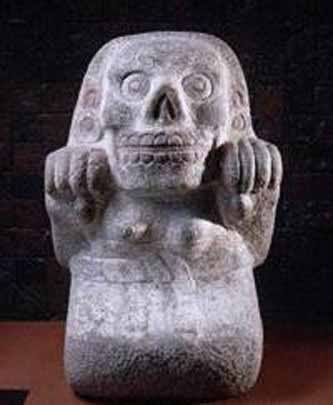
Mictecacihuatl 
By contrast, in several Roman Catholic national traditions, the Feast of All Souls has taken on a much greater significance than elsewhere. This is especially the case in Mexico, where the holiday is celebrated as Día de los Muertos or Day of the Dead. A Day of the Dead had preceded Christianity by centuries in Mexico, with evidence of some practice of a related holiday dating back over 2000 years. When the Spanish arrived in Mexico, they found that their Feast of All Souls corresponded with the worship among Aztecs and others of the goddess Mictecacihuatl who was Queen of Mictlan or the Underworld. The Roman Catholic Church syncretized the worship of Mictecacihuatl, replacing her veneration with that of the Virgin Mary, Mother of Jesus. Mictecacihuatl, known as the Sante Muerte (Saint Death) or simply the Dama de la Muerte (Lady of the Dead) is still present in some Mexican celebrations.  

In Mexico, the Día de los Muertos is major holiday on which people go to graveyards to visit the graves of their dead relatives. It should be noted that this holiday shares little if any of the North American uneasiness with death or with graveyards. Instead, the Mexican version of the holiday celebrates the unity between life and death and recognizes a strong sense of belief in the afterlife. The Día de los Muertos is a very festive time with people bringing photos and favorite foods of their deceased loved ones to the gravesites. Commonly people bring to the cemetery skulls made of sugar or marzipan with the name of the deceased one on the forehead. Other special foods include  candied pumpkins and the sweet soft bun decorated with pretend bones called pan de muerto (bread of the day). Throughout Mexico, marigolds (called Flores del Muerto or Flowers of Death) are used to decorate for the holiday (a tradition with origins in the Aztec rituals). It is also a time in which children are given toys, often with a skeleton theme (such as skeleton dolls or papier mache figures). In many homes, government offices and workplaces, people erect special altars centered around an image of the Virgin Mary with offerings to the departed placed there. 

Many traditions for the Día de los Muertos are regional in nature. These involve wearing skull masks, erecting skelton sculptures, having mariachi bands play while dressed as skeletons, having weddings of skeleton marionettes or of people dress as skeletons, wearing special clothing with regional ties to the holiday and holding dances or parades.

In 2008, the UNESCO officially inscribed Día de los Muertos celebrations as an Intangible Cultural Heritage of Humanity.

Holidays similar to the Mexican Día de los Muertos are celebrated in the elsewhere in Latin America. In Guatemala, the holiday is called Día de los Difuntos (which also means Day of the Dead) and is celebrated by visiting graves, flying kites and eating a special salad called fiambre made up of up to 50 different ingredients and only eaten once a year during the holiday. Bolivia’s indigenous people celebrate Dia de los Natitas (Day of the Skulls) in which indigenous peoples bring to Church the actual (not sugar) skulls of their dead which many traditionally keep in their homes.  Similar practices (without the actual skulls) are conducted among the Quechua-speaking community in Ecuador on All Souls Day. All Souls Day is also widely celebrated in Brazil where it is also called Finados, and people visit the graves of relatives. Outside of Latin America, Day of the Dead celebrations are practiced widely in the Philippines where it is called Todos los Santos (All Saints Day) in Spanish but Araw ng mga Patay ("Day of the Dead") in Tagalog and celebrated as a two-day family with visits to the graveyard and parties for the extended family.

All Souls Day is an official public civic holiday for public employees in AngolaBelgiumBoliviaBrazilEcuadorEl SalvadorHaitiMexico and Uruguay. It is also an official holiday in the US territory of Guam.

Reformation Day

Many Protestant denominations celebrate Reformation Day on the first Sunday on or following October 31.  Reformation Day is a public civic holiday in the nation of Slovenia as well as in the five predominantly Lutheran German Länder (states) of Brandenburg, Mecklenburg-Vorpommern, Saxony, Saxony-Anhalt and Thuringia.

Martin Luther began the Reformation by nailing his 95 Theses on the door of Wittenberg Church on the Eve of All Saints Day, October 31, 1517. Reformation Day is a holiday to commemorate this event for many Protestant denominations.

For these denominations, Reformation Day was also a way of repurposing All Saints Day. These denominations are either opposed to the concept of All Saints Day, some because of its association with the Roman Catholic Church or because of their refutation of the concept of sainthood (or both). In many Protestant denominations, some of the features of All Saints Day are combined with those of All Souls Day as worshipers remember those among the faithful or among one’s local congregation who have passed away.

The first recorded Reformation Day was decreed by law in 1569 in the officially Lutheran former German Duchy of Pomerania on what had been Saint Martin’s Day (November 11), because it bore the name of Lutheranism’s founder, Martin Luther. The  practice of observing Reformation Day was taken up by several other officially Lutheran States but without consistency as to practice or even date. Some uniformity took hold on the 100th anniversary of the Reformation in 1617. In that year, Reformation Day was observed on October 31 and November 1 among all of the Lutheran nations throughout what is now Germany (Germany as a single nation did not exist until 1871).  Among Lutheran churches today, the observances are mixed. For many Lutheran churches, the observance of Reformation Sunday is on the Sunday on or before October 1, with a separate holiday of All Saints Day on the Sunday on or following November 1. Lutherans, it should be pointed out, do not generally believe in saints in the same way as do Roman Catholics, Eastern Orthodox or Anglicans. For Lutherans, therefore, All Saints Day is a lesser holiday used to remember saints both dead and living and to honor Jesus Christ.

Some Evangelical and Pentecostal Christian movements have begun to use Reformation Day as a way to repurpose the secular holiday of Halloween. For many Evangelical and Pentecostal Christians, Halloween is an offensive holiday. As the Evangelical Director of the Children’s Ministry International, Brad Winsted asks,

“For so many Halloween presents a dilemma, what do you do with a holiday with roots in the occult?”  http://www.cbn.com/spirituallife/onlinediscipleship/halloween/reformation_day.aspx

Minister Winsted’s answer is to repurpose Halloween as Reformation Day.  


Halloween, Oíche Shamhna and All Saints Eve

The secular version of All Hallows Eve or Halloween is an especially popular holiday in the English-speaking world. The secular holiday has its roots in the religious holidays of Samhain and is called Oíche Shamhna (Samhain Night) in Ireland even by those who do not practice Wicca or Neo-Paganism. The secular holiday has spread to many non-English-speaking countries beginning roughly in the 1990’s, where it has been viewed mostly as a US import.

During Colonial times, North America was largely opposed to Halloween celebrations. Celebrations of All Saints Day were banned and any suspected ties to witchcraft were highly condemned (although not all as dramatically as the Salem Witch Trials). There is no formal record of Halloween having been practiced anywhere until the mid-19th Century. Thus, Halloween was not commonly celebrated in the United States until the late 19th Century, following the Irish Famine of the 1840’s. The holiday seems to have grown out of Scottish immigration to Canada in a similar manner.

The Commercialization of Halloween

By the beginning of the 20th Century, Halloween had devolved to an evening in which teenagers played pranks including property damage and assaults, a tradition grown from the English practice of Mischief Night (still practiced in some US cities as Devil’s Night on the night of October 30). Countering movements tried to commercialize Halloween as a night of safer entertainment in which children dressed up with the first commercially produced hand-made Halloween costumes appearing in the first decade of the 20th Century. In 1912, the Boy Scouts of America became involved in ensuring the safety with a “Sane Halloween” campaign that was largely successful. It was from here that the custom of trick-or-treating from door to door had its roots in the United States and Canada. Halloween celebrants were encouraged to turn the celebration into what was called “Beggar’s Night” to request a treat in return for not carrying out a trick (e.g., property damage). This trick-or-treating grew considerably more widespread during the Depression. By the mid-1930’s, manufacturers began to sell mass-produced Halloween costumes and decorations. 

Halloween in Hard Times: The Great Depression, Great Recession and  COVID-19 Pandemic

Halloween served both as a stress relief for adults during the Depression as well as a source of sweets (given by those better off) for poorer children who would not otherwise be able to afford them. This pattern may repeated itself in the Great Recession. In an interview, retail analyst Doug Johnson noted that “Halloween has become more popular because of the relative low costs and the escape from daily worries and a chance to be a kid again.” http://www.wrn.com/2011/10/halloween-makes-a-killing-in-retail-sales/  


This pattern has continued during the COVID-19 pandemic. Despite the pandemic, Halloween spending has increased. Phil Rist, Executive VP of Prosper Insights explains this: “Although fewer are celebrating this year, the ones who are aren’t shying away from Halloween-related purchases, spending $11 more on average, primarily on decorations and candy.” https://nrf.com/media-center/press-releases/consumers-anticipate-new-ways-celebrate-halloween-despite-covid-19   

In fact, the US National Retail Federation (NRF) found that only 58% of Americans plan to celebrate, a massive drop from the highpoint in 2017 and 2018 with over 70% indicating they will celebrate the holiday (the figure was 72% in 2017, the highest percentage ever recorded).  In both 2017 and 2018, sales of Halloween-related products and candy were over $9.0 billion (easily exceeding the previous record of 2016's $8.4 billion).  The trend for high Halloween spending remains entrenched now with three years -- 2016, 2017 and 2018 --exceeding the previous record high of $7.98 billion in 2012. In 2018, sales fell mildly for only the third time since 2005 with sales of Halloween-related products and candy have been on an upward trajectory. In 2020, by contrast overall spending fell by a billion dollars to $8.05 billion. 


The NRF data show that despite the overall decline in the number celebrating Halloween due to the pandemic, 2020 is actually expected to reach a record per-household sale, with US consumers planning to spend $92.12 per household. This makes Halloween for four years running second only to Christmas for per household spending on a holiday in the United States.

As with previous years, spending is greatest on costumes with anticipated sales of $3.2 billion. One newly growing trend -- emerging noticeably in 2018 -- is an increase in the sale of costumes for pets, with 20% of Americans buying costumes for their pets. This is an jump of 16% in sales of pet costumes over 2017. Prosper Insights Vice President Phil Rist indicated that this trend is strongest among pet owners between the ages of 25-34: "Out of the 31.3 million Americans planning to dress their pets in costumes, millennials (25-34) are most likely to dress up their pets, the highest we have seen in the history of our survey." https://nrf.com/media/press-releases/halloween-spending-reach-9-billion


In an unusual move, a US government agency has forbidden employees to dress up as President Donald Trump. The Department of Interior reminded its employees to avoid dressing as the president with an email with the subject line: "Halloween Hatch Act Reminder." The Hatch Acts prohibits federal employees from engaging in political activity while on duty. The Department of Interior warned its employees:

“While we enjoy the Halloween activities this afternoon, it is important to remember that employees should not wear costumes that resemble candidates for partisan political office. Please keep in mind that President Donald J. Trump is officially a candidate for reelection.”  October 31, 2018 memo to Department of Interior employees https://www.thedailybeast.com/interior-department-tells-staff-dont-dress-up-as-trump-on-halloween-it-could-violate-the-law  
Costumes -- for humans or pets -- at $3.2 billion far exceed the $2.7 billion spent on decorations and the $2.6 billion on candy.  The only figure showing a decline is with Halloween greeting cards, with an estimated $400 million in sales, nearly a $100 million drop in dollar amount from 2017. Still, for those planning Halloween purchases, 35% indicated that they will purchase Halloween cards.

In terms of percentage planning to make any Halloween purchase (in other words, by volume rather than dollar value), candy is by far the dominant choice.

Religious-Based Objections to Secular Halloween

Despite its overall popularity as a holiday, some Evangelical and Pentecostal Protestant groups are strongly opposed to Halloween as a holiday. For example, the Evangelical Christian preacher Pat Robertson said on the September 27 episode of his 700 Club television show that, “Halloween is Satan’s night, it’s the night for the devil.”  To see the video of this please click on http://www.youtube.com/watch?v=UaFiQfta6SM

Similarly, some Muslims also find Halloween offensive. The Islam.com website on About.com has devotes a page to Islam and Halloween in which it advises avoiding Halloween participation: “Virtually all Halloween traditions are based either in ancient pagan culture, or in Christianity. From an Islamic point of view, they all are forms of idolatry (shirk). As Muslims, our celebrations should be ones that honor and uphold our faith and beliefs. How can we worship only Allah, the Creator, if we participate in activities that are based in pagan rituals, divination, and the spirit world?” http://islam.about.com/od/otherdays/a/halloween.htm  As the blog “Stand Up 4 Islam” puts it, “If there’s a festival that must be so obviously un-Islamic, it’s got to be Halloween.” http://standup4islam.wordpress.com/  


Some Evangelical and Pentecostal Christians have tried to strike a balance.  For example, the website The Hem of His Garment Bible Study at  http://www.hem-of-his-garment-bible-study.org/Christian-Halloween-alternatives.html suggests several "Christian Halloween alternatives" or, failing that it advises that "If your kids are just determined to go door to door on October 31st, do something a bit different.
*Dress up as Bible Heroes
*Politely refuse any candy offered to you.
*Instead, give out candy wrapped in the witnessing stickers to every home that you visit."


The Influence of Samhain on All Saints Day and Halloween

It is not accidental that Samhain coincides with Halloween. This is because the secular celebration of Halloween actually has its root in the ancient Celtic holiday of Samhain. That said, it should be noted that within Wicca and many Neo-Pagan traditions, Samhain is a serious holiday and should not be lumped together in the same lighthearted attitude given toward Halloween.

It is also not coincidental that the Roman Catholic Church set the holidays of All Saints Day and All Souls Day on Samhain. At some point during the papacy of Pope Gregory III (731-741), All Saints Day was moved from the first Sunday after Pentecost to November 1. It should be noted that in the Eastern Orthodox Churches, All Saints Day continues to be celebrated on the first Sunday after Pentecost. 

Even the setting of the earlier date of the first Sunday after Pentecost had ties to pagan observances as this coincided with the Roman pagan holiday of Lemuria. Practices related to Lemuria were still widely celebrated even after Christianity became Rome’s state religion and paganism was officially suppressed. Before the conversion of Rome to Christianity, the ancient Romans believed that Lemures (also call Larvae) were vampire-like ghosts who haunted those relatives who were still alive. To protect against the Lemures, the male head of the household had to rise in the midnight and, after ritually washing their hands, throw black beans outside for the Lemures to collect. The head of the household then entreated the spirits to keep from harming his family. It is from Lemuria, in part, that the tradition of vampires and the spirits of the dead walking the earth derive.   

By declaring the observance of All Saints Day Eve roughly at the time of Lemuria, the early Church was able to Christianize the pagan practice. This absorption of the pagan practices into All Saints Day Eve effectively worked in gradually eliminating Lemuria from memory altogether. 

Pomona
That said, practices tied to yet another pagan holiday – Pomona Day—remained strongly in place on and around October 31. In an historical irony, the pre-Christian celebration of Pomona Day was itself a direct influence of the Celtic Samhain. During Rome’s 1st Century BCE Roman of the Celtic lands of northwest FranceBritain and Ireland, Roman troops became acquainted with the Celtic observances of Samhain. As these soldiers returned back home, they took with them many of the rites of Samhain. 

To Romanize Samhain, the Pagan Roman authorities merged these Celtic Samhain rites with the veneration of the Roman Pagan harvest goddess PomonaPomona’s harvest symbol was the cornucopia or horn of plenty and her worship included the sharing of apples and nuts (from which arguably the tradition of giving of treats derived). 
Pope Gregory III

One argument as to why Gregory III moved All Saints Day from the first Sunday after Pentecost to November 1 may have been to absorb the vestiges of Pomona Day into the holiday just as the Church had absorbed those rites earlier associated with Lemuria into the holiday. In other words, by moving the date, Pope Gregory III effectively made the Italian Pomona Day pagan rites a part of Church-sanctioned practices. All Saints Day, however, was practiced only in Rome itself where the All Saints Chapel in Saint Peter’s served as a pilgrimage destination. As a result, while the Pomona Day rites became Christianized in Italy, the  Pagan and druidic practices continued to have a hold on the former Celtic lands, especially in Ireland, Brittany and Scotland and people still continued to celebrate Samhain even though they were officially Roman Catholic. In 835, Pope Gregory IV extended the All Saints Day to include all Christians wherever they were and extended the Day to honor all saints (not just Saint John the Baptists and the early Church martyrs). In extending All Hallowmas beyond Rome, the Church was able to syncretize the continuing Samhain practices in the traditionally Celtic lands, making them part of the Church’s acceptable practices just as it had done for the Pomona Day practices in Italy

In moving All Saints Day to November 1, Pope Gregory III dedicated a chapel in Saint Peter’s in Rome. Pope Gregory III ostensibly moved the date to November 1 to benefit from the harvest in Rome as a means to accommodate pilgrims who would come to Rome to observe All Saints Day. It seems at least arguable that (just as with the earlier dating of the holiday to coincide with Lemuria), Pope Gregory III may also have chosen to move All Saints Day to November 1 to make sacred the continuing pagan practices. 


Pope Gregory IV

It is interesting to note how persistent the Samhain rites have remained. In a case of history repeating itself almost exactly, the pre-Christian Roman hierarchy had syncretized Samhain to their Pagan religious practices centuries before Popes Gregory III would syncretized the Roman Pagan rites of Pomona Day that were themselves syncretized from Samhain.  

Pope Gregory IV would then do the same for the continuing practices in Great BritainIreland and Brittany. Lutherans and other Protestants would then do the same by repurposing as Reformation Day the Roman Catholic All Saints Day which itself was a repurposed Pomona Day which was itself a repurposed of the original Samhain. In the holiday of Halloween, the holiday has been repurposed once more to reflect a more secular society’s approach to the same rites. That said, the practices in the United States and Canada continue to incorporate the original Samhain imagery of harvest (pumpkins, apple bobbing, sharing treats with others), the souls of the dead walking the earth (haunted houses, ghosts, and later vampires and zombies), and witchcraft practices (use of familiars such as black cats). 

As with all of these messages, these observations represent my own understanding of these holidays, and are not meant to take a position on religious practice in any way. I welcome all feedback for corrections or to say that you appreciated this summary.


Want to read more?

On Wiccan and Neo-Pagan Samhain holiday


On Roman Catholic All Saints Day and All Souls Day


On Protestant Practices of All Saints Day and Reformation Day


http://www.abpnews.com/content/view/5818/9/ (this Associated Baptist Press opinion piece reflects some of the debate among Baptists regarding the holiday)

http://www.cbn.com/spirituallife/onlinediscipleship/halloween/reformation_day.aspx (Christian Broadcasting Networking calling for the repurposing of Halloween as Reformation Day)

On Day of the Dead


On Halloween as a Secular Holiday (including sales figures)


https://uk.reuters.com/article/us-halloween-day-britain/from-trick-to-treat-after-years-of-antipathy-britain-embraces-halloween-idUKKBN1CZ1TL


On Opposition to Halloween Celebrations

The Pat Robertson episode http://www.youtube.com/watch?v=UaFiQfta6SM


On the Intertwined History of Samhain, Pomona Day, All Saints Day and Hallowe’en


Clip Art Sources


The Samhain greeting is from
http://www.squidoo.com/samhain_halloween

The Samhain altar is from http://paganwiccan.about.com/od/samhainoctober31/ig/Samhain-Altar-Gallery/
The image of soul cakes is at http://allrecipes.co.uk/recipe/8607/soul-cakes.aspx

The image for All Saints Day comes from
http://www.topnews.in/pope-celebrates-all-saints-day-282531

The site about.com provides a wide assortment of holiday images for free. the Happy Halloween clip art is at http://0.tqn.com/d/desktoppub/1/0/l/h/3/01GhostCard2-Publisher2010.PNG
while the cornucopia at the same site is at
http://desktoppub.about.com/library/holidays/pdh001.gif

The picture of trick or treaters comes from the Hem of His Garment Bible Study page suggesting Christian Halloween alternatives at http://www.hem-of-his-garment-bible-study.org/Christian-Halloween-alternatives.html

The charts for Halloween sales is from the National Retail Federation  https://nrf.com/media/press-releases/halloween-spending-reach-9-billion

Pet costume photo is from extremehalloween.com at http://www.extremehalloween.com/pet.htm

The photo of a Swedish cemetery on All Souls Day is taken from  http://jinge.se/dagens-bild/de-hadangangnas-dag-dagens-bild.htm

Thw image of Pomona is from the Wilson Almanac blog at  http://wilsonsalmanac.blogspot.com/2005/09/month-of-september.html

The image of Pope Gregory III is from the history site Mindserpent.com at
http://www.mindserpent.com/American_History/introduction/intro_010.html

The image of Pope Gregory IV is from the Gregory IV page of the Cultural Catholic website at http://www.culturalcatholic.com/PopeGregoryVII.htm

The image of St. Odilo of Cluny is from the Saints SPQN website at http://saints.sqpn.com/saint-odilo-of-cluny/

The statue of Mictecacihuatl is taken from http://media.photobucket.com/image/mictecacihuatl/fatalignorance/Spanish%203/mictecacihuatl.jpg?o=1

The guitar-playing skeleton is from the free clip art collection Picture This at http://leehansen.blogspot.com/2008/10/day-of-dead-skeleton-musician.html
  • Dress up as Bible Heroes
  • Politely refuse any candy offered to you.
  • Instead, give out candy wrapped in the witnessing stickers to every home that you visit."