Welcome to the David Victor Vector Blog

Welcome to the David Victor Vector blog. This is blog that covers religious observances around the world international affairs and global business. This blog describes religious holidays for most major religions as well as raising issues dealing with globalization, international business ethics, cross-cultural business communication and political events affecting business in an integrated world economy. I look forward your discussion and commentary on these articles and subjects. Enjoy!
Showing posts with label Buddha. Show all posts

Monday, December 3, 2012

Bodhi Day 2020

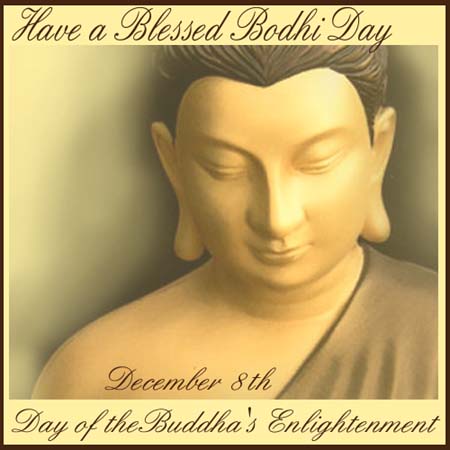
December 8 is the major Buddhist religious holiday of Bodhi Day. 

Bodhi Day is one of Buddhism’s three major holidays, and Buddhists in the workplace and school should be accommodated for worship.

Bodhi (बोधि) means "awakening" or more generally interpreted as "enlightenment" in both Sanskrit and Pali (the Buddha's own language), and some variant of the phrase "Bodhi Day" is used in most Buddhist traditions. That said, in Zen Buddhism, Bodhi Day is known as Rohatsu and in Tendai and other Japanese Buddhist traditions, it is known as Shaka-Jōdō-e.


The Buddha's Attainment of Bodhi

 The Enlightened Buddha
Wall hanging, Kuro-Shoin, Goten, Ninna-ji, Kyoto
Bodhi Day commemorates the day in 596 BCE on which the 35-year-old Prince Siddhartha Gautama after searching for Dharma (the truth) for six years, attained Bodhi (which in both Sanskrit and Pali roughly translates as "awakening" or “enlightenment”). Following 49 days of unbroken meditation beneath a pipul fig tree, discovered the Four Noble Truths and the Noble Eightfold Path that are the basis today Buddhism. 

For the last seven of those days, Prince Siddhartha stared at the tree without blinking, after which he attained Bodhi. From this point on, Prince Siddhartha became the first Buddha (which in both Sanskrit and Pali means “the Awakened One”).

As Professor Takashi Miyaji of the Institute of Buddhist Studies put it in an interview with NPR's Scott Simon on Bodhi Day 2020, 
And so this is where he awakens to the middle path and the path of moderation. And then he goes to underneath a Bodhi tree and says to himself, I am not leaving from this place until I attain awakening and finally does so one morning. And we say that that day is on December 8.

It should be noted that while Bodhi Day is important in both branches of Buddhism, the holiday is often held to be especially important in Mahayana (vs. Theravada) Buddhism. Mahayana Buddhism is most traditionally associated with the Buddhist traditions of China, Tibet, Korea, Japan, Mongolia, Bhutan, Vietnam and north India.

Even among Theravada Buddhists, however, Bodhi Day is a significant holiday. Moreover, in the United States, Canada and Europe, because of Bodhi Day’s proximity to the majority culture’s emphasis on Christmas, some Theravada Buddhists may place greater emphasis on Bodhi Day than in other countries where Theravada Buddhism is practiced.

The Bodhi Tree and Its Descendants

The original Bodhi Tree grows near the banks of the Falgu River under which the Buddha sat to attain enlightenment once grew at the site of what is now the Bodh Gaya.  The site itself is Buddhism's most sacred point of pilgrimage.

The Mahabodhi Tree
Sri Mahabodhi Temple
Bodh Gaya, India
The direct descendent of the tree -- called the Mahabodhi Tree -- is now located on the grounds of the Buddhist religious complex of the Mahabodhi Temple in the Indian state of Bihar. Additionally, there are three other trees grown from  cuttings of the original tree.


Sri Mahabodhi Temple Tree at Bodh Gaya
The tree marking the spot of the Buddha's enlightenment has had a temple surrounding it for over 2200 years. The original temple called the Bodhimanda Mahabodhi Temple was built in about 250 BC by the Maurya Dynasty Buddhist Emperor Ashoka the Great.

That said, the tree presently growing at the site of the Buddha's enlightenment dates only to the year 600 AD and is the fourth tree to have stood on the spot. Soon after King Ashoka built the Sri Mahabodhi Temple, his queen -- Tissarakkha -- became jealous of the attention given to the tree, and had the first tree destroyed. As recorded in the Nibbana of the Thera, "the treacherous Tissarakkha" did so with the thought

Forsooth, the king worships the great Bodhi-tree to my cost!' drawn into the power of hate and working her own harm, caused the great Bodhi-tree to perish by means of manduthorn.
         -- Nibanna of the Thera, Chapter 20 http://lakdiva.org/mahavamsa/chap020.html
 
The tree miraculously resprouted on the same spot.

After the death of Asoka, the Hindu Sunga Dynasty came to power in northern India, ruling the area including Bodh Gaya. Some say that King Pushyamitra Sunga, founder of the Sunga Dynasty, had the Bodhi Tree chopped down sometime in the 2nd Century BCE. It should be noted that conflicting historical opinions exist as to whether this actually occurred. Both sides of this debate, however, believe that the tree dates back to the original tree either because it still was the original tree (i.e., it was never chopped down by Pushyamitra Sunga) or because it was propagated from a cutting of the original tree.

Shashanka of Gauda
cut down the original Bodhi Tree
in 600 CE
There is no debate regarding the next cutting down of the Bodhi Tree  In 590 CE, the religious intolerant monarch Shashanka founded the Gauda Kingdom (the first unified Bengal kingdom). He carried out a series of attacks on Buddhists in his lands, paying 100 gold coins for the head of each Buddhist monk brought to him and destroying all of the stupas in his lands. During this period of persecution of Buddhism, Shashanka had the Bodhi Tree chopped down in the year 600 CE. The tree that stands at the site today was planted soon after from cutting of the original tree.


The Bodhi Tree at Svrasti

Following the Islamic invasions of India -- especially following those of Muhammad bin Qasim (695-715 CE) -- the original temple was largely abandoned and fell into disrepair. In the 1880's during the British rule in India, the current temple was restored and expanded.  Since 2002, it has been a UNESCO World Heritage Site.

Other Descendants of the Bodh Gaya Bodhi Tree
 
Two cuttings from the Bodh Gaya tree were transplanted and grown at two other temples within the first two centuries following the Buddha's death. One of these is at Sravasti in Uttar Pradesh in India. The city (called Savatthi in Buddha's lifetime), was the sixth largest city in South Asia at the time that the Buddha preached. It was the center of the area where most of his teachings were given. The site remains an important pilgrimage site for Buddhists ever since, and is a UNESCO World Heritage Site.

Jaya Sri Maha Bodhi
Anuradhapura, Sri Lanka
The other cutting of the original Bodh Gaya is at Anuradhapura in Sri Lanka. The Bodhi tree at Anuradhapura was planted in 288 BCE, where it was brought by Ashoka the Great's daughter Sangamitta Thera at the request of the Buddha's disciple Ananda. Called the Jaya Sri Maha Bodhi or simply the Ananda Bo Tree, it has been continuously protected and monitored. This makes the Anuradhapura tree the world's oldest known angiosperm tree with a verifiable history. It is a major Buddhist pilgrimage site and is a UNESCO World Heritage Site.

In modern times, one other descendant of the Bodhi Tree has been transplanted. In 1913, the Sri Lankan Buddhist preacher Anagarika Dharmapala brought a cutting of the Sri Lankan Jaya Sri Maha Bodhi tree to Honolulu, Hawaii, where he gave it to the American Mary Foster. Anagarika Dharmapala was the first major Buddhist speaker to preach internationally in both Europe and North America as well as in Asia, and Foster funded much of his efforts. The Honolulu tree was planted in the gardens Foster and her husband Thomas had bought from the Hawaiian royal family in 1884. When Mary Foster died in 1930, she left the gardens including the Bodhi Tree to the public as Foster Botanical Gardens.

Bodhi Day Observance and Customs

Bodhi Day is often celebrated through intensive day-long meditation, prayer and study. In the Japanese Zen tradition, the week leading up to Bodhi Day is devoted to intense meditation.

For 30 days beginning with Bodhi Day, Buddhists often bring a ficus or a sacred fig tree into their house in remembrance of the Bo (or Bodhi) Tree under which the Buddha sat during his 49-day meditation. The tree is often decorated with three brightly colored ornaments representing the Three Jewels: the Buddha, the Dharma (the way of Truth) and the Sangha (the community of those seeking enlightenment, or of the followers of Buddhism as a whole, a concept similar to the Muslim notion of the Ummah).

Heart-shaped leaves of the pipul fig
Traditionally on Bodhi Day throughout all Buddhist traditions, believers will eat (often as the morning meal) some combination of milk and rice. This has the following religious significance. The Buddha had spent the last seven of the 49 days of meditation without eating or drinking. On seeing Venus rising in the morning, the Buddha announced his attainment of Bodhi by proclaiming: "That's it! That's it! That's me! That's me that's shining so brilliantly!" At this point, the Buddha’s great disciple Sujata knew that the Buddha’s fast had ended and quickly brought the Buddha milk and rice to sustain Him.

Buddha with origami pipul leaves


In some traditions, Buddhists make sweet food (often cookies or candy) in the shape of a fig tree or in the shape of a heart with their children.  This helps the children associate sweetness with the goal of enlightenment. 

A "Bodhi Tree"
from the website of the
Eugene Buddhist Priory
During these 30 days, it is also common to decorate one's house. It is common to do so pipul fig leaves. These can be real leaves from living pipul figs or representative ones. In some Bodhi Day traditions, people make origami pipul leaves. The heart shape represents the heart-shaped leaves of the sacred pipul fig tree (ficus religiosa), the species of fig tree under which the Buddha sat when he attained enlightenment.


Many Buddhist decorate their houses with colored lights. Others light a candle each day for 30 days. In both cases, the lights or candle represent the enlightenment attained by the Buddha.

Some Buddhists (especially in North America) have repurposed the Christian Christmas tree as a Bodhi Tree to serve a Buddhist end, with the lights on the tree representing the enlightenment of the Buddha.


Concluding Comments


As with all of my blog posts on religion, this is not an attempt to indicate proper practice, but merely to inform in a very general way. Buddhism is a rich and varied tradition, and there are many ways to observe Bodhi Day, none definitive.

Finally, there is no traditional greeting on Bodhi Day, although many people do wish each other a "Blessed Bodhi Day" or a "Happy Bodhi Day."

Happy Bodhi Day!


Further Reading


Jundo Cohen (February 28, 2011), "Rohatsu -- Bodhi Day", Buddhist Family, https://sites.google.com/site/buddhistfamilyholidays/project-updates

 Chan Minh Đài (Deccember 20, 2011), "Happy Bodhi Day, Dharma Sharing,  http://www.thebuddhacenter.org/2011/12/08/happy-bodhi-day/

Caroline Donne, (July 2013), "Bodhi Day (Buddhist Festival)" Assemblies UK, (vol. 15, no. 7) http://www.assemblies.org.uk/standing/world_religions/wr_bodhiday.html

Ryuei Michael McCormick (December 8, 1999), LotusSutra.net  "Bodhi Day: Celebrating the Buddha's Awakening": http://sd2cx1.webring.org/l/rd?ring=ryuei;id=86;url=http%3A%2F%2Fnichirenscoffeehouse%2Enet%2FRyuei%2FBodhiDay2%2Ehtml

Barbara O'Brien (March 8, 2019) "An Overview of Bodhi Day: Commemoration of the Buddha's Englightenment," Learn Religions, https://www.learnreligions.com/bodhi-day-449913

Re:Online: The Place for Excellence (2020), "Bodhi Day," https://www.reonline.org.uk/festival_event/bodhi-day/ 

Fa Dao Shakya (November 10, 2008), Exploring Chán, Bodhi Day: The Day of Enlightenment": http://www.hsuyun.org/Dharma/zbohy/Literature/essays/fds/BodhiDay.html

Scott Simon, "Buddhists Prepare To Observe Bodhi Day, When Siddhartha Gautama Became Buddha," https://www.npr.org/2020/12/05/943453999/buddhists-prepare-to-observe-bodhi-day-when-siddhartha-gautama-became-buddha 

Alden Smith, “How to Celebrate Bodhi Day,” http://www.doityourself.com/stry/bodhi-day

 Clipart Sources

Opening "Happy Bodhi Day" greeting: "40 Oz. of Bad Karma" blogsite:
http://bodhipunx.wordpress.com/2010/12/08/bodhi-day-the-last-night-of-hanukkha-and-the-rohatsu-session/

The enlightened Buddha, wall hanging, Kuro-Shoin, Goten, Ninna-ji, Kyoto, Japan: My own photograph 

Mahabodhi Tree: Photo by Ken Wieland, Wikipedia site free access photo: http://en.wikipedia.org/wiki/File:Bodhgaya_3639641913_f4c5f73689_t.jpg

Shashanka gold coin (ca. 700 CE): http://jewellery.indianetzone.com/1/coins.htm

The Bodhi Tree at Sravasti, Wikipedia site free access photo:  http://en.wikipedia.org/wiki/File:Anandabodhi2.jpg

Jaya Sri Maha Bodhi, Anuradhapura, Sri Lanka: Photo by Joerg Reuter, Wikipedia free access photo: http://en.wikipedia.org/wiki/File:Jaya_Sri_Maha_Bodhi.jpg

Pipul fig leaves: Photo by Eric Guinther, Wikipedia free access photo: http://en.wikipedia.org/wiki/File:Ficus_religiosa_Bo.jpg

Bodhi Day pipul leaf origami: http://suite101.com/article/how-to-celebrate-bodhi-day-a318371

Bodhi Tree from Eugene (Oregon) Buddhist Priory website: http://buddhistfaith.tripod.com/beliefs/id32.html

Closing clip art "Blessed Bodhi Day": http://fc05.deviantart.net/fs12/f/2006/335/6/8/Happy_Bodhi_Day_by_Tutankhamun.jpg

Friday, April 27, 2012

Vesak (Wesak)

Introduction

Buddha Altar
US Air Force Academy
Colorado Springs, Colorado
The Birthday of Lord Buddha is one of the most important holidays in Buddhist tradition. The holiday is celebrated on different days varying by religious and national tradition.  

For 2022, Vesak comes as early May 8 and as late as June 14 depending on tradition. In Mahayana (and some  traditions, Vesak is generally celebrated a week earlier (this year May than in Theravada Buddhist tradition (as explained below). This is complicated by different locational differences. The earliest date officially celebrating Vesak is in Macau and Taiwan, where May 8 it is observed as an official state holiday. The latest date officially celebrating Vesak comes in Bhutan and Mongolia, where for 2022, June 14, is observed as a national holiday.   

Below you will see listed the place and 2022 date that the birthday of the Buddha is an official public holiday 
  • May 8   South Korea, Hong Kong, Macau, Taiwan (set as second Sunday in May); in Macau and Hong Kong May 9 is an official holiday making this a long weekend. Although not officially recognized, this is the date Vesak is celebrated in much of the rest of the PRC (see note below) as well as the overseas Chinese communities in the Philippines, the United States and Canada.
  • May 14 Myanmar (recognizing the official state holiday as the Full Moon of Kasong Day)
  • May 15 Bangladesh, Cambodia, India, Indonesia, Malaysia, Singapore, Sri Lanka and Thailand and (unofficially) Laos, Myanmar and Vietnam
  • May 16 (the Monday following in lieu of Vesak falling on a weekend) is an official state holiday in Bangladesh, India (15 of 36 of India's states/union territories (explained below), Indonesia, 12 of 16 of Malaysia's states/territories (explained below), Nepal, Singapore, Sri Lanka, and Thailand
  • June 14 Bhutan, Mongolia, Sikkim (in India) and (unofficially) Tibet 
Bhutan, Mongolia and Tibet celebrate on one day the birth, the paranirvana (enlightenment) and attainment of nirvana. This national holiday, called  in Bhutanese does not combine the three events but marks the day Buddhists in this tradition believe that all three events occurred (the 15th day of the fourth month of the Tibetan/Bhutanese calendar). In Bhutanese, the holiday is called Duechen Nga Zom (nga meaning "five" and zom meaning "coincide") marking the coinciding of five events: Buddha's conception, birth, victory over evil, enlightenment and attainment of nirvana.
 
Although Vesak is not an officially recognized state holiday outside of Hong Kong and Macau, it is widely celebrated in the PRC with the date varying by which Buddhist tradition is followed (May 8 for most Chinese Buddhists; May 15 for the Dai-lue of Yunan Province, June 14 for Tibetan Buddhists)

In India and Malaysia, each individual state or territory has local jurisdiction as to whether to provide the following Monday off when Vesak falls on a Sunday. In India, 15 of the nation's states and territories provide Monday, May 16 off in lieu of Vesak falling on a Sunday. These are: Arunachal Pradesh, Assam, Chandigarh, Delhi, Himachal Pradesh, Jammu & Kashmir, Jharkhand, Madhya Pradesh, Maharashtra, Mizoram, Odisha, Tripura, Uttar Pradesh, Uttarakhand, and West Bengal. In the Indian state of Sikkim, Buddhists follow the Tibetan tradition and observe the holiday on June 14. In Malaysia, all 4 of nation's 16 states and territories will not give Monday May 16 off in lieu of Sunday. The only four Malaysian states that do not allow the following Monday off are Johor, Kedah, Kelantan and Putrajaya. 

The holiday is most widely known as Vesak or Wesak, or in religious writings as Vesākha, the original word in Pali (the language of the Buddha). Other names for the Birthday of Lord Buddha include 
  • Fó Dàn in several Chinese dialects
  • Saga Dawa in Tibetan and Sikkimese (and thus in many Vajrayan traditions)
  • Visakha Bucha or Wisakhabucha in Thai
  • Vixakha Bouxa in Lao
  • Visak Bochea in Khmer (Cambodian)
  • Phật Đản in Vietnamese
  • Hanamatsuri in Japanese
  • Seokka Tanshin-il in Korean
  • Waisak in Balinese, Javanese, Sundanese, Bahasa Malaysia and Bahasa Indonesia
  • Visakah Puja or Buddha Purnima in Nepalese
These are all names for the same holiday.

Dating Vesak

 Tian Tan Big Buddha, Hong Kong
The date assigned to Vesak depends on which of the different Buddhist lunar calendars each specific Buddhist tradition uses. Additionally, because none of these calendars parallel the Gregorian calendar, the date of Vesak appears on different days of the secular calendar; however, generally, Vesak comes in April or May.

Mahayana. Vesak is on May 8 in 2022 for most Mahayana Buddhist traditions. This is the date used in South Korea, Hong Kong, Macau and (most of) China and Taiwan, Hong Kong. 

In Mahayana tradition, Vesak falls on the eighth lunar day of the fourth month in the East Asian lunar calendar. Thus in 2022, Vesakh falls on May 8 in those traditions. In both Hong Kong and Macau, the day after Buddha's birthday is also a public holiday. 

Theravada. Vesak is on May 15 in 2022 in (most) Theravada  Buddhist traditions -- in other words, Vesakh begins a week later. In their calendar traditions, Vesak begins on the first full moon Uposatha (mind-clearing day) of the second month of their calendar.

Theravada is the dominant tradition practiced in Thailand, Vietnam, Singapore, Laos, Myanmar, Cambodia, southern India, Bangladesh and Sri Lanka.

Vajrayana. Vesak is on June 14 in 2022 in most (but not all) Vajrayana traditions. Vesak for Vajrayana Buddhists is a combined commemoration of the coinciding events of Buddha's birth, paranirvana and attainment of nirvana.  Tibetan Vajrayana Buddhism is the dominant tradition practiced in Tibet, Bhutan, Mongolia and the Buddhist Tuva and Kalmykia Republics in Russia. This is also the tradition practiced in much of northern India and is in the dominant religion of the state (and until 1975 independent monarchy) of Sikkim. Vajrayana Buddhism is also an important religious minority in Arunachal Pradesh and the Lakh district of Kashmir. It is also the tradition worldwide of the Tibetan diaspora community centered around the Dalai Lama at Dharamshala in Himachal Pradesh.   

The Newa people in Nepal (and from whom the country gets its name) follow their own Newar Buddhist tradition called Buddhamarga. The Newa people primarily live in the Katmandu Valley including Lalitpur (historically called Patan), the Buddha's place of birth, where they constitute the majority of the population. Buddhamaraga Buddism can be viewed either as a form of Vajrayana tradition or as very closely tied to Vajrayana Buddhism. 

A separate announcement on Paranirvana or Nirvana Day will go out when this holiday occurs, as other traditions celebrate this separately from the birth of Buddha.

UN Vesak Day. The Theravada traditional Vesak day (May 16 in 2022) is also the date celebrated by the United Nations for the holiday.   

Finally, in Japan, Vesak (or Hanamatsuri) is not determined by the East Asian lunar calendar but instead has been officially tied to April 8 in the Gregorian calendar since the Meiji Restoration.

As multiple interpretations of when the date fell existed based on Chinese, Hindu and other calendars, the Conference of the World Fellowship of Buddhists met in Sri Lanka in 1998 and agreed to the first full moon of May date (with a leap year built into the cycle on a complicated formula that occasionally places the date in June).

Monks celebrating Vesak
at United Nations, 2006
This resolution was the basis for the United Nations General Assembly's resolution regarding the dating of Vesak. Since 2000, the United Nations officially observes Vesakh as the first full moon of May. The official UN Resolution for Vesak observance reads:


The General Assembly,
Acknowledging the hope expressed by the International Buddhist Conference, held in Sri Lanka in
November 1998, that the Day of Vesak, the Day of the Full Moon in the month of May each year, be recognized internationally and, in particular, at United Nations Headquarters and other United Nations offices,
Recognizing that the Day of the Full Moon in the month of May each year is the day most sacred to
Buddhists, who commemorate on that day the birth of the Buddha, his attainment of enlightenment and his passing away,
Considering that international recognition at United Nations Headquarters and other United Nations offices would constitute acknowledgement of the contribution that Buddhism, one of the oldest religions in the world, has made for over two and a half millennia and continues to make to the spirituality of humanity,
Resolves that, without cost to the United Nations, appropriate arrangements shall be made for
international observances of the Day of Vesak at United Nations Headquarters and other United Nations offices, in consultation with the relevant United Nations offices and with permanent missions that also wish to be consulted.
 http://www.worldlii.org/int/other/UNGARsn/1999/192.pdf  
The Birth of the Buddha

The Gautama Buddha was born in 563 BCE in the town of Lumbini in northern India to the King Sudhodana and Queen Maya, the rulers of the kingdom of Sakya.  His parents named him Siddhartha. He is also called Sakyamuni or the Sage of Sakya.

His mother the queen had a dream of a white elephant and a white lotus entering her womb.  This was interpreted as an omen that the child she would bear would be either a great warrior or a great religious leader. It was for this reason that the young Siddhartha was shielded from the outside world by his father who wanted him to be a great warrior king and feared that exposure to the sufferings of the world would turn his son into a spiritual leader instead.


Birth of the Buddha
Panel painting, Jogyesa Temple
Seoul, South Korea
Legend has it that Queen Maya gave birth to him with no pain of childbirth and that immediately after being born, the baby Siddhartha took seven steps to represent the seven Buddhist directions (east, south, west, north, up, down and here). It is for this reason that when the Buddha is depicted as an infant, he is often shown standing while pointing with one hand up and the other down to signify the seven directions.

In the Mahayana tradition, the infant is also supposed to have immediately spoken, saying, "I alone am the World-Honored One." It is important to note that this last point is highly debated. Some Buddhists do not accept that he said these words while others interpret these words only as meaning that he was aware at birth of the Buddha nature that is present in all living beings, not simply referring to himself.

Queen Maya died one week after the birth of her son but not before the visit of the ascetic Asita who pronounced that he saw in the child the 80 signs that he would become the Enlightened One. After his mother's death, the young Siddhartha was raised by his older sister.


Traditions Where the Buddha's Death Is Celebrated With His Birth


In Theravada Buddhism, Vesak is seen as both the day of the Buddha's birth and that of his death. This remains a very happy celebration even in Theravada tradition where the Buddha's death is intermingled with his birth. This is because at the Buddha's death, the Buddha counseled the disciple Ananda not to cry or feel sad but rather to honor the Dhamma, for the teachings that the Buddha shared are -- it was taught -- the only thing that is eternal.  Buddhists interpret this, then, as celebrating Vesak by reaffirming their belief in the Eight Noble Truths, to seek enlightenment, to practice acts of love, and to try to bring peace and harmony to the world.

Mahayana Buddhism, by contrast, celebrates the day of Buddha's death as a separate holiday. Please see my blog on Paranirvana (or Nirvana Day) for more on that holiday:


Observances and Celebrations

The celebration of Vesak -- regardless of tradition -- usually centers around ceremonies at the Buddhist
temple.  Buddhists in most traditions sing prayers about the Buddha, the Buddha's teachings (called the Dhamma) and the followers of the Buddha (called the Sangha). 

It is customary to bring beautiful offerings that by intention do not last long, showing the impermanence of all things.  Thus, some people bring cut flowers or flower petals (that wither soon), decorated candles (that soon burn out) or incense sticks (that rapidly turn to ash). 

In almost all Buddhist traditions, people celebrate with items that fly, as representative of the freedom of the spirit brought by the Buddha's teachings. Among the most common of these practices comes with flying kites and with hanging paper lanterns that move in the wind. Many traditions fly special flags. Releasing birds is also practiced in many traditions.


Bathing the infant Buddha

Another common practice shared across many different traditions is the washing of an image of the Buddha as a baby standing with one hand pointing up and one hand pointing down. Worshippers place the baby Buddha statue on an raised altar inside of a basin or large bowl. They then pour water or tea from a ladle symbolically washing the baby Buddha.

Because this is a point of common misunderstanding, it should be emphasized here that images of the Buddha, though treated with great reverence, are not idols but simply representations of the Buddha. These statues and images are not seen as deities themselves.

Many Buddhists traditionally wear white as a part of the holiday as well. It is also customary to eat only vegetarian meals on Vesak for those who otherwise are not vegetarian.

An important aspect of Vesak is to express happiness and especially to bring happiness to those who may be unhappy.  This involves giving donations or doing special things for the sick and the elderly. It is also traditional to decorate the temples with things of beauty and with scenes of the life of the Buddha, which are supposed to bring happiness to all who see them.


As always, this is my own summary of a religious tradition. I welcome your input.

Happy Vesak!

Want to Learn More?


"The Birth of the Buddha: Legend and Myth," About.com Buddhism:  http://buddhism.about.com/od/buddha/a/birthofbuddha.htm


“The Life of the Buddha,” Souled Out.org., http://souledout.org/wesak/storybuddha.html
"The Significance of Vesak: Buddha Day," (The Venerable) Mahinda, Buddhanet: http://www.buddhanet.net/vesak.htm

"Lord Buddha's Parinirvana in Bhutan in 2022," Office_Holidays, https://www.officeholidays.com/holidays/bhutan/buddha-parinirvana 


"Vesak or Visakah Puja," Buddhist-tourism.com, http://www.buddhist-tourism.com/buddhist-festivals/vesak.html


"What is Vesak Day and Why Celebrate It?" James Ure, The Buddhist Blog: http://thebuddhistblog.blogspot.com/2007/04/what-is-vesak-day.html

Photo and Clip Art Credits

Buddha Altar, US Air Force Academy, Colorado Springs, Colorado: My own photo

Tian Tan Big Buddha, Hong Kong: My own photo

Monks celebrating Vesak at United Nations, 2006: http://www.worldzen.org/vesak.php

Birth of the Buddha panel painting, Jogyesa Temple, Seoul: My own photo

Bathing the infant Buddha: http://www.palyulph.org/teachings.htm

Sunday, February 12, 2012

Parinirvana or Nirvana Day

Introduction

Dai-Batsu Buddha Shrine, Kamakura, Japan
February 8 or 15 (depending on which tradition one observes)  is the Buddhist holiday of Parinirvana or Nirvana Day. Note that while February 15 is the date for most Mahayana Buddhists, in some traditions, Parinirvana is observed on February 8 this year. In Canada, regardless of tradition, the holiday is officially observed on February 15.  

Nirvana Day marks the day in 483 BCE when Siddhārtha Gautama – the Buddha – died.  The Sanskrit word parinirvana or the equivalent Pali word parinibbāna refers to the death of physical body of anyone who attains enlightenment. The use of the word Parinirvana or Parinibbāna to refer to a holiday generally refers to the death of Siddhārtha Gautama -- Lord Buddha – as the first person to attain enlightenment.   

Theravada and Mahayana Buddhism
regions
Nirvana Day is celebrated primarily by Mahayana Buddhists. There are two major schools of Buddhism: Mahayana (with its offshoot of Vajrayana Buddhism) and Theravada. It should be noted that while the death of the Gautama Buddha is important in both branches of Buddhism, the event is celebrated as a holiday in the Mahayana (vs. Theravada) tradition. Theravada Buddhists usually celebrate this event in May as part of the the holiday of Vesak. Mahayana Buddhism is most traditionally associated with the Buddhist traditions of China, Tibet, Korea, Japan, Mongolia, Bhutan, Cambodia Vietnam and northern India.

Mahayana Buddhists celebrate the Buddha’s death as something joyous. It is not a sad event. This is because, in dying, the Buddha attained nirvana. Through his death, the Buddha left the world with his final lessons on achieving freedom from earthly existence and the cycle of suffering.

As a holiday, Parinirvana is an opportunity not only to rejoice in the death of the Buddha but also a day to recall those who have died among one’s relatives, friends and teachers. This, in turn, is used as a time to reflect on one’s own mortality and to be mindful of one’s own life in the face of the inevitability of death.

Two Versions of the Mahaparinirvana

Sakyamuni Buddha
Po Lin Monastery, Lantau Island
Hong Kong 
The death of the Buddha is described in two different versions, both with the same name. The Sanskrit Mahaparinirvana Sutra is the main sutra on which Mahayana Buddhism relies. Thereravada Buddhists, in turn, rely on the Pali language version known as the Maha-parinibbana Sutta.  To avoid confusion, the Mahayana version is frequently called just that: the Mahayana Mahaparinirvana Sutra.

For an English version of the Mahayana Mahaparinirvana Sutra, please see Kosho Yamamoto’s translation at


Yamamoto’s translation is the first full translation of the Mahayana Mahaparinirvana Sutra that has been widely accepted.

To compare this with the Theravada Pali language Maha-parinibbana Sutta, please see the translation of Francis Story’s English rendition of Sister Vajira version posted at the Buddhist Publication Site at:


While these two versions both describe the last days and final teachings of Gautama Buddha, and both describe his death and parinirvana, it is important to re-emphasize that the two scriptures differ significantly in content and structure.

Bhutanese Buddha
Indeed, while Theravada and Mahayana Buddhism share a great deal in common, the teachings of the Buddha in his final days presents one source of significant differences. This is an important distinction since in both traditions, the Mahaparinirvana text lays out in greatest detail the central principles of Buddha-dhatu (also called “Buddha nature” in English, Tathāgatagarbha in Sanskrit and Bussho in Japanese).

For more on the shared principles as well as the differences between Theravada and Mahayana Buddhism, I recommend that you read see Ankur Barua and M.A. Basilio’s excellent overview “Similarities And Differences Between Theravada And Mahayana Buddhism” at


Because the holiday of Parinirvana is primarily a Mahayana Buddhist holiday, the version of the Buddha’s death and the related passages quoted here are from the Mahayana scripture.


The Death of the Buddha

Foreknowledge and Delay of Death

 Death of the Buddha
Exterior of Daeungjeon Shrine
Jogyesa Temple complex, Seoul
Siddhārtha Gautama attained enlightenment at age 40, becoming the first person to attain buddhood. From this point, he acquired the title of the Buddha, meaning “Enlightened One.”  For more on Lord Buddha’s enlightenment, see the entry on this blog for Bodhi Day at


Buddha cave painting, 8th century
Dunhuang caves, Gansu Province, China

At the point of his enlightenment, the Buddha had the ability to enter Nirvana immediately, and be free from the cycle of attachment and suffering. He chose, however, to stay in his earthly existence to share the truth of enlightenment with those who would listen. For the next 40 years following his enlightenment, the Buddha traveled around northern India teaching and receiving those who sought understanding.

Because he had complete enlightenment, the Buddha knew exactly when and how he would die. He told his disciples that he would die at 80 far in advance of his death.

Cunda and the Final Meal

At 80, the Buddha became severely ill as he had foretold. For some time, he began to suffer from sharp abdominal pains. In the Theravada version of his death, Lord Buddha had sent his followers away for a set time during which his body began to fail. In this version, he willed himself to remain so that his followers could learn from him in his death.  In the Mahayana version, this is less clear. In both versions, in the days leading up to his death, the Buddha – weak and still suffering from intestinal pain -- was surrounded by his disciples in Kushinigar, the capital of what was then the nation of Malla, which is now the town of Kasia in the modern Indian state of Uttar Pradesh.

Buddha receives his last meal
from the metalsmith Cunda
In his last day, the Buddha traveled with his disciples to the village of Pava where he rested in the mango grove owned by a pious metalworker named Cunda. The Buddha requested his personal attendant, the great disciple Ānanda, to procure an offering of food from Cunda. Unknown to Ānanda or to Cunda, but known to the Buddha, this offering will be the last meal of the Buddha. Cunda provides two meal offerings. One is of general food and the other -- the meal eaten by the Buddha -- is called sukaramaddava which means “boar’s delight” but the content of which is debated. In some (though not all) Mahayana tradition this meal is one of “pig truffles” (that is, of truffles found by a pig); in Theravada (and some Mahayana) traditions, this meal is one of pork.

Whatever the actual last meal is, the food is contaminated. Knowing that eating Cunda’s offering will kill him, the Buddha willingly eats the meal. The Buddha, however, prevents any of those around him from eating the sukaramaddava. Instead he asks his disciples to bury the remainder of his own meal and insists that they eat only from the other food that Cunda has offered. The Buddha then enters into a discussion with Cunda about the nature of the two offerings, then answering questions that the artisan raises. The Buddha then blesses Cunda for the offering. This discussion is recorded in the Cunda Sutra.

Kushinigar Temple
is on the site of
the Buddha's mahaparinirvana
The Buddha soon after eating Cunda’s food becomes violently ill. Despite this, the Buddha insists on traveling to the city of Kushinigar, approximately nine miles away from Pava. Throughout the journey, the Buddha grows weaker and weaker and is in great discomfort with terrible stomach pains. Colored lights emanate from the Buddha’s mouth and other phenomena suggesting that all is not normal.

The Last Teaching Beneath the Sala Trees

Once in Kushinigar, the Buddha bathes in the Kakuttha river and rests under a grove of sala trees. The Buddha then turns to Ānanda and expresses concern for Cunda:


The Buddha next asks Ānanda to
please make a couch ready for me with its head to the North between two big sala trees. I am tired and I want to lie down.

Sala tree (Shorea robusta) in bloom
Also called sal or shala trees, the species gave
shade both at the birth and death of the historical Buddha

When the Buddha lies down, although February is not the right season for it, the sala trees burst into bloom and begin to shower the Buddha with flower petals.

The request to rest under the sala trees is significant as Queen Māyā of Sakya -- the Buddha's mother -- had given birth to him beneath a sala tree.


The Buddha then says
Ānanda the two big sala trees are scattering flowers on me as though they are paying their respects to me. But this is not how I should be respected and honoured. Rather, it is the monks or nuns, or the men or woman lay followers, who live according to my teaching, that should respect and honor me.

 Now it may happen that some people may make Cunda regret having given me the meal that made me sick.  Ānanda, if this should happen, you should tell Cunda that you have heard directly from the Buddha that it was a gain for him. Tell him that two offerings to the Buddha are of equal gain; the offering of food just before his supreme enlightenment and the offering of food just before he passes away. This is the final birth of the Buddha.

 Death of the Historical Buddha (Nehan)
Kamakura period (1185–1333), 14th century
 Metropolitan Museum of Art, New York
 

Once the disciples have gathered beside him, the Buddha lies on his right side in what is called the lion position, with his legs one on top of the other and his head supported in his hand.  This is the position in which all representations depict the reclining Buddha. The Buddha then asks his disciples if they have any last questions, and no one among those gathered speaks. The Buddha then utters his last words:

Now, monks, I declare to you: All conditioned things are of transient nature; Strive on untiringly with diligence.

At this point, the Buddha died and enters mahaparinirvana.

Parinirvana Observation

The commemoration death of the Buddha on Nirvana Day, as mentioned before, is a joyful occasion even if the day is also often quite solemn. The joyfulness of Parinirvana focuses on celebrating the Buddha’s escape from the cycle of suffering of the soul with the soul’s final freedom to achieve Nirvana. The solemnity centers on using the day to contemplate one’s own mortality, one’s own path to nirvana and the illusion of permanence in the material world. Nirvana Day is also a time for remembering those among one’s family, friends and teachers who have passed away.

On Parinirvana, people go to the temple where the recite portions of the Mahaparinirvana Sutra, sing special chants and meditate. During this time, the lighting in the temple is intentionally kept very dim. At the conclusion of the chants and meditations, the room is made bright. This symbolizes the enlightenment of the world through the Buddha’s teachings.

Nirvana Day in many areas is also traditionally a day for distributing gifts of money, clothing and other goods, especially to monks and nuns, but also to the needy.


Dum Alu

Many regional traditions have particular foods associated with Nirvana Day. In northern India, people traditionally eat Dum Alu (or Dum Aloo). This is made of potatoes (alu means potato in several northern Indian languages) in a rich spicy gravy. A recipe for Dum Alu can be found at


Udon Miso Soup

In Japan, some people mark the day by eating Udon Miso Soup. Udon are flat, wheat noodles.  A recipe for Udon Miso Soup can be found at


Concluding Comments

As with all posts on this blog, this overview is meant only to give a superficial overview of a widely celebrated holiday. This blog makes no intention of suggesting that one interpretation or religious text is correct or incorrect. The intent here is to be informative.

As always, I welcome your comments either here on the blog. Please share your traditions and customs.

Happy Nirvana Day! Blessed Parinirvana!

Want to Read More?

Buddha, Karen Armstrong, Penguin: 2004


“The Buddha’s Last Meal,” Buddha Dharma Education Association/Buddha.net, http://www.buddhanet.net/e-learning/buddhism/lifebuddha/2_29lbud.htm


“How to Celebrate Parinirvana Day,” Helium How-To Guides

“The Life of the Buddha,” Souled Out.org., http://souledout.org/wesak/storybuddha.html

“The Mahaparinirvana Sðtra and the Origins of Mahayana Buddhism,” Sasaki Shizuka, Japanese Journal of Religious Studies, 1999. 26:1-2, http://nirc.nanzan-u.ac.jp/publications/jjrs/pdf/539.pdf

“Nirvana Day,” About.com Buddhism,  http://buddhism.about.com/od/buddhistholidays/a/nirvanaday.htm


“Parinirvana Day of Shakyamuni Buddha,” The Jade Turtle Records, http://jadeturtlerecords.blogspot.com/2011/03/parinirvana-day-of-shakyamuni-buddha.html

“Parinirvana of Gautama Buddha,” Ramalingam, Relijournal, http://relijournal.com/buddhism/parinirvana-of-gautama-buddha/

Clip Art Sources

Dai-batsu Buddha Shrine, Kamakura, Japan. This is my own photograph. Please give credit if you wish to copy it.

Theravada and Mahayana Buddhism regions map: Buddha.net,  http://www.buddhanet.net/e-learning/buddhistworld/schools1.htm

Sakyamuni Buddha, Po Lin Monastery, Lantau Island, Hong Kong This is my own photograph. Please give credit if you wish to copy it.

Bhutanese Buddha. From the 2008 traveling exhibition "The Dragon's Gift: The Sacred Arts of Bhutan,"  http://www.buddhistchannel.tv/picture/upload/bhutan-art.jpg

Death of the Buddha, Exterior of Daeungjeon Shrine, Jogyesa Temple complex, Seoul: This is my own photograph. Please give credit if you wish to copy it.

Buddha 8th century Dunhuang cave painting:  http://dunhuang.mtak.hu/en/large-ch-53-1.htm

Kushinigar Temple: Buddhist Temples -- Path to Salvation: http://www.buddhist-temples.com/kushinagar.html

Sala trees: J. M. Garg, http://en.wikipedia.org/wiki/File:Sal_(Shorea_robusta)-_flowering_canopy_W_Picture_117.jpg

Death of the Historical Buddha (Nehan), Kamakura period (1185–1333), 14th century, Metropolitan Museum of Art, New York:   http://www.metmuseum.org/toah/works-of-art/12.134.10