Welcome to the David Victor Vector Blog

Welcome to the David Victor Vector blog. This is blog that covers religious observances around the world international affairs and global business. This blog describes religious holidays for most major religions as well as raising issues dealing with globalization, international business ethics, cross-cultural business communication and political events affecting business in an integrated world economy. I look forward your discussion and commentary on these articles and subjects. Enjoy!
Showing posts with label Jainism. Show all posts

Thursday, November 4, 2021

Diwali

For 2021, the Hindu, Jain and Sikh celebration of Diwali begins on Thursday November 4 and will continue for five days through Tuesday November 9.

The festival of Diwali  (also called as Deepavali, Deepawali, Divali, Devali and -- in Nepal -- Tihar or Swanti) is the most important holiday in the Hindu calendar. It is also an important holiday for Jains and Sikhs. 

For most people, the holiday should not affect class or work attendance, but may be observed by many students who practice one of these three religions.

Diwali marks the last day of the Hindu calendar.  The holiday can last up to five days and celebrates (at least in part) the victory of light over darkness and good over evil. In much of India (and especially in the North), the business community starts their financial new year with the holiday, and it is the beginning of the fiscal year. 

Diwali is celebrated throughout the Hindu world, regardless of region (which is not always the case for other holidays).  Divali is an official holiday not only in India and Nepal which both of majority Hindu populations, but also in Bali, Singapore, Sri Lanka, Trinidad & Tobago, Malaysia, Guyana, Mauritius and Fiji. Likewise, Diwali is observed by throughout the world, wherever there are Hindus, Sikhs and Jains.

Diwali Traditions
Diya


Various traditions for celebrating Diwali include lighting of oil lamps (diyas or jyothis), setting off of fire crackers, exchanging and eating decorated sweets, gathering at people's holiday-decorated homes in celebration and visiting temples.   

Narkasur dancing, Goa
While lighting diyas is universal and gif exchanges are fairly universal. often different regios have different traditions. For instance, in Goa the battle in which Lord Krishna defeats the demon Narkasur is commemorated. This often takes the form of burning an effigy of the demon Narkasur, often accompanied by drumming.  Contests are held in which prizes awarded to those with the best battle depiction as well as best costumes. Likewise, it is common in Goa for those dressed as the demon Narkasur to dance outside people's homes. I have a Goan friend who shared who Narkasur would frighten him and the other children until the burning of the Narkasur effigy showed victory of good over evil.

In much of South India, Diwali begins with Abhyanga Snan, a ritual oil bath. The bath, usually a massage using sesame oil, is thought to rid the body of toxins and pollutants to give one a fresh start for the new year, and to balance the pitta or fire energy. Pitta is one of the five basic elements of Ayurveda.

In Bengal. Odisha and Assam, Diwali coincides with Kali Puja. While most Hindus worship Laxmi and Ganesha on this day, eastern Indians give honor to Kali, the goddess of death. Unlike many Divali worship traditions which predate historic records, the combination of Kali Puja on the date of Diwali dates only back to the 1600s ("only" in Indian terms means that 500 years is not that long ago, as opposed to North American and Australian views, for instance). For Kali Puja, devotees set up altars (pandals) with sculptures of the goddess Kali (and often accompanied by Lord Shiva the Destroyer, who is her consort. Devotees offer Kali red hibiscus flowers, rice and lentils. Kali Puja rituals takes place at night in darkness -- the opposite of the Diwali worship of light.   Worship at major temples in East India also are centers of worship on Kali Puja. Of particular note are those temples specifically devoted to Kali. Among these is the Kali Temple in Kolkatta's Kalighat district, which is a major Shakt Pita (pilgrimage site). Other notable temples devoted to Kali are the Kripamayee Kali Temple in Baranagar, West Bengal and Bjadrakali Temple in Aharapada in Odisha.

In different parts of India, the holiday is marked by the giving of gifts of new utensils (especially cooking utensils), wearing of new clothes and/or the cleaning and painting of homes or workplaces. Many cities and towns also hold Diwali melas or open-air fairs during Diwali. 

Diwali and the Economy

Because gift-giving and gathering with family are major components of Diwali, the holiday has an impact on the economy in India, Nepal, Mauritius, Sri Lanka, Fiji, Bali and other areas with large Hindu populations. The effect is comparable to Christmas season in Christian country and the lunar New Year in East Asia.

The pandemic severely affected spending in 2020, although some improvement is anticipated for 2021. 


YouGov India followed spending during the pandemic. In 2020, over half (54%) of Indians spent less than the previous year. That figure is expected to improve for 2021 (with only 31% saying less and 28% saying the same), but this is still not expected to be back to normal yet.

Laxmi and Ganesha

For most Hindu traditions, Laxmi (or Lakshmi), the goddess of prosperity is especially revered on Divali. With homes with children, people often leave female footprints on the floor after the children have gone to sleep so that when they wake up they will see that the goddess Laxmi has visited the home in the night.


Laxmi footprints


Since her devotees invited Laxmi to visit their homes on Diwali, some traditions include setting up a greeting pylon at the main gate to one's courtyard or entrance to one's home to welcome her. Laxmi's worshippers usually decorate the pylon with flowers and painted parts from local plants such as mango or banana leaves.
Welcoming pylon with painted banana leaves


Likewise given special reverence is Lord Ganesha, the elephant-headed god of prosperity and wealth. This makes reverence for Ganesha particularly appropriate since it is customary at Diwali to ask for good fortune and wealth for the coming year.  

Moreover, the history of the goddess Laxmi and the god Ganesha are particularly intertwined. Because Laxmi was childless, she adopted Ganesha from his mother Parvati. When Laxmi did so, she pronounced that all of her prosperity and luxury would belong equally to Ganesha. Laxmi also proclaimed that those who do not worship Ganesha with her will never achieve wealth in their lives. Also connected to the worship of of Ganesha is the tradition that he is the most righteous deity. 

Diwali oil lamps set before Laxmi and Ganesha

Traditional foods
 
Gulab jaman
Special foods are often eaten. Some of these are widely eaten throughout India. For instance, regardless of region, it is customary to eat things that are sweet such as gulab jaman, which is usually made of milk dough soaked in rosemary, sugar syrup and cardamom. A recipe for gulab jaman can be found at:

http://www.cooks.com/rec/view/0,1613,158184-243192,00.html

Poha
Also, specialties made with cashews or pistachios are also widely eaten for Diwali. In much of India, delicacies are made from Lord Krishna’s favorite food Poha (also called Foav or Pauva) which is pounded semi-cooked sweetened rice and eaten on the second day of the festival. 

Other Diwali food specialties are more regional.  For example, in much of the north of India, people eat patandas made of flour, unprocessed sugar cane and ghee as well as poodas (or mal poohas) made of flour and sugar syrup and eaten with chutney. 


Sel roti
In Nepal, the traditional treat for Tihar (the Nepali name for Diwali) is called sel roti. Made of rice flour, milk and ghee and (depending on custom) flavored with cardamom or clove, the sel roti is somewhat like a thin, circular doughnut. Many Nepalis exchange sel roti with one another as gifts throughout Tihar. A recipe for sel roti can be found at 

http://www.indobase.com/recipes/details/sel-roti.php 

In the far south of India, many sweets are eaten leading up to Diwali and into the first day, notably those made from honey and unprocessed sugar cane.   
Mawa Kachori
In Maharashtra a special mix of cane sugar and coriander seeds is customarily eaten on the first day. In Rajasthan, many people traditionally begin the holiday by eating Mawa Kachori, a puffed pastry made with sweetened evaporated milk (mawa) and nuts. A recipe for Mawa Kachori can be found at: 


Religious Significance Diwali

Lord Krishna defeating Narakasura
Metropolitan Museum of Art, New York 
Hindu Traditions 

Diwali has three main Hindu religious stories attached to it.  While some Hindu traditions have other associations as well, these three are the most widespreaed.


First (and especially in South India), the holiday of Diwali commemorates the victory of Lord Krishna over the demon king Narakasura, and so the victory of good over evil. Narakasura -- himself a son of Vishnu -- had become power-crazed overwelming Indra and other Vedas. He also became horribly abusive to women, enraging Krishna's wife Stayabhama and her relative Aditi. At the pleading of the Vedas and Aditi, Krishna attacked the demon. Riding on the battle-eagle Garuda, Krishna withstood various attacks from the armies of Narakasura, then withstood the thunderbolts and trident attacks of Narakasura himself. Krishna then used his discus to behead the demon king. Before dying, though, Krishna was asked to celebrate the anniversary of his death as a holiday, to which Krishna agreed. As a result, the first day of Diwali is celebrated as such. 

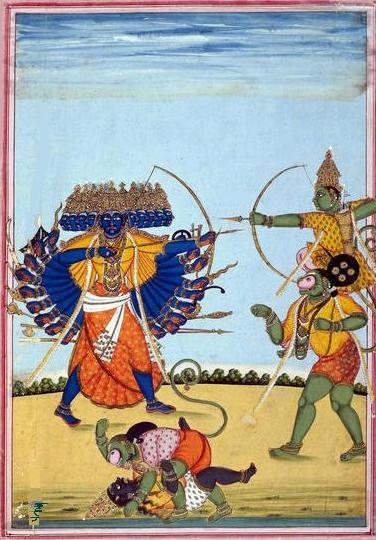
Rama defeating Ravana
Second (and especially in North India), Diwali celebrates the return after 14 years of exile of King Rama and his wife Sita and brother Lakshmana. The holiday marks their return after a war in which King Rama killed the demon Ravana.  Because it was dark as they returned, people lit oil lamps to light their way and thus the link of light over darkness. 

Third, in Bhavishyottara and Bramhavaivarta Purana holy writings, Diwali is associated with Daitya king Bali, who is allowed to return to earth once a year.

The Significance of the Five Days

For Hindus, each of the five days carries a different significance. The first day throughout India is customarily dedicated to honoring Dhanavantri (also called Dhanvantar), the physician of the gods and the source of the Ayurveda (in Sanskrit, “the complete knowledge for long life”). Because of its association with Dhanavantri, the first day of Divali is often known as Dhanteras and includes the ritual lighting of oil lamps and veneration of the goddess Laxmi in her owl form. As with most pujas, Lord Ganesha – the deity who removes obstacles – is given honor at the opening of the holiday.

Deepdaan


In many Hindu traditions, the first day of Diwali includes the ritual of Deepdaan in which worshipers light oil lamps for each member of their family and for often for their ancestors then set them afloat (usually) in a river or pond. Another Hindu tradition practiced in much of India is the giving of gold and jewelry gifts to bring about prosperity, making Diwali a major day for jewelers.  In northern India and Gujarat, many Hindus celebrate Yamadeepdaan in which lamps are dedicated to the god of death Yamraj (or Yam) and kept lit all night long. In the far south of India, many Hindus celebrate the days leading up to Diwali as Asweyuja Bahula Thrayodasi, dedicated to the god of finance Lord Kubera in which shopowners whitewash their business, recite a special mantra to Lord Kubera and give coins to honor the goddess Laxmi. In West Bengal, Diwali coincides with the Puja Kali. While the rest of India honors Laxmi on this day, in West Bengal, Hindus honor Kali the Destroyer goddess of time and change. 

Diwali fireworks

For many Hindu traditions, the second day of Diwali often begins with ritual bathing before the sun comes up, with an anointing of oil and scrubbing of the body with ubtan (a mixture of fragrances with grains or rough flour). In West Bengal, as part of the Puja Kali celebrations, the second day is observed as the day the goddess Kali destroyed the demon Raktavija. Regardless of tradition, this is the traditional day for cracking open crackers (of the sort used in Britain on Christmas Day) and for setting off of firecrackers. Many areas have major firework displays on the second day of Diwali.

Swami Dayananda Saraswati
The third day of Diwali for most Hindu traditions centers on the veneration of Laxmi. That said, the third day of Diwali also marks the anniversary of the death in 1883 of the founder of the Arya Samaj Hindu Reform Movement Swami Dayananda Saraswati.  The followers of the Arya Samaj therefore often mark the day as a day of remembrance for Swami Dayananda Saraswati.

Lord Krishna 
lifting Gorvardhan
The fourth day of Diwali is celebrated in many Hindu traditions with a special Govardhan Puja. This puja commemorates Lord Krishna’s defeat of the rain god Lord Indra by lifting Govardhan Mountain. Some interpretations (there are many variations) explain that Lord Krishna needed to defeat the Lord Indra because the rain god had become to arrogant and filled with self-pride. In doing so Lord Krishna taught worshipers to pray to more than just the rains by embracing the whole of nature. This celebration is also called Annakut (literally meaning “pile of grain”) because people in many parts of India decorate a mountain of grain symbolizing Govardhan Mountain.

On the fifth Day of Diwali comes the Bhai Duj or Bhai Teeka, a final day of celebration. On this day traditionally, brothers visit the houses of their sisters to honor them and bring gifts. Sisters in turn feed their brothers special delicacies. The celebration commemorates the visit on this day of the death god Lord Yama to his twin sister Yami (also called Yamuna or Yamini), the first woman. Lord Yama gave his sister a special gift that whoever visited her on this day would be cleared of sins.

Diwali in Jainism and Sikhism

As mentioned earlier, Diwali is not only practiced by Hindus. It is also a holiday for Jains and Sikhs. 

 
Diwali Traditions in Jainism

Lord Mahavira


In Jainism, Diwali is of particular significance. Jains, like Hindus, celebrate the holiday not only as the beginning of their New Year and as a time for a fresh start. Importantly, though, Jains also celebrate the holiday as the anniversary of Moksha (the attaining of nirvana) of Lord Mahavira, the founder of the religion.


Diwali Traditions in Sikhism

In Sikhism, Diwali is celebrated as a commemoration of the release from prison of the sixth Sikh Guru Hargobind Sahib Ji.  When Jahangir, the fourth Mughal emperor succeeded his father -- the famously religiously tolerant Akbar the Great. Although he was not a particularly devout Muslim, Jahangir  felt threatened by the non-Muslims in his empire, including the Sikhs but also many Hindus. As a result of his concerns regarding the Sikhs, Jahangir arrested Hargobind's father the fifth Sikh Guru Arjan Dev. Jahangir tortured Guru Arjan Dev for five days before having him killed. 

Release of Guru Hargobind Sahib Ji 
and the 52 Hindu Kings
At this point, the young Hargobind -- only eleven years old at the time -- became the sixth Sikh Guru. Jahangir arrested the young Guru Hargobind but did not kill him as he had killed his father. Instead, Guru Hargobind was imprisoned (along with 52 Hindu kings) at Gwalior Fort. He remained there from 1617 until Diwali of 1619 when Guru Hargobind and the Hindu kings were freed. It is this release from imprisonment that the Sikhs celebrate at Diwali. The holiday is commonly called Bandi Chorh Divas or Prisoner Release Day.

Concluding Remarks

This overview of Diwali is meant only as a very superficial summary. Also, nothing written here is meant to be an indication of one way or another as the proper or correct way to worship. This is meant solely as an attempt to provide a layperson's quick summary of Diwali. 

Because there are literally hundreds of separate traditions for celebrating Diwali, I could only cover a few here. Please do feel free to share any of your own traditions that I have not covered.

Whatever your tradition,  Happy Diwali! 


Want to learn more?

For Hindu traditions, you may wish to look at


For Sikh tradtions and the story of Guru Hargobind, turn to


For Jain traditions, turn to 


Lord Krishna defeating the demon Narakasura: http://en.wikipedia.org/wiki/File:Krishna_Narakasura.jpg


Release of Guru Hargobind Sahib Ji and the 52 Hindu Kings: http://jattsingh.com/wp-content/uploads/2011/10/Bandi-Chhorh-Divas.jpg


Saturday, August 29, 2015

Raksha Bandhan

Raksha Bandhan (or simply Rakhi) is a holiday celebrating the love between brother and sister in the Hindu, Jain and some Sikh traditions.  In 2017, the holiday falls on Monday, August 7.

Dating Raksha Bandhan

The holiday falls on the full moon of Shraavana, the fifth month of the Hindu calendar. Since the Hindu  and Gregorian (secular) calendars do not align, Raksha Bandhan seems to move around in the secular calendar. For instance, this year, 2017, the holiday falls on Monday, August 7. In 2015, it fell on Saturday, August 29; in 2014, the holiday fell on Sunday, August 10; in 2013 on August 21 and so on.

Raksha Bandhan Traditions

Raksha Bandan celebrates the special bonds between brothers and sisters.

Rakhi wristbands
On the morning of Raksha Bandhan, sisters tie a special string or band around the wrist of their brothers. The band is call a "rakhi" and may vary from a plain but brightly-colored string to an elaborately decorated wristband (or even a piece of jewelry for some people).  It is customary for both brother and sister to dress up in fine clothing for the ceremony and for the string to be tied while the rest of the family (parents, grandparents and so forth) watch the ceremony.

When the sister ties the band around, she says a prayer for the health and well-being of her brother. The sister performs aarthi, in which she ritually moves a lighted diya (stone or metal lamp) around her brother's face. After this, the sister place a tikka or tilaka (a mark of brightly colored powder or paste) on her brother's forehead.

After the sister finishes, the brother pledges to protect, honor and love his sister. In most traditions, the brother and sister then hug.  In most traditions, the sister then hand feeds her brother special sweets.

Mal puas 
Some of the most common sweets given include vermicelli kheer (dried pasta with cardamom, saffron, mal pua (a fried, sugary dumpling soaked in syrup).  Recipes for all of these can be found at the Society for the Confluence of Festivals of India's "Rakhi Recipes" website at: http://www.raksha-bandhan.com/rakhi-recipes.html
nuts and dried fruits), banana "cutlets,"and

In some traditions, the brother then feeds his sister sweets; in other traditions, the brother gives his sister some sort of gift such as clothing or something particular to her.
Nepalese kwati

In Nepal, instead of sweets, sisters feed their brothers kwati, a special soup for the holiday. Kwati is
made of the sprouts of nine plants: chickpea, soybean, field pea, garden pea, cowpea, field bean, rice bean, green lentil and black lentil

It is customary for the brother to wear the tikka mark and the rakhi wristband for the entire day to school or work.

Happy Raksha Bandhan!


Want to Learn More?

"Rakhi: The Thread of Love,"Hinduism: About.com: http://hinduism.about.com/od/rakhi/a/rakshabandhan.htm

"Raksha Bandhan," Society for the Confluence of Festivals in India: http://www.raksha-bandhan.com/rakhi-traditions-and-customs.html

"Raksha Bandhan…" Iam33now/Slices of my life: https://iam30now.wordpress.com/2013/08/21/raksha-bandhan/

"Rakshabandhan," Know India (India.gov): http://www.archive.india.gov.in/knowindia/culture_heritage.php?id=74

"What is Raksha Bandhan (Rakhi)?" BBC: Religion: http://www.bbc.co.uk/religion/religions/hinduism/holydays/raksha.shtml


Illustration Sources

Rakhi wristbands: https://iam30now.wordpress.com/2013/08/21/raksha-bandhan/

Mal puas http://www.raksha-bandhan.com/rakhi-recipes.html

Nepalese kwati: Karrattul, Wikipedia Commons: https://en.wikipedia.org/wiki/Kwati_%28soup%29#/media/File:Buba_kwati.jpg 

Happy Raksha Bandhan, techyhunt.com:
https://sp.yimg.com/ib/th?id=JN.DZXbK4AR68znosDMc%2fGUcQ&pid=15.1&P=0&w=300&h=300

Sunday, January 13, 2013

Year of the Black Water Snake: Some Background

Sunday, February 10, 2013 begins the Year of the Snake. It is the beginning of the year 4710 (in some traditions, 4711) in the Asian lunar system, which is the Year of the Black Water Snake.   

In today’s posting, I would like to share with you some specifics about the Year of the Snake as well as some background to the Asian Zodiac system as a whole.

That said, you may also be interested in reading three related posts on

1)  Lunar New Year Customs: Year of the Snake around the world at
http://davidvictorvector.blogspot.com/2013/01/lunar-new-year-celebrations-around.html

2)  Year of the Snake: Business Impact  at http://davidvictorvector.blogspot.com/2013/01/year-of-snake-business-impact_22.html

3) List of 88 Year of the Snake Festivals from 21 countries outside East Asia at
http://davidvictorvector.blogspot.com/2013/01/lunar-new-year-celebrations-around.html

In today’s posting, though, we look only at the background to the Year of the Snake specifically and the Asian Zodiac system as a whole.

The Asian Zodiac Briefly Explained

The Asian Zodiac (or horoscope) associated with the Asian or Chinese New Year is taken very seriously by those who follow it in their tradition. The significance attributed to the combinations associated with the Asian horoscope affect business decisions, dates selected for important events such as weddings, and many other aspects of daily life. These views are widely shared, with a larger following than any single religion -- Western or Eastern. As a result, these beliefs should be treated with the respect accorded a religious belief (rather than with that of superstition as Western astrology is sometimes treated).

The Lunar Calendar

Because the Asian lunar calendar follows the moon, it seems to move within our solar-based Gregorian calendar. Moreover, the Gregorian calendar does not correspond fully with the Asian lunar calendar. Thus, February 10  marks the beginning of the Asian lunar calendar only this year (for instance, it began last year on January 23, 2012 with the last day of that year -- Year of the Dragon -- falling on February 9, 2013).

The Twelve Animals of the Zodiac

The lunar calendar runs on a cycle of 12 years each represented by an animal.  The animals all have a balance of compatability or incompatability as represented in their place in the circle of the 12-year cycle. This year is the Year of the Snake.
The 12 Animals of the Zodiac


The 12 animals in their order are

  1. Rat
  2. Ox
  3. Tiger
  4. Rabbit
  5. Dragon
  6. Snake
  7. Horse
  8. Sheep
  9. Monkey
  10. Rooster
  11. Dog
  12. Pig

Each animal corresponds to a month of the lunar year. The dragon corresponds to the fifth animal in the cycle.

 Snake, Zhou Dynasty, 11-10 Century BCE, Boston Museum of Fine Arts

The Five Elements of the Wu Xing Cycle
Additionally, each 12-year cycle of animals runs on an additional cycle corresponding to the Wu Xing cycle of the five traditional Chinese elements. These are
  1. metal
  2. fire
  3. wood
  4. water
  5. earth
  6. Wu Xing Cycle


The five elements are in balance with each other, the basis of much of feng shui.

Each element is also associated with a color. In the case of water, that color is black (or in some instances blue).

Combined, each element combines with each animal over a period of 60 years.  The current 12-year cycle combines with the element of Water. Thus, this year is the Year of the Black Water Snake.  


Snake, Han Dynasty (202 BCE-220 CE), Shanghai Museum

Spiritual Importance of the Asian Horoscope

Many followers of the Asian zodiac have a formal religious belief in the importance of the animal element combinations associated with each year in the 60-year cycle. This is clearly the case for those practicing Taoism.

For Taoists, the New Year is always of religious significance. This because in Taoism, the Lunar New Year's first day is a time when lesser deities or spirits are believed to ascend to the throne of the Jade Emperor (King of Heaven).  In Taoist tradition, the 12 animals were in a contest to greet the Jade Emperor; a 13th animal – the cat – was tricked by the rat (about five variations of how exist), which explains why cats have hated rats ever since.  A children's version of this story is told in an very pleasant rendition at the Topmarks education site. I encourage you to take a look at this version at http://www.topmarks.co.uk/ChineseNewYear/ZodiacStory.aspx

The 12 Zodiac animals
in their race

The New Year is a religious event as well for a great number of the sects of Buddhism, and most famously for Tibetan Buddhists. In Buddhist tradition, the 12 animals were in a race to do honor to Lord Buddha on the eve of his death.  The rat and cat story is part of this tradition, too.  Incidentally, the rat was the first animal to greet Buddha.  He did so by helping the ox (which had poor eyesight) find his way across a stream by riding on his head.  When the two reach Lord Buddha on the other shore, the rat jumped off the ox’s head, reaching Lord Buddha first.  
Additionally, though Confucianism is not technically a religion (but rather a philosophical system) its followers also traditional observe the lunar New Year to show reverence to their ancestors.  Because of this, even Christians in countries such as Korea or Vietnam generally celebrate the holiday. The same holds true for those people in cultures with strong Confucian customs who have no religion at all or for those with mixed traditions.


Personality Traits and Asian Astrological Year


Detail from Snake with Skink (1877) by Kitagawa Utamaro 
Metropolitan Museum of Art, New York
Many people attribute a great deal of significance to the personality traits attributed to the animal associated with the year in which they are born.  Each animal has its own traits, and then each animal and element combination has their own subtraits. These are explained later in the blog.

The Year of the Snake is associated with good luck in general, and especially in issues of material wealth. For those who believe in the tradition, as with all Asian Horoscope years, those born in a previous Year of the Snake (e.g., 1929, 1941, 1953, 1965, 1977, 1989 or 2001) will find this year an especially auspicious year.

It is important to note that the animal of one’s birth year is not seen as fully able to stand on its own in understanding an individual’s personality traits and tendencies. These at a minimum must, as we have discussed, take into account the associated five elements. Additionally, East Asian astrologers account for the inner or secret animal assigned by the day of the month and hour of the day on which one is born.  In all, there are 8640 combinations (e.g., 12 months, 5 elements, 12 months, 12 times of day).

Snake by Ai Weiwei
Hirshhorn Museum, Washington, DC


Chinese Astrology Not A Particular Accurate Term

The system discussed here is often called Chinese astrology. This is a misnomer for two reasons.  First, the holiday is far more widely observed than in just China, especially in Korea, Singapore, Bhutan, Japan, Tibet, Mongolia and Vietnam as well as those from these backgrounds living in other countries.


I have described the holiday in general in this post. In a future post, I will discuss followed the culturally specific differences in customs at the close of this summary.


East Asian lunar zodiac
That said, for all the culturally diverse places in which the Asian New Year is celebrated, the calendar on which it is based does have its origins in China. The first written records of the calendar and the celebration of the New Year date to China’s Shang Dynasty (1766-1050 BC), although traditionally it is believed to date back to the rule of the semi-mythical Yellow Emperor Huang Di around 2600 BC.

A second reason the phrase Chinese astrology is a misnomer is that the system really has nothing to do with constellations as astrology does in the West. It is less a reading of the stars than an interpretation of the importance of the time, date and year in which one is born.  To the extent that when one is born matters to Western-style astrology, there is a correspondence. Moreover, there is another similarity as  the five elements in the system, in fact, do correspond with the five planets known in ancient China.

Because of these corresponding commonalities with Western astrology, people call the Asian system’s combinations of animals and elements the lunar or Chinese “horoscope”.  This is a bit of a misnomer, however, not only for the reasons just described but because the way in which people view the two “horoscopes” is very different.  

The difference is that many people in Europe, Australia and the Americas consider the Western zodiac horoscope of star signs (Scorpio, Sagittarius, etc.) to be a form of superstition, a game or something believed only partially. 

This is NOT the case with the Asian lunar horoscope cycle, where people follow their sign very seriously. As a result, the system, though it transcends that of any specific religion, should be treated with the respect accorded religious beliefs. In any case, the point here is that in a cross-cultural and inter-religious sense, the issue of lunar horoscope animal element signs should be treated with respect.

As one of many examples, it might be worth looking at an article last year that was widely distributed by the Associated Press. This was a report out of Seoul entitled “Year of Dragon could be China's time to lead Asia.” The article’s opening sentence reads:
This is the Year of the Dragon in China, one for bold decision-making and strong leadership, and one that may see the country emerge as the political power of Asian football. http://news.yahoo.com/dragon-could-chinas-time-lead-asia-020101296--spt.html  
The point of view of this article is significant, not because it tells us something about Chinese leadership in the world of football, but because those who take the Asian calendar seriously would consider this a newsworthy factor. Here the contrast to Western astrology is notable. Very few would cite the Western horoscope in such a fashion, let alone in an article widely distributed by the AP.

Shinzo Abe  
Nor was this an isolated oddity. For example, in a press conference on January 6, 2013, Japan's new Prime Minister Shinzo Abe said:

We want a rocketlike start toward economic recovery...The Year of the Snake symbolizes prosperous business. This administration will unite to boost the economy. http://www.asiaone.com/News/AsiaOne%2BNews/Asia/Story/A1Story20130106-393648.html
In a similar light, several business articles (both inside and outside of Asia) referred to Year of the Snake when making predictions on nations in East Asia. For just one example, an article on the Chinese economy in Bloomberg Business Week began,
Incoming President Xi Jinping may find China’s investment-driven economic recovery in the Year of the Snake jeopardized by mounting risks in the finance industry. http://www.businessweek.com/news/2013-01-02/china-poised-for-2013-rebound-as-debt-risks-rise-for-xi
The point of all of this is to emphasize that the importance of the lunar calendar and its animal cycle should be taken seriously.

Year of the Snake


 East Asia has no tradition
of the Serpent
as in this detail from
Lucas Cranach's
Adam and Eve (1526)

Courtauld Institute of Art, London
People born in the Year of the Snake have specific characteristics associated with them, a great many of which are considered very positive, such as gracefulness, intelligence and the ability (and drive) to attain material possessions.

In the East Asian tradition, the snake is generally a positive, second only to its close kin the dragon as a the symbol of good luck and material wealth.  In East Asia, no tradition of the snake as evil exists. There is no association of the snake or serpent with the banishment from the  Garden of Eden tradition of the Western religions.
Unlike the Jewish, Christian and Islamic tradition of evil serpents tempting Eve into sin, Asian religions -- most notably Hinduism, Jainism, Taoism and Buddhism -- view snakes as one of protection.


 Vishnu sheltered by the snake Adishesha
Parsurameswar Temple
Bhupaneswar, Orissa, India
In Hinduism, snakes -- especially cobras -- are associated with several dieties. Vishnu is often sheltered by the five-headed cobra Adishesha. Similarly, Ganesha is often shown with a snake encircling is stomach. Likewise Shiva is often depicted with a cobra wrapped around his neck as he dances. The Hindu festival of Nag Panchami venerates lives snakes or images of them.

 Cobra shading Parsvanatha
India, 12th Century
Victoria and Albert Museum, London
In Jainism too, snakes hold a protective role. The 8th century Parsvanatha -- Jainism's 23rd Jina -- is usually shown with a seven-hooded cobra shading his head.

Since the Asian Lunar Calendar deals primarily with Taoist and Buddhist roots, though, it is the view of these two faiths toward snakes that carries the most importance here, and in both Taoism and Buddhism snakes are also viewed favorably.
Jade Emperor
Jade Emperor Temple
Ho Chi Minh City, Vietnam
In the Taoist tradition, the Jade Emperor gave the snake the second place of honor, behind only the dragon, that most-favored of all the 12 animals. Originally, the snake was not favored at all by the Jade Emperor. The snake was angry and began biting people and other animals. Man-Ho Kwok in his book on Chinese Astrology (listed in the bibliography below) relates the rest of this Taoist tale regarding the snake and the Jade Emperor as follows:

Although the snake was summoned before the Jade Emperor and asked to stop [his angry ways], he was an obstinate animal and he continued. As a punishment, his four legs were taken from him... Ashamed by his past behaviour, the snaked turned his efforts towards helping the people in an attempt to redeem himself. He helped his relative, the dragon, to control the rains and he donated his body to be used as medicine after his death. Impressed, the Emperor gave the snake a place just after the dragon in the animal signs. (Kwok, p. 22)

Buddha on coiled naga snake
Wat Chedi Jet Thaew, Thailand

The view of snakes is likewise positive in Buddhism. It was a great cobra, for instance, that protected the Buddha under the mucalinda tree during the sixth week after his enlightenment. As recounted by the Buddha Dharma Association's "Life of the Buddha" on Buddha.net, the story goes:

The Buddha then went and meditated at the foot of a mucalinda tree. It began to rain heavily and a huge king cobra came out and coiled his body seven times around the Buddha to keep him warm and placed his hood over the Buddha’s head to protect him from the rain. After seven days the rain stopped and the snake changed into a young man who paid his respects to the Buddha.  http://www.buddhanet.net/e-learning/buddhism/lifebuddha/17lbud.htm

Indeed, one of the most visited pilgrimage sites in Buddhism is the site of the Buddha's enlightenment at Bhodghaya in India's Bihar state. There in Muchalinda Lake is a statue of the cobra Muchalinda shading the Buddha at what believers hold to be the exact spot where the event took place.
 
 Muchalinda shading the Buddha 
Muchalinda Lake, Bhodghaya, Bihar
Guardian naga
Angkor Wat, Cambodia
Because of this relationship with the Buddha at Bhodghaya, snakes frequently depicted as protecting entities in Buddhist Temples. This is particularly the case in the Buddhist traditions of Southeast Asia, especially in Thailand, Laos, Cambodia and Burma.  In these traditions, the snakes are known as the temple guardian nagas. Nagas, for example, are a common feature of the famous temple at Angkor Wat in Cambodia. 

All of this is to explain that in the Asian tradition, snakes are viewed quite differently than they are customarily seen in Europe, Australia and the Americas. While snakes are respected and treated with caution, they have on the whole a postive image in much of Asia. 


Personality Traits Associated with Year of the Snake
It is important, again, to emphasize that for many people, the traits described here are taken very seriously and, by many others, at least somewhat seriously. The descriptions that follow are general traits. Professional astrologers in East Asia bore down through the specific year in the 60-year cycle (the element), the specific day and the specific hour of birth. As mentioned above, this produces 8640 possible permutations. The characteristics of any given year's zodiac animal, therefore, is considered by believers to be a very general influence.

Positive Snake Traits

Snake netsuke
Japan, 19th Century
Ashmolean Museum, Oxford
Those born in the Year of the Snake are – on the positive side -- considered to be naturally graceful, quick-witted and particularly good at acquiring material possessions. People born under the sign of the snake are extreme sophisticates. As the Chinesezodiac.org site puts it,

They are physically striking and often have a wonderful sense of personal style. They are independent and rather private people who follow their own path, no matter what others think. http://www.chinesezodiac.org/snake
Snake people are thought to be at once the most enigmatic as well as the most intellectual of the signs. As one online site explains:


Snake is the wisest, deepest thinker, most enchanting and biggest enigma of the Chinese cycle. Snake people are endowed with deep philosophical understanding. They are born thinkers who excel in finding solutions to complex problems. They make deals and do the killing when they judge the moment is right. Depth and charisma make the Snake a formidable presence. What you see is not what you get. http://chinesehoroscop-e.com/Snake%20Zodiac.html

In contrast to the Western folk views of snakes, the East Asian zodiacal version of the snake is something akin to a mix of the Western folklore regarding the owl and fox: wisdom and slyness.

Buddha with snakes, Mandalay, Myanmar
Negative Traits
On the negative side, people born in the Year of the Snake are believed to be loners to a fault. As the Suite 101 article "Chinese Zodiac Signs" explains:


Snakes, being loners, usually rely on themselves to get ahead in life. They tend to mistrust the thoughts and opinions of others on important matters. Snakes tend to make decisions based on their own deeply held feelings and intuition, rather than on facts. http://suite101.com/article/chinese-zodiac-signs-year-of-the-snake-a343471
People born in the Year of the Snake, in the view of believers, are the most complex of all the zodiacal signs. This is illustrated in a complex mix of stinginess tied up with an overly generous trait for those they do help. This, in turn, leads to a negative possessiveness to those of whom they choose to take care. As one Chinese Astrology site puts it:
Snakes are a bit tight when it comes to lending money, though his sympathy for others often leads him to offer help. The fatal flaw in his character is, in fact, a tendency to exaggerate – in helping friends as with everything else. If he does somebody a favor, he becomes possessive towards them in an odd way. http://www.chinesezodiac.org/snake
 
Paiwan wooden snake
Late 19th Century Taiwan
Metropolitan Museum of Art, New York

Finally, people born in the Year of the Snake are viewed as complex in terms of love relationships as well. As Man-Ho Kwok (see bibliography) writes, people born in the Year of the Snake:
have a very seductive nature, and when you have resolved to woo someone, you plan your moves carefully and do not abandon your quest lightly. You are a humorous and romantic partner who jealously guards important relationships; even if you wander off to flirt with others, you are determined not to lose what you already have.    p. 23.

As for the year governed by the snake, the complicated characteristics that govern the people also, for believers, will govern the year. Things as they appear on the surface, believers hold, are not what actually are likely to be in reality. As a result, years governed by the snake are years for thinking carefully before acting.

Black Water Dragon

This year, 2012, as noted before, is the Year of the Black Water Year. 

Because snakes are the sign of intellect and water is the element most associated with education, the Water Snake Years are supposed to be exceptional years for research, scientific breakthroughs and learning in general. 

 As the popular site Chinese Astrology.com puts it:
This is a good time for me to say this is a Water year. And that’s the element most closely associated with education and research. So Water reinforces the Snake’s influence in this area, making 2013 a very special year for scientists and scholars. http://www.onlinechineseastrology.com/horoscopes/horoscope-2013-Year-Of-The-Snake.aspx


The professional astrologist Paul Ng takes this further, balancing the year within the 60-year cycle. Ng explains that this is the Mountain-Wind Urn year in that cycle, with an uneven balance of yin and yang (2 yang influences as against 4 yin ones). He suggests:
While the outside seems to be solid, the inside is empty. Hence it is a year of conservation, a year of rebuilding and a year of changes. http://www.paulng.com/CMS/uploads/2013-geo.pdf
Please read about the other posts on the blog on Asian New Year traditions from country to country at

http://davidvictorvector.blogspot.com/2013/01/lunar-new-year-celebrations-around.html

Happy Year of the Snake!


Want to Learn More

Chinese Horoscop-e.com, "Snake"  http://chinesehoroscop-e.com/Snake%20Zodiac.html

Chinese Zodiac.org, "Year of the Snake" http://www.chinesezodiac.org/snake

Man-ho Kwok, Chinese Astrology: Forecast Your Future from Your Chinese Horoscope, Tuttle Publishing, 1997.

Theodora Lau, The Handbook of Chinese Horoscopes (6th edition), Collins Reference, 2007.

Kah Joon Liow, "12 Chinese Zodiac Sign," Living Chinese Symbols http://www.living-chinese-symbols.com/12-chinese-zodiac-sign.html

Paul Ng, "Predictions for 2013 (Year of the Water Snake)" http://www.paulng.com/CMS/uploads/2013-geo.pdf
Online Chinese Astrology http://www.onlinechineseastrology.com/

Neil Somerville, Your Chinese Horoscope 2013, Harper Collins, 2012.

Topmarks Education, "Zodiac Story, Chinese New Year."  http://www.topmarks.co.uk/ChineseNewYear/ZodiacStory.aspx

David Twicken, Five Element Chinese Astrology Made Easy, iUniverse, 2000.

Suzanne White, The New Chinese Astrology, Thomas Dunne Books, 2009.

Shelly Wu, Chinese Astrology: Exploring the Eastern Zodiac, New Page Books, 2005.

Derek Walters, The Complete Guide to Chinese Astrology, Watkins Publishing, 2005.
Ho-Peng Yoke, Chinese Mathematical Astrology: Reaching Out to the Stars, Routledge, 2003. This is the pre-eminent book on the mathematical science of Asian lunar horoscope calculations. It is downloadable at http://www.ebook3000.com/Chinese-Mathematical-Astrology--Reaching-out-for-the-stars--Needham-Research-Institute-Series-_130932.html

Xiaosui Zhao and Graeme Mills, "Chinese Zodiac -- Year of the Snake" http://kaixin.com.au/chinese-zodiac/2010/10/18/chinese-zodiac-year-of-the-snake-she.html

Clip Art Sources:

Wu Xing Cycle: http://upload.wikimedia.org/wikipedia/commons/thumb/f/f0/Wuxing_en.svg/220px-Wuxing_en.svg.png

Yin Yang animation: http://www.eharrishome.com/Kungfu.html

The 12 Zodiac animals in their race:  http://media.photobucket.com/image/recent/firefoxthief/zodiaccolor.jpg'
 
Snake with Skink (1877) by Kitagawa Utamaro, Metropolitan Museum of Art, New York: http://www.metmuseum.org/collections/search-the-collections/60001395

Snake by Ai Weiwei, Hirshhorn Museum, Washington, DC: http://www.hirshhorn.si.edu/collection/ai-weiwei-according-to-what/#detail=/bio/ai-weiwei-snake-ceiling-2009/&collection=ai-weiwei-according-to-what

East Asian Lunar Zodiac:  http://www.china-family-adventure.com/chinese-zodiac.html


Shinzo Abe at January 2013 Press Conference: http://www.asiaone.com/News/AsiaOne%2BNews/Asia/Story/A1Story20130106-393648.html

Lucas Cranach's Adam and Eve (1526), Courtauld Institute of Art, London: http://www.courtauld.ac.uk/gallery/collections/paintings/renaissance/cranach.shtml

Cobra shading Parsvanatha , India, 12th Century, Victoria and Albert Museum, London: http://www.vam.ac.uk/content/articles/j/jainism-jinas-and-other-deities/

Vishnu sheltered by five-headed snake Adishesha, Parsurameswar Temple, Bhupaneswar, Orissa, India:  http://en.wikipedia.org/wiki/File:Bishnu.jpg


Jade Emperor, Jade Emperor Temple, Ho Chi Minh City, Vietnam, photo by Glyn John Willett, Virtual Traveler: http://members.virtualtourist.com/m/p/m/1fc5d7/

Buddha on coiled naga snake, Wat Chedi Jet Thaew, Thailand: http://sukhothai.thaiwebsites.com/watchedijetthaew-sisatchanalai.asp

Muchalinda shading the Buddha, Muchalinda Lake, Bhodghaya, Bihar: http://www.touristlink.com/india/muchalinda-lake/overview.html

Naga at Angkor Wat: http://www.lonelyplanet.com/travelblogs/241/157377/A+Little+History%E2%80%A6Myths+and+Spirits+in+Modern+Myanmar?destId=357592

Red snake design at start of personality trait description: http://kaixin.com.au/chinese-zodiac/2010/10/18/chinese-zodiac-year-of-the-snake-she.html

Snake netsuke, Japan, 19th Century, Ashmolean Museum, Oxford University: http://jameelcenter.ashmolean.org/collection/4/1238/1242/6405

Buddha with snakes, Mandalay, Myanmar: http://www.allmyanmar.com/Mandalay-Images.htm

Paiwan wooden snake, Late 19th Century Taiwan. Metropolitan Museum of Art, New York: http://www.metmuseum.org/Collections/search-the-collections/50008838?rpp=20&pg=1&ao=on&ft=snake&where=Asia|Taiwan&pos=1

Black water snake: http://en.wikipedia.org/wiki/File:Snake.svg

Closing year of snake image:  http://www.freepik.com/free-vector/wind-chinese-year-of-the-snake-card-vector-material_609894.htm