Welcome to the David Victor Vector Blog

Welcome to the David Victor Vector blog. This is blog that covers religious observances around the world international affairs and global business. This blog describes religious holidays for most major religions as well as raising issues dealing with globalization, international business ethics, cross-cultural business communication and political events affecting business in an integrated world economy. I look forward your discussion and commentary on these articles and subjects. Enjoy!
Showing posts with label religious holidays. Show all posts

Thursday, November 4, 2021

Diwali

For 2021, the Hindu, Jain and Sikh celebration of Diwali begins on Thursday November 4 and will continue for five days through Tuesday November 9.

The festival of Diwali  (also called as Deepavali, Deepawali, Divali, Devali and -- in Nepal -- Tihar or Swanti) is the most important holiday in the Hindu calendar. It is also an important holiday for Jains and Sikhs. 

For most people, the holiday should not affect class or work attendance, but may be observed by many students who practice one of these three religions.

Diwali marks the last day of the Hindu calendar.  The holiday can last up to five days and celebrates (at least in part) the victory of light over darkness and good over evil. In much of India (and especially in the North), the business community starts their financial new year with the holiday, and it is the beginning of the fiscal year. 

Diwali is celebrated throughout the Hindu world, regardless of region (which is not always the case for other holidays).  Divali is an official holiday not only in India and Nepal which both of majority Hindu populations, but also in Bali, Singapore, Sri Lanka, Trinidad & Tobago, Malaysia, Guyana, Mauritius and Fiji. Likewise, Diwali is observed by throughout the world, wherever there are Hindus, Sikhs and Jains.

Diwali Traditions
Diya


Various traditions for celebrating Diwali include lighting of oil lamps (diyas or jyothis), setting off of fire crackers, exchanging and eating decorated sweets, gathering at people's holiday-decorated homes in celebration and visiting temples.   

Narkasur dancing, Goa
While lighting diyas is universal and gif exchanges are fairly universal. often different regios have different traditions. For instance, in Goa the battle in which Lord Krishna defeats the demon Narkasur is commemorated. This often takes the form of burning an effigy of the demon Narkasur, often accompanied by drumming.  Contests are held in which prizes awarded to those with the best battle depiction as well as best costumes. Likewise, it is common in Goa for those dressed as the demon Narkasur to dance outside people's homes. I have a Goan friend who shared who Narkasur would frighten him and the other children until the burning of the Narkasur effigy showed victory of good over evil.

In much of South India, Diwali begins with Abhyanga Snan, a ritual oil bath. The bath, usually a massage using sesame oil, is thought to rid the body of toxins and pollutants to give one a fresh start for the new year, and to balance the pitta or fire energy. Pitta is one of the five basic elements of Ayurveda.

In Bengal. Odisha and Assam, Diwali coincides with Kali Puja. While most Hindus worship Laxmi and Ganesha on this day, eastern Indians give honor to Kali, the goddess of death. Unlike many Divali worship traditions which predate historic records, the combination of Kali Puja on the date of Diwali dates only back to the 1600s ("only" in Indian terms means that 500 years is not that long ago, as opposed to North American and Australian views, for instance). For Kali Puja, devotees set up altars (pandals) with sculptures of the goddess Kali (and often accompanied by Lord Shiva the Destroyer, who is her consort. Devotees offer Kali red hibiscus flowers, rice and lentils. Kali Puja rituals takes place at night in darkness -- the opposite of the Diwali worship of light.   Worship at major temples in East India also are centers of worship on Kali Puja. Of particular note are those temples specifically devoted to Kali. Among these is the Kali Temple in Kolkatta's Kalighat district, which is a major Shakt Pita (pilgrimage site). Other notable temples devoted to Kali are the Kripamayee Kali Temple in Baranagar, West Bengal and Bjadrakali Temple in Aharapada in Odisha.

In different parts of India, the holiday is marked by the giving of gifts of new utensils (especially cooking utensils), wearing of new clothes and/or the cleaning and painting of homes or workplaces. Many cities and towns also hold Diwali melas or open-air fairs during Diwali. 

Diwali and the Economy

Because gift-giving and gathering with family are major components of Diwali, the holiday has an impact on the economy in India, Nepal, Mauritius, Sri Lanka, Fiji, Bali and other areas with large Hindu populations. The effect is comparable to Christmas season in Christian country and the lunar New Year in East Asia.

The pandemic severely affected spending in 2020, although some improvement is anticipated for 2021. 


YouGov India followed spending during the pandemic. In 2020, over half (54%) of Indians spent less than the previous year. That figure is expected to improve for 2021 (with only 31% saying less and 28% saying the same), but this is still not expected to be back to normal yet.

Laxmi and Ganesha

For most Hindu traditions, Laxmi (or Lakshmi), the goddess of prosperity is especially revered on Divali. With homes with children, people often leave female footprints on the floor after the children have gone to sleep so that when they wake up they will see that the goddess Laxmi has visited the home in the night.


Laxmi footprints


Since her devotees invited Laxmi to visit their homes on Diwali, some traditions include setting up a greeting pylon at the main gate to one's courtyard or entrance to one's home to welcome her. Laxmi's worshippers usually decorate the pylon with flowers and painted parts from local plants such as mango or banana leaves.
Welcoming pylon with painted banana leaves


Likewise given special reverence is Lord Ganesha, the elephant-headed god of prosperity and wealth. This makes reverence for Ganesha particularly appropriate since it is customary at Diwali to ask for good fortune and wealth for the coming year.  

Moreover, the history of the goddess Laxmi and the god Ganesha are particularly intertwined. Because Laxmi was childless, she adopted Ganesha from his mother Parvati. When Laxmi did so, she pronounced that all of her prosperity and luxury would belong equally to Ganesha. Laxmi also proclaimed that those who do not worship Ganesha with her will never achieve wealth in their lives. Also connected to the worship of of Ganesha is the tradition that he is the most righteous deity. 

Diwali oil lamps set before Laxmi and Ganesha

Traditional foods
 
Gulab jaman
Special foods are often eaten. Some of these are widely eaten throughout India. For instance, regardless of region, it is customary to eat things that are sweet such as gulab jaman, which is usually made of milk dough soaked in rosemary, sugar syrup and cardamom. A recipe for gulab jaman can be found at:

http://www.cooks.com/rec/view/0,1613,158184-243192,00.html

Poha
Also, specialties made with cashews or pistachios are also widely eaten for Diwali. In much of India, delicacies are made from Lord Krishna’s favorite food Poha (also called Foav or Pauva) which is pounded semi-cooked sweetened rice and eaten on the second day of the festival. 

Other Diwali food specialties are more regional.  For example, in much of the north of India, people eat patandas made of flour, unprocessed sugar cane and ghee as well as poodas (or mal poohas) made of flour and sugar syrup and eaten with chutney. 


Sel roti
In Nepal, the traditional treat for Tihar (the Nepali name for Diwali) is called sel roti. Made of rice flour, milk and ghee and (depending on custom) flavored with cardamom or clove, the sel roti is somewhat like a thin, circular doughnut. Many Nepalis exchange sel roti with one another as gifts throughout Tihar. A recipe for sel roti can be found at 

http://www.indobase.com/recipes/details/sel-roti.php 

In the far south of India, many sweets are eaten leading up to Diwali and into the first day, notably those made from honey and unprocessed sugar cane.   
Mawa Kachori
In Maharashtra a special mix of cane sugar and coriander seeds is customarily eaten on the first day. In Rajasthan, many people traditionally begin the holiday by eating Mawa Kachori, a puffed pastry made with sweetened evaporated milk (mawa) and nuts. A recipe for Mawa Kachori can be found at: 


Religious Significance Diwali

Lord Krishna defeating Narakasura
Metropolitan Museum of Art, New York 
Hindu Traditions 

Diwali has three main Hindu religious stories attached to it.  While some Hindu traditions have other associations as well, these three are the most widespreaed.


First (and especially in South India), the holiday of Diwali commemorates the victory of Lord Krishna over the demon king Narakasura, and so the victory of good over evil. Narakasura -- himself a son of Vishnu -- had become power-crazed overwelming Indra and other Vedas. He also became horribly abusive to women, enraging Krishna's wife Stayabhama and her relative Aditi. At the pleading of the Vedas and Aditi, Krishna attacked the demon. Riding on the battle-eagle Garuda, Krishna withstood various attacks from the armies of Narakasura, then withstood the thunderbolts and trident attacks of Narakasura himself. Krishna then used his discus to behead the demon king. Before dying, though, Krishna was asked to celebrate the anniversary of his death as a holiday, to which Krishna agreed. As a result, the first day of Diwali is celebrated as such. 

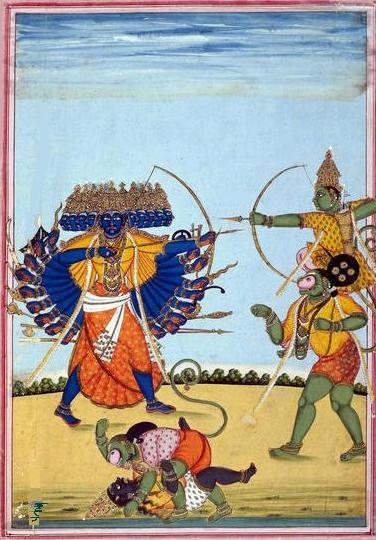
Rama defeating Ravana
Second (and especially in North India), Diwali celebrates the return after 14 years of exile of King Rama and his wife Sita and brother Lakshmana. The holiday marks their return after a war in which King Rama killed the demon Ravana.  Because it was dark as they returned, people lit oil lamps to light their way and thus the link of light over darkness. 

Third, in Bhavishyottara and Bramhavaivarta Purana holy writings, Diwali is associated with Daitya king Bali, who is allowed to return to earth once a year.

The Significance of the Five Days

For Hindus, each of the five days carries a different significance. The first day throughout India is customarily dedicated to honoring Dhanavantri (also called Dhanvantar), the physician of the gods and the source of the Ayurveda (in Sanskrit, “the complete knowledge for long life”). Because of its association with Dhanavantri, the first day of Divali is often known as Dhanteras and includes the ritual lighting of oil lamps and veneration of the goddess Laxmi in her owl form. As with most pujas, Lord Ganesha – the deity who removes obstacles – is given honor at the opening of the holiday.

Deepdaan


In many Hindu traditions, the first day of Diwali includes the ritual of Deepdaan in which worshipers light oil lamps for each member of their family and for often for their ancestors then set them afloat (usually) in a river or pond. Another Hindu tradition practiced in much of India is the giving of gold and jewelry gifts to bring about prosperity, making Diwali a major day for jewelers.  In northern India and Gujarat, many Hindus celebrate Yamadeepdaan in which lamps are dedicated to the god of death Yamraj (or Yam) and kept lit all night long. In the far south of India, many Hindus celebrate the days leading up to Diwali as Asweyuja Bahula Thrayodasi, dedicated to the god of finance Lord Kubera in which shopowners whitewash their business, recite a special mantra to Lord Kubera and give coins to honor the goddess Laxmi. In West Bengal, Diwali coincides with the Puja Kali. While the rest of India honors Laxmi on this day, in West Bengal, Hindus honor Kali the Destroyer goddess of time and change. 

Diwali fireworks

For many Hindu traditions, the second day of Diwali often begins with ritual bathing before the sun comes up, with an anointing of oil and scrubbing of the body with ubtan (a mixture of fragrances with grains or rough flour). In West Bengal, as part of the Puja Kali celebrations, the second day is observed as the day the goddess Kali destroyed the demon Raktavija. Regardless of tradition, this is the traditional day for cracking open crackers (of the sort used in Britain on Christmas Day) and for setting off of firecrackers. Many areas have major firework displays on the second day of Diwali.

Swami Dayananda Saraswati
The third day of Diwali for most Hindu traditions centers on the veneration of Laxmi. That said, the third day of Diwali also marks the anniversary of the death in 1883 of the founder of the Arya Samaj Hindu Reform Movement Swami Dayananda Saraswati.  The followers of the Arya Samaj therefore often mark the day as a day of remembrance for Swami Dayananda Saraswati.

Lord Krishna 
lifting Gorvardhan
The fourth day of Diwali is celebrated in many Hindu traditions with a special Govardhan Puja. This puja commemorates Lord Krishna’s defeat of the rain god Lord Indra by lifting Govardhan Mountain. Some interpretations (there are many variations) explain that Lord Krishna needed to defeat the Lord Indra because the rain god had become to arrogant and filled with self-pride. In doing so Lord Krishna taught worshipers to pray to more than just the rains by embracing the whole of nature. This celebration is also called Annakut (literally meaning “pile of grain”) because people in many parts of India decorate a mountain of grain symbolizing Govardhan Mountain.

On the fifth Day of Diwali comes the Bhai Duj or Bhai Teeka, a final day of celebration. On this day traditionally, brothers visit the houses of their sisters to honor them and bring gifts. Sisters in turn feed their brothers special delicacies. The celebration commemorates the visit on this day of the death god Lord Yama to his twin sister Yami (also called Yamuna or Yamini), the first woman. Lord Yama gave his sister a special gift that whoever visited her on this day would be cleared of sins.

Diwali in Jainism and Sikhism

As mentioned earlier, Diwali is not only practiced by Hindus. It is also a holiday for Jains and Sikhs. 

 
Diwali Traditions in Jainism

Lord Mahavira


In Jainism, Diwali is of particular significance. Jains, like Hindus, celebrate the holiday not only as the beginning of their New Year and as a time for a fresh start. Importantly, though, Jains also celebrate the holiday as the anniversary of Moksha (the attaining of nirvana) of Lord Mahavira, the founder of the religion.


Diwali Traditions in Sikhism

In Sikhism, Diwali is celebrated as a commemoration of the release from prison of the sixth Sikh Guru Hargobind Sahib Ji.  When Jahangir, the fourth Mughal emperor succeeded his father -- the famously religiously tolerant Akbar the Great. Although he was not a particularly devout Muslim, Jahangir  felt threatened by the non-Muslims in his empire, including the Sikhs but also many Hindus. As a result of his concerns regarding the Sikhs, Jahangir arrested Hargobind's father the fifth Sikh Guru Arjan Dev. Jahangir tortured Guru Arjan Dev for five days before having him killed. 

Release of Guru Hargobind Sahib Ji 
and the 52 Hindu Kings
At this point, the young Hargobind -- only eleven years old at the time -- became the sixth Sikh Guru. Jahangir arrested the young Guru Hargobind but did not kill him as he had killed his father. Instead, Guru Hargobind was imprisoned (along with 52 Hindu kings) at Gwalior Fort. He remained there from 1617 until Diwali of 1619 when Guru Hargobind and the Hindu kings were freed. It is this release from imprisonment that the Sikhs celebrate at Diwali. The holiday is commonly called Bandi Chorh Divas or Prisoner Release Day.

Concluding Remarks

This overview of Diwali is meant only as a very superficial summary. Also, nothing written here is meant to be an indication of one way or another as the proper or correct way to worship. This is meant solely as an attempt to provide a layperson's quick summary of Diwali. 

Because there are literally hundreds of separate traditions for celebrating Diwali, I could only cover a few here. Please do feel free to share any of your own traditions that I have not covered.

Whatever your tradition,  Happy Diwali! 


Want to learn more?

For Hindu traditions, you may wish to look at


For Sikh tradtions and the story of Guru Hargobind, turn to


For Jain traditions, turn to 


Lord Krishna defeating the demon Narakasura: http://en.wikipedia.org/wiki/File:Krishna_Narakasura.jpg


Release of Guru Hargobind Sahib Ji and the 52 Hindu Kings: http://jattsingh.com/wp-content/uploads/2011/10/Bandi-Chhorh-Divas.jpg


Friday, September 18, 2020

Rosh HaShanah 2021

For 2021, the Jewish New Year, Rosh HaShanah, begins on Monday September 6 at sundown and concludes at sunset -- depending on practice -- either on Tuesday September 7 or Wednesday September 8. For Orthodox and Conservative Jews, the holiday lasts for two days concluding at sundown on September 8. Many Reform and Reconstructionist Jews, however, observe the holiday only for one day (so for them, the holiday would conclude at sundown on September 7).


While definitions vary as to levels of practice from person to person, work is prohibited during the holiday. For Orthodox and most Conservative Jews, this is defined generally as no manner of work whatsoever (including school, telephone use, email, Internet surfing, etc.) during RoshHaShanah.  


Because some Jews observe only one day, it is easy to make the mistake that the second day is not as important to those Jews observing both days.  But for Conservative and Orthodox Jews, the two days are equally important and indeed can be understood as a single very long day.  


Rosh Ha Shanah and the Pandemic


Last year, 2020, amid the height of the pandemic, many temples and synagogues held video services either streamed or recorded. For many where COVID restrictions remain in place, the same will be done in 2021. Where pandemic restrictions  have been lifted, many congregations allow for a mix of streaming, Zoom or in person worship. Among Orthodox, this is controversial because of the ban on using the computer. Last year after formal rabbinic rulings, most Conservative Jews formally allowed some type of Zoom or streaming broadcast of services (including Saturday Sabbath services). By contrast, most Orthodox have not allowed the use of technology. Some Orthodox groups have attempted ways around the ban and the situation remains fluid. This current situation among Orthodox Jews is explained well in Irene Connelly's article here


The Jewish New Year and Its Significance

Rosh HaShanah is the Jewish New Year; the Hebrew means “Head of the Year.” This year is 5781 in the Jewish reckoning. 


Unlike the secular New Year, Rosh HaShanah is a very solemn day as it is the day Jews ask God for forgiveness for sins of the past year.  Perhaps the only similarity to the secular New Year is that many Jews make resolutions to lead a better life in the coming year.  Most of the day is spent in the synagogue or temple. 


Together with Yom Kippur (the Day of Atonement) which occurs 10 days later (beginning this year on September 15 at sunset), Rosh HaShanah forms part of what are called the High Holy Days. The days between RoshHaShanah and Yom Kippur are known as the Yamim Noraim (or “Days of Awe”) which act as days of repentance. 


Generally speaking, the High Holy Days are the most important days of observance in Judaism. Among observant Jews, traditionally, the weekly observance of the Sabbath on Saturdays is the most important Jewish holiday. In practice, though, for many Jews who do not regularly attend weekly Sabbath services, the High Holy Days often take place of prominence.  (Please note that I am in no way attempting to take a stance on what is or is not proper observance for any religion in these updates, but rather simply trying to make the general community aware of the various religious practices as they affect activities for employees, students or others).    


While Rosh HaShanah, like all Jewish holidays, appears to wander in the secular calendar, this is only because the secular calendar is not consistent with the Jewish calendar. In the Jewish calendar, though, the holiday actually occurs on the same day of the Jewish calendar.  


Interestingly, Rosh HaShanah does not occur at the beginning of the Jewish calendar; rather, it occurs on the first two days of Tishrei, the seventh month (not the first).  This seeming inconsistency rests in the Jewish concept of four different yearly cycles described in the Jewish Talmud. Rosh HaShanah represents the new year for relationships among people (including legal contracts) as well as for animals. The day marks the anniversary of the sixth day in the Creation story in which God created Adam and Eve, the first people. There is considerable variance among Jews as to whether this anniversary of the creation of humankind is viewed as the literal date or simply a symbolic anniversary. 


In the Jewish Torah (first five books of the Bible), the name “RoshHaShanah” never appears for the holiday. Instead, the Torah refers to the holiday as either the Zicaron Terua or “remembrance of the blowing of the horn” (as in Leviticus 23:24) or as the Yom Terua or “day of the blowing of the horn” (Numbers 29.1). Even in the Jewish liturgy of prayers used for the day,  Rosh HaShanah is generally referred to either as the Yom HaZikaron (the “Day of Remembrance”) or the Yom HaDin (“Day of Judgment”).


The Shofar


 Ram's horn shofar

The horn referred to above is called a shofar. The blowing of the shofar is a central part of the religious observance of the holiday of Rosh HaShanah (and concludes the service on Yom Kippur).


Here too the COVID-19 restrictions come into play. For all Orthodox and most Conservative Jews, listening to a recording (including a live-stream or broadcast) of the shofar blast does not fulfill the commandment of hearing the shofar in person. 


Blowing shofar above synagogue entrance
Congregation Beth Shalom, Pittsburgh
 
Yet blowing the shofar spreads airborne particles, increasing the risk of disease spread. Numerous strategies have come into use. Blowing the shofar outdoors. Other strategies for indoor use include blowing the shofar behind a curtain or in a separate room apart from the congregation. In a combination of the indoor/outdoor strategies, some congregations in 2020 had the shofar blower stand outside the building while the congregants sat inside the building with the windows open. 


Traditionally among Jews of Eastern  and Central European origin, the shofar is made from a ram’s horn. This is also the majority choice among the Jews of the United States, Canada and Australia. 


Among those Jews using a ram's horn, one of the associations of the ram's horn is with the Biblical story of the ram that appeared to Abraham at the binding of Isaac in the Book of Genesis:

And Abraham lifted up his eyes, and looked, and behold behind him a ram caught in the thicket by his horns.                                   -- Genesis: 22:13

Yemenite kudu horn shofar

That said, other animal horns such as those of antelopes are allowable. In fact, among Yemeni Jews, the shofar is customarily made from the long, curlicued horn of the kudu antelope.  This was also the practice among the Jews of Iraq for centuries until their expulsion in 1951, following the founding of the state of Israel.


Goat horn shofar

Among Italian Jews, the preferred shofar is made from a goat's horn. This was also the custom among the Jews of Spain before the Alhambra Edict which expelled them from the country in 1492 (it was only formally rescinded in 1968). In the years following the expulsion, thousands of Spanish Jews took this custom with them to the Low Countries and the New World where they had fled. As a result, today the goat's horn shofar is common in the Netherlands and present among some communities in South America. 


Oryx horn shofar

Many Moroccan Jews today blow a shofar made of an oryx horn (where it has long been the traditional horn used) However, some Jewish communities use an oryx horn as a way of remembering the suffering of the crypto-Jews of Iberia. Among the roughly 200,000 conversos (those who had converted before the expulsion eliminated that option in Spain or had been forcibly converted in Portugal in 1497) who remained in Iberia, several thousand continued to practice as secret Jews. The appropriate term for these people is crypto-Jews or secret Jews (and not as marranos meaning "pigs" in the Spanish of the time and marrãos which still means "pigs" in modern Portuguese ). Among crypto-Jews,  the preferred shofar was made of the long and totally straight horn of the oryx. This shape allowed them to carry the shofar surreptitiously held by their belt and down their trouser leg. 


Taschlikh


Waterside Taschlikh ceremony

On the first afternoon of Rosh HaShanah, Jews traditionally participate in the Taschlikh ceremony. The name comes from the Hebrew word meaning "to cast."


In this ceremony, Jews carry bread crumbs to a stream, river or other naturally flowing source of water. There they say prayers asking to “cast their sins into the waters” with the bread crumbs symbolically representing the sins.

Rosh HaShanah Foods

Rosh HaShanah, as with many holidays, is usually marked by eating traditional foods. 


Round Challah

One of the foods most associated with RoshHaShanah is a round challah.The traditional Jewish bread used on holidays is called challah. Challah used each week on the Jewish Sabbath is normally baked in long, braided loaves. On Rosh HaShanah, though, the challah is made in totally round loaves. The circle of the loaves represents the continuation of life (which is part of the central prayers of the holiday).  


Apples and honey

Another notable food tradition for Rosh Ha Shanah is the eating of apples dipped in honey. This represents a wish for a sweet and abundant year to come with the honey standing for sweetness and the apples for abundance.  


Pomegranate

For many Jews (especially among Orthodox and Conservative Jews), on the second day of Rosh HaShanah people eat a fruit that is new to the season. This allows Jews to say a prayer of thanksgiving (called the shehechiyanu) for being allowed to reach a new season. A common choice for this fruit is a pomegranate since (in folk tradition) that fruit has 613 seeds, one for each of the commandments in the Torah. 


Sea bass with honeyed apples

Finally, in some Jewish traditions, it is customary to eat fish on Rosh HaShanah. In this custom, the fish plays two symbolic roles. First, since the fish’s eyes are always open, it symbolizes total awareness. Second, because fish are plentiful, the meal represents the wish for a fruitful and plenteous year to come. 


Because of the dipping of apples in honey, honey or apples (or both) is often used to prepare the fish. For example, one recipe for sea bass with honey and apples can found at the "All Recipes" site at:

http://allrecipes.com/Recipe/Sea-Bass-with-Honeyed-Apples/Detail.aspx​ ​


Traditional Rosh HaShanah Apple Cake

Finally, desserts and other sweets are an important part of the festive meal, symbolizing a wish for a sweet year to come.  These too tend to emphasize the traditional pomegranates, apples and especially honey. 


Among the most typical Rosh HaShanah desserts is the honey or apple cake. A recipe for Rosh HaShanah apple cake can be found at the "My Jewish Learning" site 


https://www.myjewishlearning.com/recipe/apple-cake-for-rosh-hashanah/


Conclusion


The simplest traditional greeting for Rosh HaShanah is L’Shanah Tovah (May you have a good year). The response back is the same. 


Many other greetings are also used among Jews during the holiday and the Days of Awe between it and Yom Kippur. One common such greeting is  L’Shanah tovah tikateiv veteichateim. This means "May you be inscribed and sealed for a good year." This refers to the belief that one asks to be inscribed in the Book of Life on Rosh HaShanah and that this be sealed in the Book of Life on Yom Kippur. Using this greeting may be said in English, and its use would show a significant understanding of the holiday. 


As always in these write-ups, I welcome your feedback. This is meant only to be informational and not to indicate that one or another practice is or is not acceptable.  Please feel free to send me corrections or things you would like me to include next time (and feel equally free to let me know if you find these worthwhile).  


Further Reading


Rabbi Raymond Apple, Oz Torah, "A Guide to the Rosh HaShanahservices" retrieved September 18, 2020:http://www.oztorah.com/2010/08/a-guide-to-the-rosh-hashanah-services/


Barsheshet Rebak Shofar Makers, "Types of Shofars," retrieved September 18, 2020: http://www.shofarot.com/index.php/the-shofar/typesofshofars/


Chabad.org, "The High Holidays: Rosh Hashanah and Yom Kippur" retrieved September 18, 2020http://www.chabad.org/holidays/JewishNewYear/template_cdo/aid/4830/jewish/How-is-Rosh-Hashanah-Observed.htm


Irene Connelly, "No streaming, no singing: here’s how High Holidays will work in Modern Orthodox synagogues," The Forward, August 7, 2020, https://www.google.com/search?client=firefox-b-1-e&q=Orthodox+Judaism+high+holiday+streaming


Dinka Kumer, "What is Taschlikh?" Chabad.com retrieved September 18, 2020: http://www.chabad.org/holidays/JewishNewYear/template_cdo/aid/564247/jewish/What-is-Tashlich.htm

​ 

​Tracey Rich, ​ "Rosh Hashanah"​ Judaism 101, 2020​http://www.jewfaq.org/holiday2.htm


Ariela Pelaia, "What is Rosh​ ​HaShanah?​​"​ About.com/Judaism, January 25, 2019,​http://judaism.about.com/od/holidays/a/roshhashanah.htm


Adam Reinherz, "Shofar blowing strategies revamped to address COVID-19 concerns," Pittsburgh Jewish Chronicle, September 8, 2020, https://jewishchronicle.timesofisrael.com/shofar-blowing-strategies-revamped-to-address-covid-19-concerns/


Torah.org, "Seven Questions People Ask About Rosh HaShanah,": http://roshhashanah.torah.org/learning/yomtov/roshhashanah/survival2.html


Rabbi Randy Wise, "Understanding the High Jewish Holidays of RoshHashanah and Yom Kippur" Torah.org, ​retrieved September 18, 2020:​ ​https://torah.org/learning/yomtov-roshhashanah-survival2/​ 


Clip Art Sources