Welcome to the David Victor Vector Blog

Welcome to the David Victor Vector blog. This is blog that covers religious observances around the world international affairs and global business. This blog describes religious holidays for most major religions as well as raising issues dealing with globalization, international business ethics, cross-cultural business communication and political events affecting business in an integrated world economy. I look forward your discussion and commentary on these articles and subjects. Enjoy!
Showing posts with label Hindu holiday. Show all posts

Thursday, March 13, 2025

Holi 2025


Introduction
March 14, 2025, begins the Hindu holiday of Holi or the “Festival of Colors.”  Holi is celebrated as a Spring Festival. Indeed, in Bengali tradition, part of the holiday is actually called Basant-Utsav which in Bengali means Spring Festival. In many traditions, Holi actually begins with the lighting of bonfires on Holi Eve (for 2025, the evening of March 13). Employees, staff and students should be accommodated for religious observance.

Colored powders used
for Holi
Holi customarily lasts three days in most Hindu traditions, although in some traditions may last up to 16 days. Holi is generally a time of boisterous celebration marked by such lack of inhibitions that people are allowed to do all sorts of things they would not normally be allowed to do. These include saying outrageous things (notably the allowable use of vulgar jokes), laughing at others, playing in puddles. Most famously, Holi is a time for celebrating with bright colors. The main means for this is with colored powder that friends and family apply to one another. It is also common to throw colored powder or squirt water colored with powder at friends, relatives and even passers-by. An expression common to Holi is the Hindi phrase  Bura na mano, Holi hai. (Don’t mind this, it’s Holi).
Outsourced (2006)


Holi received considerable attention in Europe and the Americas when the
holiday featured prominently in the popular romantic comedy Outsourced. The film was released in 2006 and had the two leads Todd Anderson (played by Josh Hamilton) and Puro (played by Asif Basra) participating in Holi activities unwillingly at first and then with great enthusiasm. 


Religious Significance of Holi

Religiously, Holi is tied to the victory of Prahlad over the demon Holika, which in itself is a representation of the victory of good over evil. Holi takes its name from Holika.


Prahlad and Holika in the fire
The story goes that the wicked king Hiranyakashipu ordered everyone to worship him. His son Prahlad, though, as a devoted follower of the Lord Vishnu, refused to do so. Hiranyakashipu then ordered his demon-sister Holika to kill Prahlad. Holika had the power to be unharmed by fire and so tried to kill Prahlad by picking him up and walking through fire with him. Prahlad, though, chanted the names of God and was as a result unharmed by the fire. Holika, however, did not know that her power to walk through fire unharmed was only intact if she walked through the fire alone. She therefore perished in the flames.  Bonfires have ever since been part of the traditional celebration of Holi.

While virtually all traditions of Hinduism recognize the ties of Holi to Prahlad and Holika, other traditions also tie Holi to other Hindu stories. Some worshipers associate with Holi the Kamadeva legend in which Lord Shiva opened his third eye burning up the love deity Kamadeva. For those following the Kamadeva tradition, worshipers make offerings of mango flowers and sandalwood.

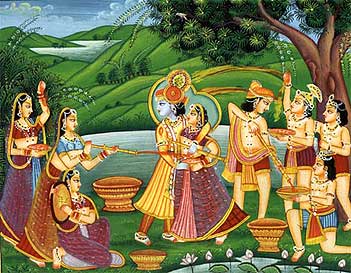
The practice of throwing colored water or powder has its origins in another Hindu legend, that of the love between Lord Krishna and Radha. Lord Krishna as part of the story applied colored powder to Radha’s face. Also, since Lord Krishna played many pranks on people (including throwing colored powder on them) when he was young, the playing of pranks on Holi also is tied to this.

Some Holi Traditions 

Holi is known by many names by different traditions and in different languages where Hinduism is practiced. While all of these names refer to the same holiday, but each name also reflects regional differences in the way in which Holi is practiced.

Uttar Pradesh

The people of Mathura in Uttar Pradesh bill themselves as the "hub of Holi." This is because Uttar Pradesh is home to the birthplace of both Lord Krishna at Nandgaon and of his beloved Radha at Barsana. Since the entire tradition of throwing colored water and powders derives from the love story of Lord Krishna and Radha, it makes sense that at Holi their birthplaces would be major centers of pilgrimage as people travel there to venerate them

Radha and her friends striking 
Lord Krishna with lathis
The Holi season begins just before Holi with the celebration of Lathmaar Holi. In Lathmaar Holi, women re-enact Radha and her female friends using lathi sticks to chase away Lord Krishna after his practical jokes and teasing became too much for her.

Women from Radha's village of Barsana dress in traditional outfits for the holiday and carry lathis. These are long cane sticks of the same sort used in the martial arts of the same name.

Lathmaar Holi in Barsana, Mathura
Men from Lord Krishna's town of Nandgaon then come the roughly 20 kilometers to Barsana carrying shields. When they reach Barsana's Radha Rani Temple, the men sing teasing songs at the women who then chase after them. The women then hit at the Nandgaon men who defend themselves with shields. The men are not allowed to strike back so that the women always win, re-enacting the success of Radha is shooing off the teasing Lord Krishna. Most of the men escape but every year a few are not so fortunate and are captured by their female pursuers who then make their captives wear women's clothing and dance in public. 

Thandai
The atmosphere of Lathmaar Holi is one of wild abandon.  The air near the temple is made thick with incense and flower petals. Throughout the battle between the men and women, both sexes drink a special cold thandai unique for that day. Thandai is a cold drink usually made of milk, water, rose petals, watermelon seeds, anise, poppy seeds, cardamom, peppercorns, saffron and almonds that is served throughout much of northern India. What makes the Lathmaar Holi thandai so special is that it is laced with marijuana for the day. A recipe for thandai (without the cannabis) can be found at:

 http://www.rediff.com/getahead/slide-show/slide-show-1-specials-holi-recipes-thandai-dahi-vada-and-more/20110317.htm


Gujarat

In the state of Gujarat people have a special tradition around buttermilk based on Lord Krishna's fondness for stealing unguarded buttermilk and butter from homes. A greeting unique to Gujarat for Holi is warn people to guard their butter and milk.

In Gujarat, boys form human pyramids
reach a buttermilk pot and become Holi King
The culmination of the buttermilk tradition comes in the crowning of the Holi King. In villages throughout Gujarat, an earthenware pot is filled with buttermilk and then hung high in the air from a rope. The boys of the village form a giant human pyramid to reach the pot. As they climb on to one another's backs, girls from the village and other onlookers throw colored water on them which adds to the exuberance of the event.

The title of Holi King is bestowed on the boy who is finally able to break open the pot and let the buttermilk come pouring out. In some villages, this is accompanied by an actual prize, but in many others, being named Holi King is prize enough.

Goa


The Shigmo Parade in Panaji, Goa
includes elaborate floats of Hindu dieties
In Goa, Holi is called Shigmo (or Shishirotsava) in the local language of Konkani. Throughout Goa, Hindus go to their local temples to ritually bathe the statue of the main dieties there.
The state government of Goa funds many events for Shimgo in the capital city of Panaji. These include street dance performances, folk music and dance shows, and most importantly the Panaji Shigmo Parade with floats showing religious scenes related to the holiday. Many of the floats feature huge images of various Hindu deities, some mechanically operated to move and gesture. The parade includes a range of participants from all castes and cultures in the state. These include people performing various regional dances, flame-throwers, acrobats, brass bands, special marchers with colored umbrellas, and people dressed as various deities. This also includes men playing special large drums rolled on special carts and beaten from a distance with long handled sticks.

The state government of Goa sponsors Shigmo events for 14 days, including many outside of Panaji in other towns and in rural areas.

Punjab

The Sikh community celebrates Holla Mohalla the day after Holi (this year on March 15), and lasting three days. The tenth Sikh Guru, Gobind Singh, developed the tradition for warriors to undertake martial arts, kushti traditional wrestling, mock sword fights and feats of strength. Following these, the warriors recite poetry.

Manipur

Yaoshang is the most important holiday among the Meitei people in Manipur. While the holiday coincides with Holi, it really represents a more central festival than in much of the rest of the Hindu world. Yaoshang begins on the same day as Holi but lasts for five days. 

On the first day at sunset, in every village across Manipur, the Meisei ritually burn a hut -- the Yaoshang Mei thaba --  after which children practice nakatheng -- going door to door requesting donations. 
Yaoshang Mei thaba, Burning of the huts, Manipur


On the following days, the nakatheng extends to blocking roads for more donations for the temple. During the festivities, in addition to the splashing of water and colors, local bands perform kirtan (religious call-and-response music), participate in sporting competitions, and, of course, spray each other with water and colors.

West Bengal and Bangladesh

In Bengali tradition, Holi is celebrated as Dol Purnima (or the Swing Festival) and, as mentioned above, with observance of a Basant-Utsav (or Vasanta Utsav, the Spring Festival).

The Bengal celebration of the holiday is somewhat unique in its dignified atmosphere in observing the holiday. In contrast to almost everywhere else in the Hindu world where Holi is celebrated with considerable abandon, for Bengal Dol's Purnima and Baasant-Utsav the atmosphere is more reserved and dignified.

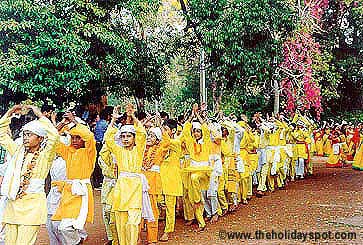
Dol Purnima Procession
at Shntiniketan, West Bengal
Dol Purnima (also called Dolyatra)  is an ancient Bengal celebration honoring Lord Krishna. On this day, people dress in saffron robes for a great procession. At the center of the procession is a swinging litter called a palki, which they decorate with garlands of flowers and brightly colored cloth. They then adorn a statue of Lord Krishna with colored powder and place it in the palki, which they then carry through the streets. As the procession moves, people blow conch shells and shout "Jai" ("Victory"). The name Dol Purnima means "Swing Festival" because the litter carrying Lord Krishna swings back and forth as it is carried.

Rabidranath Tagore
While Dol Purnima has been celebrated for centuries, the observance of Basant Utsav was actually only introduced in the early 20th century by the Nobel Laureate Rabidranath Tagore. To build on the tradition of Holi in an intellectually and spiritually uplifting sense, Tagore lived at the time in Shantiniketan, West Bengal, and because of this focused his attentions on Bishwabharati University, and started what he called Basant Utsav, or the Spring Festival, there.

Because Tagore was among the best-known Indians worldwide, the Basant Utsav attracted international attention from its very start. Today, Shantiniketan has become a center not only of Bengali celebration of Holi but as a major tourist destination from across India and beyond.

Dance performance
at Bishwabharati University 
The Basant Utsav events at Bishwabharati University involve special shows including major dance performances and group choreography, musical performances and a wide variety of other cultural programming. The Bishwabharati University students as well as local children in the city dress in special outfits of saffron and other bright colors.

Finally, at the end of the events, as with Holi celebrations elsewhere in India, the participants paint each other in brightly colored powders.

Nepal

Nepal, the only officially Hindu nation, celebrates Holi for a full week. In Nepal, another name for the holiday is Phagu which is the name for a sacred red powder.

Nepalese Chir
The holiday begins on the first day with a tradition unique to Nepal: the setting up of the chir. The chir is a long bamboo pole on which brightly colored cloth is hung. Each strip of cloth represents a good luck charm for the coming year.

The chir is tied to Lord Krishna and his teasing of young women. The Nepalese tradition tells of an incident where Lord Krishna came upon a group of young women all bathing in the Yamuna River in what they thought was total privacy. The mischievous deity then hung all of their clothing high in a tree well out of their reach. Some versions of the story say that the reason the women were all bathing at once was also related to a trick of Lord Krishna, who had covered them all with colored powder.

The festival culminates at the end of the week with the dousing of each other with colored water. In Nepal, the colored water is held in lolas (a type of water balloons) that people throw at family and friends. Finally, at the close of day on the last nigh of the festival, the chir is set on fire in a communal bonfire. The burning of the cloth strips serve as offerings for good luck.


 Conclusion

As with all of these religious observance posts, this is meant only as informational. Nothing I have written here or in any of these blogs is intended to indicate what is or is not the proper way to worship or observe traditions.

Also, while I have researched these to the best of my ability, if I have made an error, please inform me. Finally, I am aware that Holi is a varied holiday and has many traditions that were not covered here. Please feel free to add your own traditions or thoughts at the end of this blog.

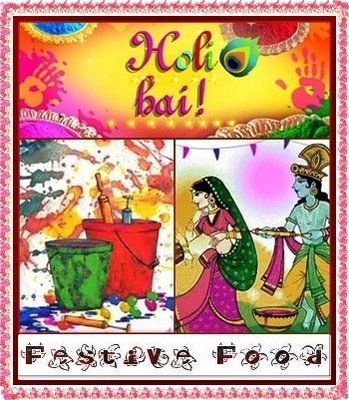
Happy Holi! Holi Hai!


Want to Read More?

Dey, Panchali (March 6, 2020), "Unique Holi traditions in North, East, West and South of India," Times Travel, https://timesofindia.indiatimes.com/travel/things-to-do/unique-holi-traditions-in-north-east-west-and-south-of-india/articleshow/62996908.cms
 
"Festivals of Nepal: Holi," Nepal Travel Guide:  http://www.nepalhomepage.com/society/festivals/fagupurnima.html

"Holi," BBC Religions: http://www.bbc.co.uk/religion/religions/hinduism/holydays/holi_1.shtml

"Holi," Religion Facts.com:  http://www.religionfacts.com/hinduism/holidays/holi.htm

"Holi," Society for the Confluence of Festivals in India: http://www.holifestival.org/

"Holi Customs," I Love India.com: http://festivals.iloveindia.com/holi/holi-customs.html
"Holi: Festival of Colours," The Colors of India: http://www.thecolorsofindia.com/holi.html

"Holi, The Festival of Colours," India Express.com: http://www.indiaexpress.com/rangoli/holi.html

"Holika Dahan -- the Bonfire or Lighting of Fire before Holi," Hindublog.com http://www.hindu-blog.com/2008/03/holika-dahan-2008-bonfire-or-lighting.html

"Shigmo in Panjim," Goacom: http://www.goacom.com/culture/religion/shigmo/

"Vasanta Utsav (or Basanta Utsab) and Holi," The Holiday Spot: http://www.theholidayspot.com/holi/vasanta_utsav.htm


Clip Art Sources


Happy Holi: http://www.wiseshe.com/wp-content/uploads/2011/03/Happy-Holi.png.jpg

Holi colored powders: http://www.religionfacts.com/hinduism/holidays/holi.htm

Outsourced (2006), IMDb, https://www.imdb.com/title/tt0425326/mediaviewer/rm2529705216/?ref_=tt_ov_i

Prahlad and Holika in the fire: http://www.hindu-blog.com/2008/03/holika-dahan-2008-bonfire-or-lighting.html

Radha and her friends beat Lord Krishna lathis: http://www.bloggermoms.com/wp-content/uploads/holi-3.jpg

Lathmaar Holi in Barsana, Mathura: http://www.tribuneindia.com/2011/20110320/nat6.jpg

Thandai: http://www.rediff.com/getahead/slide-show/slide-show-1-specials-holi-recipes-thandai-dahi-vada-and-more/20110317.htm

Gujarat boys forming human pyramid:   http://www.theholidayspot.com/holi/graphics/team.jpg

Yaoshang Mei thaba, Burning of the huts, Manipur. Jimmy Leivon, "Yaoshang festival begins in Manipur, Express," https://indianexpress.com/article/north-east-india/manipur/yaoshang-festival-begins-in-manipur-8484747/

Dol Purnima Procession at Shntiniketan, West Bengal: The Holiday Spot: http://www.theholidayspot.com/holi/graphics/ghy3.jpg

Tagore: http://en.wikipedia.org/wiki/File:Tagore3.jpg

Dance performance at Bishwabharati University: http://www.theholidayspot.com/holi/graphics/ghy3.jpg

Nepalese chir: http://www.nepalhomepage.com/society/festivals/fagupurnima.html

Holi Hai image: http://www.kamalascorner.com/wp-content/uploads/2009/03/holi-hai.jpg

Friday, January 17, 2025

Maha Kumbh Mela 2025

This week — beginning last Monday January 13, 2025​ and running through​ Wednesday February 26 marks the bathing rite pilgrimage in India of the Hindu and Jain Maha Kumbh Mela or Grand Kumbh Mela at Prayagraj. ​

The most auspicious day for is the Mauni Amavasya (or silent new moon day) on January 29, 2025. The BBC's Geeta Pandey estimates that on the single day between 50 and 60 million people will bathe at the confluence of the Yamuna and Ganges. Over the course of the entire 45-day Maha Kumbh Mela, officials estimate that 400 million people will take part over the full 45 days. The AP estimated that 15 million people entered the waters on the first day alone.  in a 4000 hectare (15.5 sq. mi/49 sq. ki) area. 

Devotees at the juncture of the Yamuna and Ganges river
Adnan Abidi/Reuters

The last Maha Kumbh Mela took place 12 years ago in 2013. The 2013 Maha Kumbh Mela marked the 12th occurrence of the12-year pilgrimage. Thus the 2013 event marked the end of a 144 year-cycle. However, due to disagreements of astronomical events affecting the dating, many believe that the 2025 event is the true Maha Kumbh Mela. 

Thus the 2025 Maha Kumbh Mela is either the actual end of the 144-year cycle or is the first Maha Kumbh Mela in the new 144 year cycle, and represents the transition to a new era. Please note that I personally take no stance on this controversy and do not wish to offend others in sharing this debated date.  ​ 

In all Kumbh Mela pilgrimages, Hindu pilgrims take a ritual bath (shahi snan) in the river, which earns merit and/or washes away sin for the worshiper​.​ Many different traditions involve prayers, group singing, religious discussions and feeding the thousands of monks and Naga Sadhu holy people who gather there. 

Naga Sadhus are digambara ("sky-clad") who neither own nor regularly wear clothes as they have renounced all possessions. Naga Sadhus cover themselves in ashes and let their hair grow untouched (so usually ending up as very long dreadlocks). They are at once the most pacifist worshippers in Jainism and Hinduism and yet warriors who protect sacred sites and temples by their presence alone but also with their tridents (trishul). Because their blessings carry good karma, the Maha Kumbh Mela is characterized by millions seeking such blessings.

Naga Sadhus with trishul at 2013 Maha Kumb Mela
Photo by Adnan Abidi, Reuters

There are four sacred Kumbh Mela pilgrimages. They occur four times over a twelve-year cycle. Each takes place at a holy river site where Hindus believe that drops of amrita (divine nectar) fell at the four spots. These are Prayag, Nashik, Ujjain and Haridwar. All involve a ritual dip in the River Ganges to wash away bad karma.

The Kumbh Mela Pilgrimage 

In all Kumbh Mela pilgrimages, Hindu and Jain pilgrims take a ritual bath in the river, which earns merit and/or washes away sin for the worshiper​.Many different traditions involve prayers, group singing, religious discussions and feeding the thousands of monks and Naga sadhu holy people who gather there. 

There are four sacred Kumbh Mela pilgrimages.  They occur four times over a twelve-year cycle.  Each takes place at a holy river site where Hindus believe that drops of amrita (divine nectar) fell at the four spots. These are Prayag, Nashik, Ujjain and Haridwar. All involve a ritual dip in the River Ganges to wash away bad karma. 

Largest Gathering of People in History

The event is expected to break the record for the largest gathering of people in one spot in history.  The Indian government estimates that 400 million people will take part over the full 45 days. By way of comparison, the population of the world's third most populous nation -- United States --is only 328 million people. 


The AP estimated that 15 million people entered the waters on the first day alone.  To put this in perspective, the annual hajj pilgrimage to Mecca (the largest annual gathering of people anywhere) numbered 1.83 million in 2024. In 2023, the hajj broke its all-time record with 2.5 million people. Six times that record number entered the waters of this year's Maha Kumbh Mela on its first day. 

Special Needs of the Gathering

Safety and Crowd Control

Safety and public calm has been another priority for over 70 years ago with the Kumbh Mela stampede of February 3, 1954, the first Kumbh Mela following India’s independence. Estimates on the stampede vary greatly, ranging between Memish et al.'s estimate of 500 dead to  PM Narendra Modi claimed that "thousands of people were killed in the Kumbh stampede in Allahabad." Both of these estimates were made in 2019, with Memish et al.'s published in the academic journal The Lancet and PM Modi's in a 2019 campaign speech.
 
Regardless of the actual death toll, the stampede was the worst in India's post-independence history. The 1954 stampede was blamed on the absence of adequate crowd control forces coupled with the excitement from the visit of politicians such as PM Jawaharlal Nehru. 

As a result, politicians have been banned from giving speeches at the gatherings ever since.  
Despite precautions, a stampede leaving 42 dead broke out at the train station on Sunday, February 10, 2013.  This was the first instance of stampede since the 1954 tragedy. 

Crowd control extends beyond stampede precautions. Issues such as getting lost, jostling others, and tracking troublemakers. To address this concerns, the organizers have provided, as Outlook's Anjali Rawat notes, "QR codes for vehicles and RFID wristbands for pilgrims will streamline entry and exit, reducing congestion and improving safety" and "Pilgrims who consent to GPS tracking through a mobile app can receive location-based alerts, ensuring they stay informed about nearby facilities."

Terrorist Precautions

Since the Mumbai attacks from Islamist terrorists in 2008, special terrorist task forces have regularly been a part of all subsequent Melas and large crowd events in India. Adding even more to these concerns, the Sikh separatist leader Gurpatwant Singh Pannun of the outlawed Sikhs for Justice Movement has publicly threatened -- twice (with the last on January 6) -- to disrupt the Maha Kumb Mela, As India Today's Shivani Sharma records, the "Khalistani terrorist" has threatened to "kill Hindutva ideology" and “Mahakumbh Prayagraj 2025 will become a battlefield”.    

Security forces have implemented a seven-tier security plan to monitor those entering the area, and eliminating a vehicles from the central zones. Additional Director General (Prayagraj Zone) Bhanu Bhaskar explained this to The Economic Times: "We have implemented a robust seven-tier security plan... This includes multiple cordons—outer, inner, and isolation—along with district and inter-state checkpoints. Prominent public places, including religious spots across the city, have been brought under strict security measures."
 
Senior superintendent of police (Mahakumbh Nagar), Rajesh Dwivedi, told the Hindustan Times: “A robust and hi-tech security system is in place. With the global spotlight on the Mahakumbh, the Mahakumbh Nagar police have gone into full alert mode ahead of the New Year celebrations.” Dwivedi explained that to ensure a safe and secure experience for devotees, 37,611 policemen are being deployed. Among these, 22,953 policemen are for the fair area, 6,887 for the Prayagraj Commissionerate, 7,771 for the GRP, and 1,378 women police officers.

Drone shot of the Sangam area ahead of the Mahakumbh 2025   


Kapil Dixit in the Times of India explains that the Mela will be protected by a "network of 2,751 CCTV cameras, including 328 AI-enabled cameras" and stationery and underwater drones. 


Water Supply

Drinking water is a continuous concern at all Kumbh Mela gatherings. It is in this area that the government has expressed some concern.  To prepare in advance for the crowds, the Uttar Pradesh Jal Nigam (urban) authorities installed a network of 1249 km (776 miles) of pipeline with 56,000 water connections, 85 tube wells and 30 generators. 


Ganges Clean-Up

In an effort to ensure that the Ganges water quality is safe, the Uttar Pradesh Pollution Control Board undertook a massive two-month clean-up effort. As Gaurav Saigal reported in the Hindustan Times, "is now flowing swift, in one of its cleanest forms seen in many years." 

This accomplishment is all the more notable considering that on November 6, 2024, the National Green Tribunal Justice Prakash Shrivastava ruled that a study of 42 locations at the site (as reported in The Economic Times): "clearly discloses the fact that the water quality is deteriorating on account of the discharge of sewage or sullage into the river Ganga," and the GTJ ruled that the Uttar Pradesh state government had to make the water suitable for bathing at the time of the Kumbh Mela. In a remarkable effort, as Saigal reported: "change in water quality came after industries in 23 districts were asked to close operations and 34 untapped drains were diverted for filtration at the temporary sewage treatment plants (STPs)." Additionally, officials have gradually released fresh water from the Narora Dam and elsewhere have gradually on an as-needed basis to maintain safe water quality for bathing devotees.
 
Devotees take a dip in the Ganga at Prayagraj
(HT File Photo)


Sanitation and Disease Control 
 
The special needs for preparing for the pilgrimage are handled through India’s Mela Administration. Particular care is given to prevent the spread of disease. There have been no major outbreaks of disease since care to public health became a priority following an outbreak of cholera at the 1892 Kumbh Mela. 

To this end, in 2025, according to Kapil Dixit in The Times of India, 10,000 sanitation workers clean up the 150,000 toilets and urinals set up for the crowds. Sanitation official, in turn, monitor each facility for safety and cleanliness with QR codes.   Because the Indian government has committed to green activities, the sanitation equipment is eco-friendly, operating, as Dixit explains, "without fuel, or electricity, thereby helping in the reduction of environmental impact." Workers also operate specially-designed battery-operated vacuums to clear the area of litter and other waste.

Five district malaria officers, 45 malaria inspectors and 28 assistant malaria inspectors not only monitor the pilgrims but actively operate specially-designed equipment to keep the area free of mosquitos, flies and other insects. They employ 110 automatic blower mist machines and 107 mini-fogging machines throughout the Mela area.

Health Care Initiatives

The Indian Army and the Mela Administration of Uttar Pradesh state have joint established joint health care operations for the event. Uttar Pradesh state has staffed the entire Mela area with 291 MBBS (western-medical training) physicians and 90 experts in Ayurvedic and Unani (both traditional Indian medical practices) supported by 182 nurses. The Uttar Pradesh government has set up on site a 100-bed hospital, two 20-bed hospitals, and several 8-bed facilities. These state facilities include, as Rawat explains: "separate wards for men, women, and children, as well as dedicated delivery rooms"  as well as special attention to holistic traditional health care: "Special attention is being given to sadhus, saints, and Kalpwasis, who will be observing extended periods of spiritual retreat during the Kumbh."

Additionally, the Indian Army has set up as 50-bed military hospital in the city of Prayagraj, a 45-bed crisis response facility on the grounds and a Class-1 Medical Assistance Post designed to provide with minimal disruption on-the-spot care for minor injuries or illnesses. Finally, the Indian Army has set up a 24/7 mobile evacuation team for critical care and emergency transport based at the Army's Ordnance Depot Fort.  

Further high-tech enhancement introduced for the 2025 Mela is a "dedicated app and AI-powered chatbot in 11 languages will guide pilgrims with information on healthcare facilities, routes, and emergency contacts." Rawat 

Eye Care Initiative

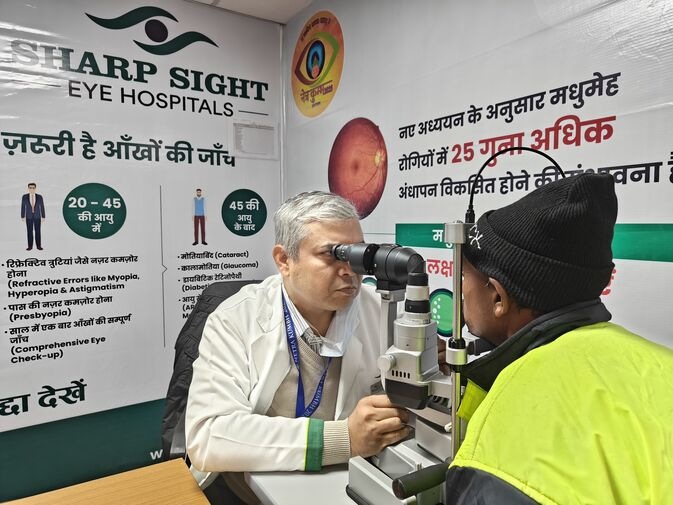
In a particularly noteworthy initiative, all people at the even will receive free eye, the largest such event in history. In a remarkable Corporate Social Responsibility action, Sharp Site Hospitals working with Netra Kumbh will provide eye care for 50 days. 
Sharp Sight Eye Hospitals at Kumbh Mela

As reported in the CSR Journal, the initiative will

  • Conduct 5,00,000 free eye tests to screen for vision problems and eye diseases.
  • Deploy an expert team of 500 ophthalmologists to offer specialized diagnostics and consultations.
  • Distribute 3,00,000 spectacles to individuals needing refractive corrections.
  • Engage 1,000 optometrists to ensure smooth execution of the initiative.
  • Perform 50,000 eye surgeries for individuals suffering from severe vision impairments, including cataracts and other critical eye conditions.

Conclusion

Hinduism has multiple traditions within it. Many of these traditions vary in their interpretation of the rites and significance of the Kumbh Mela. This post is meant only as a brief introductory overview. It is not intended to indicate any particular practice. 

As always, I welcome your corrections (or praise) and any other input.  

Happy Maha Kumbh Mela! 


Works Cited

CSR News: World’s Largest Free Eye Check-Up Camp in Mahakumbh 2025 (January 17, 2025), CSR Journalhttps://thecsrjournal.in/corporate-social-responsibility-csr-news-worlds-largest-free-eye-check-up-camp-in-mahakumbh-2025/


Dash, Nivedita (November 20, 2024), India TVhttps://www.indiatvnews.com/uttar-pradesh/mahakumbh-2025-1-249-km-long-network-of-pipes-to-provide-water-supply-updates-2024-11-20-962557


Dixit, Kapil (January 11, 2025), “10,000 sanitation workers to make Kumbh clean & green,” https://timesofindia.indiatimes.com/india/10000-sanitation-workers-to-make-kumbh-clean-green/articleshow/117134518.cms


Dixit, Kapil (January 13, 2025), “From AI cams to drones, Kumbh Mela site a fortress with 7-ring security,”  https://timesofindia.indiatimes.com/india/with-seven-ring-security-sangam-turns-into-fortress/articleshow/117181725.cms


“Maha Kumbh 2025: Seven-ring security plan turns Prayagraj’s Sangam into a fortress” (January 13, 2025), The Economic Timeshttps://economictimes.indiatimes.com/news/india/maha-kumbh-2025-seven-ring-security-plan-turns-prayagrajs-sangam-into-a-fortress/articleshow/117198758.cms


“Mahakumbh-2025: Three-tier security for entry to mela area ahead of New Year” (December 26, 2024), Hindustan Times, https://www.hindustantimes.com/cities/lucknow-news/mahakumbh2025-three-tier-security-for-entry-to-mela-area-ahead-of-new-year-101735224176483.html 


Memish ZA, Steffen R, White P, Dar O, Azhar EI, Sharma A, Zumla A. (May 18, 2019),  “Mass gatherings medicine: public health issues arising from mass gathering religious and sporting events.”  The Lancet.  (10185):2073-2084. doi: 10.1016/S0140-6736(19)30501-X. PMID: 31106753; PMCID: PMC7159069.  https://pmc.ncbi.nlm.nih.gov/articles/PMC7159069/#tbl1


Pandey, Geeta, (January 12, 2025), "Millions start bathing in holy rivers at India's biggest Hindu festival, BBC, https://www.bbc.com/news/articles/cvg7gzzx3gno


“PM Modi recalls 1954 Kumbh Mela stampede at election rally in UP (May 1, 2019), The Economic Timeshttps://economictimes.indiatimes.com/news/elections/lok-sabha/india/pm-modi-recalls-1954-kumbh-mela-stampede-at-election-rally-in-up/articleshow/69129977.cms?from=mdr


Rawat, Anjali (January 7, 2025), “State-Of-The-Art Healthcare For Maha Kumbh 2025: Ensuring Pilgrim Safety, Outlook, https://www.outlookindia.com/brand-studio/state-of-the-art-healthcare-for-maha-kumbh-2025-ensuring-pilgrim-safety


Sheikh Saaliq (January 14, 2024), “Millions of pilgrims and naked, ash-smeared ascetics take holy dips in India’s mega Hindu festivalAP, https://apnews.com/article/india-maha-kumbh-hinduism-527170e00730b5e2a61a70b7423493ad


Saigal, Gaurav (January 11, 2025), “Mahakumbh-2025: Two months of action later, Ganga water fit for holy dip,” Hindustan Timeshttps://www.hindustantimes.com/cities/lucknow-news/mahakumbh2025-two-months-of-action-later-ganga-water-fit-for-holy-dip-101736612105117.html


Sharma, Shivani (January 6, 2025), “Prayagraj chalo: Khalistani terrorist Pannun threatens to disrupt Mahakumbh,” India Todayhttps://www.indiatoday.in/india/story/prayagraj-chalo-khalistani-terrorist-gurpatwant-singh-pannun-threatens-to-disrupt-mahakumbh-2025-magh-mela-2660303-2025-01-06


Sukheja, Bhavya (Dec. 21, 2024), NDTV, Maha Kumbh 2025: Know History, Location, Significance And More, NDTV, https://www.ndtv.com/feature/maha-kumbh-2025-know-history-location-significance-and-more-7302358b


“Water quality of Ganga in UP deteriorating due to discharge of sewage: NGT” (November 9. 2024), The Economic Timeshttps://economictimes.indiatimes.com/news/india/water-quality-of-ganga-in-up-deteriorating-due-to-discharge-of-sewage-ngt/articleshow/115112215.cms?utm_source=contentofinterest&utm_medium=text&utm_campaign=cppst


Clip Art Sources


Kumbh welcome opening image, Maha Kumbh 2025: Know History, Location, Significance And More, NDTV,Kumbh.gov.in  https://www.ndtv.com/feature/maha-kumbh-2025-know-history-location-significance-and-more-7302358b


Devotees at the juncture of the Yamuna and Ganges riverAdnan Abidi/Reuters 

Devotees take a dip in the Ganga at Prayagraj, Hindustan Timeshttps://www.hindustantimes.com/cities/lucknow-news/mahakumbh2025-two-months-of-action-later-ganga-water-fit-for-holy-dip-101736612105117.html


Naga Sadhus with trishul at 2013 Maha Kumb Mela Photo by Adnan Abidi, Reuters  https://www.reuters.com/news/picture/naga-sadhus-idINRTR3D6PA/ 


Maja Kumbh Mela devotees: Rawat, Anjali (January 7, 2025), “State-Of-The-Art Healthcare For Maha Kumbh 2025: Ensuring Pilgrim Safety, Outlook, https://www.outlookindia.com/brand-studio/state-of-the-art-healthcare-for-maha-kumbh-2025-ensuring-pilgrim-safety


A drone shot of the Sangam area ahead of the Mahakumbh 2025, Dixit, Kapil (January 13, 2025), “From AI cams to drones, Kumbh Mela site a fortress with 7-ring security,”  https://timesofindia.indiatimes.com/india/with-seven-ring-security-sangam-turns-into-fortress/articleshow/117181725.cms


Sharp Sight Eye Hospitals at Kumbh Mela, “CSR News: World’s Largest Free Eye Check-Up Camp in Mahakumbh 2025 (January 17, 2025), CSR Journal,  https://thecsrjournal.in/corporate-social-responsibility-csr-news-worlds-largest-free-eye-check-up-camp-in-mahakumbh-2025/

Friday, October 25, 2024

Diwali 2024

As part of my ongoing announcements of religious observances, please note that for 2024, the 5-day Hindu, Jain, and Sikh celebration of Diwali begins on Wednesday October 29 with Dhanteras and will continue for five days through Sunday November 3 with Bhaj Dooj, with the most important celebration Laxmi Puja (or Lokkhi Pujo falling on the third day, Friday, November 1.  

Please note that individual worship practices may vary. So while some people may observe just the Laxmi Puja date (the third day), many other may observe the holiday for the entire five days. For most people, the holiday should not affect class or work attendance, but may be observed by many students who practice one of these three religions.

The festival of Diwali  (also called Deepavali, Deepwali, Divali, Devali and -- in Nepal and Sikkim  -- Tihar or Swanti) is the most important holiday in the Hindu calendar. It is also an important holiday for Jains and Sikhs. 

Some Buddhists also observe Diwali, but only as the commemoration of the date in 257BCE when Emperor Ashoka converted to Buddhism.

Diwali marks the last day of the Hindu calendar. Diwali celebrates (at least in part) the victory of light over darkness and good over evil. In much of India (and especially in the North), the business community starts their financial new year with the holiday, and it is the beginning of the fiscal year. Relatedly, in much of India, Hindus and Jains view the first day of Diwali (Dhanteras or Dhanatrayodashi) as a highly auspicious (muhurat) day for bringing luck and wealth. 

Customarily, on this first day of Diwali people buy gold, silver and jewelry to welcome in this good fortune. Newspapers publish the exact time that is most auspicious time for purchases. For example, for 2024, The Economic Times announced that "The auspicious time for Dhanteras puja muhurat in 2024 is between - 06:57 PM to 08:21 PM on October 29, 2024."  
 
On the third day -- November 1 for 2024 -- both of India's stock exchanges, the NSE and BSE, open for a special "Muhurat Trading Session" from 6:00-7:00 PM. As one financial journalist explains:
The importance of Muhurat trading stems from the fact that it provides investors with the opportunity to embark on their investment journey during an auspicious time. Goddess Laxmi is traditionally considered the Goddess of Wealth and traders consider it auspicious to kick start the new year with her blessings. 
Many seasoned investors also take this opportunity to incorporate new stocks into their portfolios or boost their investments in stocks they already own. This presents an excellent opportunity for seasoned investors to broaden their portfolios by introducing new stocks or expanding their current positions. Sparsh Bansal,  Financial Express (Oct. 25, 2024) 
Diwali is celebrated throughout the Hindu world, regardless of region (which is not always the case for other holidays).  Diwali is an official holiday not only in India and Nepal which both have majority Hindu populations, but also in Singapore, Sri Lanka, Trinidad & Tobago, Malaysia, Guyana, Mauritius and Fiji. Additionally, US states have begun to recognize Diwali as a school holiday. On October 25, 2024, Pennsylvania became the first US state to make Diwali an official state holiday. This is a step further than New Jersey and Texas which (in 2022 and 2023 respectively recognized Diwali as a school holiday 2023. Additionally, in 2024, New York City officially is observing Diwali as a school holiday.
Diya


Laxmi's footprints
Various traditions for celebrating Diwali include lighting of oil lamps (diyas or jyothis), setting off of firecrackers, exchanging and eating decorated sweets, gathering at people's holiday-decorated homes in celebration and visiting Temples.   

In different parts of India, the holiday is marked by the giving of gifts of new utensils (especially cooking utensils), wearing of new clothes and/or the cleaning and painting of homes or workplaces. Many cities and towns also hold Diwali melas or open-air fairs during Diwali. For most Hindu traditions, Laxmi (or Lakshmi), the goddess of prosperity is especially revered on Divali. With homes with children, people often leave female footprints on the floor after the children have gone to sleep so that when they wake up they will see that the goddess Laxmi has visited the home in the night.
 
Gulab jaman
Special foods are often eaten. Some of these are widely eaten throughout India. For instance, regardless of region, it is customary to eat things that are sweet such as gulab jaman, which is usually made of milk dough soaked in rosemary, sugar syrup and cardamom. A recipe for gulab jaman can be found Cooks.com.

Also, specialties made with cashews or pistachios are also widely eaten for Diwali. In much of India, delicacies are made from Lord Krishna’s favorite food Poha (also called Foav or Pauva) which is pounded semi-cooked sweetened rice and eaten on the second day of the festival. 

Other Diwali food specialties are more regional.  For example, in much of the north of India, people eat patandas made of flour, unprocessed sugar cane and ghee as well as poodas (or mal poohas) made of flour and sugar syrup and eaten with chutney. 


Sel roti
In Nepal, the traditional treat for Tihar (the Nepali name for Diwali) is called sel roti. Made of rice flour, milk and ghee and (depending on custom) flavored with cardamom or clove, the sel roti is somewhat like a thin, circular doughnut. Many Nepalis exchange sel roti with one another as gifts throughout Tihar. A recipe for sel roti can be found at the Indobase.com Indian Recipes section.  

In the far south of India, many sweets are eaten leading up to Diwali and into the first day, notably those made from honey and unprocessed sugar cane.   
Mawa Kachori
In Maharashtra a special mix of cane sugar and coriander seeds is customarily eaten on the first day. In Rajasthan, many people traditionally begin the holiday by eating Mawa Kachori, a puffed pastry made with sweetened evaporated milk (mawa) and nuts. A recipe for Mawa Kachori can be found at Manjula's Kitchen. 


Religious Significance Diwali

Lord Krishna defeating Narakasura
Metropolitan Museum of Art, New York 
Hindu Traditions 

Diwali has three main Hindu religious stories attached to it.  While some Hindu traditions have other associations as well, these three are the most widespread.


First (and especially in South India), the holiday of Diwali commemorates the victory of Lord Krishna over the demon king Narakasura, and so the victory of good over evil. Narakasura -- himself a son of Vishnu -- had become power-crazed, overwhelming Indra and other Vedas. He also became horribly abusive to women, enraging Krishna's wife Stayabhama and her relative Aditi. At the pleading of the Vedas and Aditi, Krishna attacked the demon. Riding on the battle-eagle Garuda, Krishna withstood various attacks from the armies of Narakasura, then withstood the thunderbolts and trident attacks of Narakasura himself. Krishna then used his discus to behead the demon king. Before dying, though, Krishna was asked to celebrate the anniversary of his death as a holiday, to which Krishna agreed. As a result, the first day of Diwali is celebrated as such. 

Rama defeating Ravana
Second (and especially in North India), Diwali celebrates the return after 14 years of exile of King Rama and his wife Sita and brother Lakshmana. The holiday marks their return after a war in which King Rama killed the demon Ravana.  Because it was dark as they returned, people lit oil lamps to light their way and thus the link of light over darkness. 

Third, in Bhavishyottara and Bramhavaivarta Purana holy writings, Diwali is associated with Daitya king Bali, who is allowed to return to earth once a year.

The Significance of the Five Days

For Hindus, each of the five days carries a different significance. The first day throughout India is customarily dedicated to honoring Dhanavantri (also called Dhanvantar), the physician of the gods and the source of the Ayurveda (in Sanskrit, “the complete knowledge for long life”). Because of its association with Dhanavantri, the first day of Divali is often known as Dhanteras and includes the ritual lighting of oil lamps and veneration of the goddess Laxmi in her owl form. As with most pujas, Lord Ganesha – the deity who removes obstacles – is given honor at the opening of the holiday.

Deepdaan


In many Hindu traditions, the first day of Diwali includes the ritual of Deepdaan in which worshipers light oil lamps for each member of their family and for often for their ancestors then set them afloat (usually) in a river or pond. Another Hindu tradition practiced in much of India is the giving of gold and jewelry gifts to bring about prosperity, making Diwali a major day for jewelers.  In northern India and Gujarat, many Hindus celebrate Yamadeepdaan in which lamps are dedicated to the god of death Yamraj (or Yam) and kept lit all night long. In the far south of India, many Hindus celebrate the days leading up to Diwali as Asweyuja Bahula Thrayodasi, dedicated to the god of finance Lord Kubera in which shop owners whitewash their business, recite a special mantra to Lord Kubera and give coins to honor the goddess Laxmi. In West Bengal, Diwali coincides with the Puja Kali. While the rest of India honors Laxmi on this day, in West Bengal, Hindus honor Kali the Destroyer goddess of time and change

Diwali fireworks

For many Hindu traditions, the second day of Diwali often begins with ritual bathing before the sun comes up, with anointing of oil and scrubbing of the body with ubtan (a mixture of fragrances with grains or rough flour). In West Bengal, as part of the Puja Kali celebrations, the second day is observed as the day the goddess Kali destroyed the demon Raktavija. Regardless of tradition, this is the traditional day for cracking open crackers (of the sort used in Britain on Christmas Day) and for setting off firecrackers. Many areas have major firework displays on the second day of Diwali.

Swami Dayananda Saraswati
The third day of Diwali for most Hindu traditions centers on the veneration of Laxmi. That said, the third day of Diwali also marks the anniversary of the death in 1883 of the founder of the Arya Samaj Hindu Reform Movement Swami Dayananda Saraswati.  The followers of the Arya Samaj therefore often mark the day as a day of remembrance for Swami Dayananda Saraswati.

Lord Krishna 
lifting Gorvardhan
The fourth day of Diwali is celebrated in many Hindu traditions with a special Govardhan Puja. This puja commemorates Lord Krishna’s defeat of the rain god Lord Indra by lifting Govardhan Mountain. Some interpretations (there are many variations) explain that Lord Krishna needed to defeat Lord Indra because the rain god had become too arrogant and filled with self-pride. In doing so Lord Krishna taught worshipers to pray to more than just the rains by embracing the whole of nature. This celebration is also called Annakut (literally meaning “pile of grain”) because people in many parts of India decorate a mountain of grain symbolizing Govardhan Mountain.

On the fifth Day of Diwali comes the Bhai Duj or Bhai Teeka, a final day of celebration. On this day traditionally, brothers visit the houses of their sisters to honor them and bring gifts. Sisters in turn feed their brothers special delicacies. The celebration commemorates the visit on this day of the death god Lord Yama to his twin sister Yami (also called Yamuna or Yamini), the first woman. Lord Yama gave his sister a special gift that whoever visited her on this day would be cleared of sins.

Diwali in Jainism and Sikhism

As mentioned earlier, Diwali is not only practiced by Hindus. It is also a holiday for Jains and Sikhs. 

 
Diwali Traditions in Jainism

Lord Mahavira


In Jainism, Diwali is of particular significance. Jains, like Hindus, celebrate the holiday not only as the beginning of their New Year and as a time for a fresh start. Importantly, though, Jains also celebrate the holiday as the anniversary of Moksha (the attaining of nirvana) of Lord Mahavira, the founder of the religion.


Diwali Traditions in Sikhism

In Sikhism, Diwali is celebrated as a commemoration of the release from prison of the sixth Sikh Guru Hargobind Sahib Ji.  When Jahangir, the fourth Mughal emperor succeeded his father -- the famously religiously tolerant Akbar the Great. Although he was not a particularly devout Muslim, Jahangir  felt threatened by the non-Muslims in his empire, including the Sikhs but also many Hindus. As a result of his concerns regarding the Sikhs, Jahangir arrested Hargobind's father, the fifth Sikh Guru Arjan Dev. Jahangir tortured Guru Arjan Dev for five days before having him killed. 

Release of Guru Hargobind Sahib Ji 
and the 52 Hindu Kings
At this point, the young Hargobind -- only eleven years old at the time -- became the sixth Sikh Guru. Jahangir arrested the young Guru Hargobind but did not kill him as he had killed his father. Instead, Guru Hargobind was imprisoned (along with 52 Hindu kings) at Gwalior Fort. He remained there from 1617 until Diwali of 1619 when Guru Hargobind and the Hindu kings were freed. It is this release from imprisonment that the Sikhs celebrate at Diwali. The holiday is commonly called Bandi Chorh Divas or Prisoner Release Day.

Concluding Remarks

This overview of Diwali is meant only as a very superficial summary. Also, nothing written here is meant to be an indication of one way or another as the proper or correct way to worship. This is meant solely as an attempt to provide a layperson's quick summary of Diwali. 

Because there are literally hundreds of separate traditions for celebrating Diwali, I could only cover a few here. Please do feel free to share any of your own traditions that I have not covered.

Whatever your tradition,  Happy Diwali! 

Want to learn more?

For Hindu traditions, you may wish to look at


For Sikh tradtions and the story of Guru Hargobind, turn to


For Jain traditions, turn to 

Opening "Happy Diwali" clipart: http://www.101kidz.com/holidays/diwali/clipart.html


Lord Krishna defeating the demon Narakasura: http://en.wikipedia.org/wiki/File:Krishna_Narakasura.jpg


Release of Guru Hargobind Sahib Ji and the 52 Hindu Kings: http://jattsingh.com/wp-content/uploads/2011/10/Bandi-Chhorh-Divas.jpg