Welcome to the David Victor Vector Blog

Welcome to the David Victor Vector blog. This is blog that covers religious observances around the world international affairs and global business. This blog describes religious holidays for most major religions as well as raising issues dealing with globalization, international business ethics, cross-cultural business communication and political events affecting business in an integrated world economy. I look forward your discussion and commentary on these articles and subjects. Enjoy!

Saturday, January 14, 2012

One New Year, Many Traditions: Lunar New Year Customs Around The World


Zodiac animals, ivory netsuke, Japan
American Museum of Natural History, New York

This post is one of a series of four posts discussing the Asian Lunar New Year in general and the Year of each year's particular animal. In this post, though, we give the background to Lunar New Year customs around the world.  (Note: This is updated annually).

This post gives background to the importance and influence of the Asian Lunar New Year and the many traditions with which people celebrate the holiday from culture to culture.

One point on terminology is merited here. The Asian Lunar New Year is celebrated by many cultures. Among the largest cultures that celebrate the holiday are the Chinese. For this reason, well-meaning people unfamiliar with the Asian Lunar New Year as a whole may refer to the holiday as the Chinese New Year (CNY). This would, however, be appropriate only when referring to the Lunar New Year as celebrated in China. Using CNY to refer to the whole range of cultures observing the Lunar New Year, though, discounts the millions of non-Chinese celebrations. These include the Mongolian Tsagaan Sar, Korean Seollal, Japanese Oshogatsu, and Bhutanese and Tibetan Losar. all of which are explained below.

CHINESE NEW YEAR

 In China, Taiwan and Singapore, as well as wherever Chinese communities exist abroad, the celebration is correctly called the Chinese New Year.  In cities with large overseas Chinese communities, major celebrations take place.  As a result, festive decoration and parades are annual events in major cities around the  world. Celebrations have long been annual events in many other non-Asian cities throughout the world. In tomorrow's post, I will list links to New Year celebrations around the world.

Some Chinese believe that children should stay up as late as possible on the first day of the New Year, believing that the longer they stay awake, the longer their parents will live. Also, many Chinese will not scold their children on the first day of the New Year, believing that reprimanding them will bring bad fortune to the
children. 

The second day is usually devoted to honoring dead ancestors.  This is particularly important in Confucian tradition.  The third and fourth days often revolve around honoring (or just visiting) in-laws.  The 5th day is called Po Woo, a day in which – unlike the rest of the celebrations – nobody visits anyone else.  Po Woo is the day that people traditionally welcome in wealth.  Visiting others on that day is believed to bring bad luck to both parties.  Other traditions occur on the 6th to 14th days, many of which vary from place to place.  


Finally the last day – the 15th day – is the ending festival called the Lantern Festival.  The Lantern Festival concludes the celebration and occurs on the full moon, and centers around decorating with lanterns and having parades of people carrying lanterns.  Taipei, Taiwan has the largest such display and has become a tourist attraction for the celebration.
Traditional red gift-giving envelopes
Many Chinese spend weeks getting ready for the New Year.  The house is cleaned thoroughly, at least traditionally to clean out any bad luck from the previous year. For others, the good cleaning is simply a way of preparing for the family gathering on the Eve of the New Year.  Doors and windows are often painted red and decorations of red are widespread.  Many people seal the doors and windows on the eve of New Year’s and break the seals open on New Year’s Day to welcome in the New Year. In Chinese tradition, red is a lucky color that for many people is seen as warding off bad luck. For others, the red decorations are simply seen as festive. Traditionally, gifts of money are given to children (and sometimes to unmarried people) in special red envelopes.

The celebration itself is generally celebrated for 15 days, with different events on each.

The 2007 Year of the Dog
Goodwill Dog Circus


On New Year’s Day, large parades take place, usually honoring the animal. Sometimes this has political significance on an international level.  For example, 2007 – as the Year of the Dog-- the government of Japan sent a “dog circus” of performing dogs to China in a move to 
improve relations between the two countries. 

Candied lotus seeds
 Other activities on the first day include setting off firecrackers (to scare off evil spirits or bad luck), wearing new clothes bought for the occasion and eating special holiday foods.  While these foods change from group to group (as Chinese culture is broad and varied), some more widespread foods include eating candied lotus seeds (which brings good luck) and candied coconut (for underscoring family ties and bonding).  Children often are given candied melon (which is thought to ensure healthy growth).

Long noodles are often eaten to represent long life (although it is considered unlucky to cut the noodles in such cases). Because clams are thought to look like gold bullion and gingko nuts are thought to look like silver ingots, these foods are eaten to ensure wealth in the coming year. Oranges or tangerines are usually exchanged among friends.  Many Chinese avoid eating meat on the first day. . In Cantonese-speaking areas, people often eat lettuce wraps since the word for lettuce in Cantonese sounds like the word for rising fortune.


VIETNAMESE TET 

In Vietnam, the holiday is celebrated as Tet.  While Tet usually occurs on the same day as the Chinese New Year, due to slightly different calendar systems, Tet may occur a day after the Chinese New Year.  The last two times this happened was in 1985 and again in 2007 (for those of you who are concerned, we won’t have to worry about the change again until 2030).

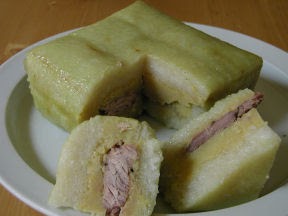
Banh chung

Traditional Tet foods include roasted watermelon seeds, and banh chung and banh tet (sticky rice prepared inside banana leaves).   For instructions on how to you’re your own banh chung and banh tet (including a video with step-by-step instructions), you may wish to go to the Viet World Kitchen site at :


Tet Pole or cay neu


In preparation for Tet, in addition to cleaning their houses, Vietnamese try to pay off all of their debts, so that they will not owe anyone as the New Year starts.  Also, many Vietnamese have a family altar for honoring one’s ancestors.  This altar is traditionally cleaned and new offering placed there on Tet. 


Traditional Tet decorations in one’s house include a decorated cay neu or Tet Pole and small kumquat trees. The first person who visits on Tet is considered an important omen for the coming year.  As a result, people invite someone they think can bring good fortune (for example, a very upbeat friend).  Being invited for this is a high honor.  

TSAGAAN SAR AND BITUUN


In Mongolia (and in China among the 4.3 million ethnic Mongolian minority), the holiday is celebrated as Tsagaan Sar. 

Mongolians are usually insulted if Tsagaan Sar is called “Chinese New Year.”  This is for two reasons.  First, the Mongolians believe that Tsagaan Sar predates the Chinese celebration, and strongly reject any Chinese influence.  Second, though this is no longer the casw the Communist leadership of China in the 1960’s tried to stamp out the religiously significant holiday among its Mongolian minority, persecuted its practitioners, and unsuccessfully attempted to rename the holiday “Cattle Breeders’ Day.”  This persecution ended with the liberalization of China, but has left very bad feeling not only among those Chinese citizens of Mongolian descent, but throughout the nation of Mongolia as well.

Mongolian buuz

Mongolian airag
Tsangaan Sar is a time of family gatherings and exchanging gifts. While the Chinese avoid meat on the first day of the New Year, the Mongolians do eat meat. Indeed, the most traditional meal of Tsangaan Sar is buuz, which are dumpling filled with beef or mutton. People also have airag, which is fermented mare’s milk.

Palden Lhamo
The celebration of Tsagaan Sar actually begins on the preceding day with Bituun. This is a day of cleaning houses and barns. In Mongolian Buddhist tradition, candles are lit at altars to symbolize the enlightenment of samsara  (the continuous cycle of life and death).  Bituun is also when people make amends with each other and settle disputes from the previous year. Finally, on Bituun,  the Buddhist Dharmapala (protecting, vengeful diety) named Palden Lhamo visits people’s homes. She arrives on horseback and people leave three pieces of ice on their doorsteps to quench its thirst.


TIBETAN AND BHUTANESE LOSAR

In Tibet and Bhutan, the lunar new year holiday is called Losar. Lo means "new" and sar means "year." Losar is also the name used for the holiday among the Sherpa and Tamang people in Nepal and the Bhutia people of the Indian state of Sikkim.


Masked performer in Losar play
In the Buddhist monasteries in Tibet , the day preceding Losar is a sort of winter equivalent to spring cleaning.  The monasteries are cleaned thoroughly, then decorated festively.  Losar itself is an important  religious observance.  Indeed, the last two days of the old year are considered a holiday -- called Gutor -- whose sole purpose is cleaning and other preparation for the first day of Losar. Special rituals are led by the Dalai Lama on Losar itself, followed by lamas, reincarnated monks and secular officials. On the first day of Losar, people traditionally bathe and go to the Temple to pray. Plays are put on in which masked performers enact the conquest of good over evil.

The second day of Losar – called King Losar Day -- is a secular celebration with gatherings of family and friends.  Traditionally, people eat dumplings with scraps of paper or bit of wood in them on which are written fortunes for the coming year.

Many Bhutanese traditionally travel attempt to travel to Tibet if possible.  In Tibet the holiday lasts 15 days; for Tibetan Buddhists in exile in India, the holiday has been shortened to 3 days; while Tibetan Buddhists in North America have customarily reduced the celebration to the first day of Losar only.

KOREAN SEOLLAL


Children wearing han bok at Seol
In Korea, people celebrate the New Year as Seollal (Solnal or Seol).  Customarily people not only clean the house for Seollal, but bathe first thing in the morning to clean themselves as well.  Many Koreans – and especially children --dress in (Solnal or Seol).  Customarily people not only clean the house for Seollal, but bathe first thing in the morning to clean themselves as well.  Many Koreans – and especially children --dress in (Solnal or Seol).  Customarily people not only clean the house for Seollal, but bathe first thing in the morning to clean themselves as well.  Many Koreans – and especially children --dress in ).  Customarily people not only clean the house for Seollal, but bathe first thing in the morning to clean themselves as well.  Many Koreans – and especially children --dress in han bok (the traditional Korean outfit). 


In contrast to the Chinese who use red on their New Year, most Koreans avoid red.  Likewise, where many Chinese avoid meat on the first day, fried meats are a traditional food for Seollal in Korea. That said, arguably the most popular Seollal dish is Duk gook (traditional Korean rice cake soup) for the morning meal. The traditional alcoholic drink called gui balk sul is drunk on Seollal as well; it is believed to make one’s hearing better… and by extension make one more aware during the coming year. In many Korean families, children show various forms of respect to parents and grandparents. For many Koreans, the most important tradition of Seollal is making offerings at the family altar, often including a seh bae or bow to the floor.  The types of offerings and where they are placed on the altar are complex and highly ritualized.

Traditional Seollal altar (left)
Performing seh bae (center)
Duk gook (right)
The game of yut
Seollal is also a time for having fun.  Adults and children often participate in family activities, such as kite flying (yeonnaligi) or playing games together. Throughout the 15 days of celebration, people traditionally play a game called yut (or yutnori) which is a sort of gambling game that uses four sticks (which is unusual in Korea where 4 is in all other things considered an unlucky number).

Also, Seol often includes visits to fortune-tellers for insight into the coming year. The 15th day concludes the celebration with the celebration of Daeboreum.  Unlike China or Vietnam, there are no lanterns involved.  Since Daeboreum occurs on the year’s first full moon, many people consider it important to be the first to see the moon rise.  Some people climb hills or even mountains to be the first to see the moon. 


Yakshik
A widespread custom (and far more common custom than mountain climbing) eating yakshik (a traditional concoction of sesame oil, honey, pinenuts and sticky rice)  One recipe for yakshik is available at the Asian Supper website: 

http://asiansupper.com/recipe/yaksik-sweet-sticky-rice

Finally, eating nuts is traditional, with the custom of cracking them with one’s teeth for the holiday.


JAPANESE OSHOGATSU


Officially, the Japanese do not celebrate the Lunar New Year. In 1873 in the midst of the modernization campaigns of the Meiji Restoration. the Japanese officially moved their traditional Lunar New Year celebration of Oshogatsu from the beginning of the lunar calendar to January 1 of the secular Gregorian calendar.


Joya no kane ceremony
at Shinnyo-do Temple, Kyoto
Nevertheless,  the Japanese continue to mix the old Oshogatsu traditions with the secular New Year and hold to the 12-animal cycle.  At the same time, in many Oshogatsu is still celebrated in rural areas at the beginning of the Lunar New Year. For example, in rural areas of Japan, the joya no kane ritual in which which people ring the great bells in Buddhist Temples 108 times (for eliminating the 108 earthly desires) on the actual Lunar New Year's Day while in the rest of Japan the bell-ringing occurs on New Year's Eve.

Even on the secular New Year, Japanese practice many of the same customs as the rest of Asia. As the Japanese site Family Customs explains:


Like other Asian New Year traditions, adults give money to children on New Year' Day. It is called "otoshi-dama" or the "new year treasure." Children also play various games to usher in the New Year. A popular game is "Furuwarai" which is the American version of pin-the-tail-on-the-donkey. http://familyculture.com/holidays/japanese_new_year.htm   


CONCLUSION

I have likely missed many cultures. Please share yours with me.

As always I welcome your input -- positive and negative -- and I hope
you find this valua
,ble. If you DO like this, please help spread the word and tell others. 


Gung Hay Fat Choy! (Chinese: May prosperity be with you!) 
Saehae bok manhi baduseyo! (Korean: May your receive many New Year's blessings!)
Lo Sar Bey Tashi Delek! (Tibetan: A New Year of prosperity and good will!)
An khang thịnh vượng! (Vietnamese: Security, good health and prosperity!) 


Clip Art Sources

Zodiac animals, ivory netsuke, Japan, American Museum of Natural History, New York


Banh chung: http://www.vietworldkitchen.com/blog/2008/02/tet-sticky-rice-cakes-banh-chung.html

Cay neu Tet pole:  http://v2.lscache6.c.bigcache.googleapis.com/static.panoramio.com/photos/original/32190086.jpg

Mongolian flag: http://www.mapsofworld.com/images/world-countries-flags/mongolia-flag.gif

Mongolian buuz: http://traditionscustoms.com/sites/default/files/buuz_mongolia.jpg

Mongolian airag:  http://upload.wikimedia.org/wikipedia/commons/4/41/Airag_2.JPG

Palden Lhamo: http://en.wikipedia.org/wiki/File:PaldenLhamo.jpg

Masked performer in Losar play: http://www.buddhachannel.tv/portail/spip.php?article11474

Children wearing han bok at Seol: http://bohemiantraveler.com/2011/02/my-korean-lunar-new-year/#

Korean altar, man doing seh bae, and duk gook: "Celebrating Soellal (Lunar New Year) in Korea," Official Site of Korea Tourism: http://english.visitkorea.or.kr/enu/SI/SI_EN_3_6.jsp?cid=941952
The game of yut: http://en.wikipedia.org/wiki/File:Korea_yut_pan.jpg

Yakshik: http://asiansupper.com/files/imagecache/recipe_page/119-yak-shik-sticky-rice-dates-nuts1.jpg

Joya no kane ceremony at Shinnyo-do Temple, Kyoto: http://www.kyotoguide.com/ver2/event/event%20currentevent-.htm


Friday, January 13, 2012

Year of the Black Water Dragon: Some Background

This coming Monday, January 23, begins the Year of the Dragon. It is the beginning of the year 4709 (in some traditions, 4710) in the Asian lunar system, which is the Year of the Black Water Dragon.  In an earlier posting, I discussed some of the economic impact of the coming Lunar New Year.  You can read at http://davidvictorvector.blogspot.com/2012/01/year-of-dragon-business-impact.html .  In today’s posting, I would like to share some of the background to the event and to the Asian Zodiac system as a whole.


The Asian Zodiac Briefly Explained

The Asian Zodiac (or horoscope) associated with the Asian or Chinese New Year is taken very seriously by those who follow it in their tradition. The significance attributed to the combinations associated with the Asian horoscope affect business decisions, dates selected for important events such as weddings, and many other aspects of daily life. These views are widely shared, with a larger following than any single religion -- Western or Eastern. As a result, these beliefs should be treated with the respect accorded a religious belief (rather than with that of superstition as Western astrology is sometimes treated).

The Lunar Calendar
Because the Asian lunar calendar follows the moon, it seems to move within our solar-based Gregorian calendar. Moreover, the Gregorian calendar does not correspond fully with the Asian lunar calendar. Thus, January 23 marks the beginning of the Asian lunar calendar only this year (it will, for instance, begin on February 10 in 2013, with the last day of the Year of the Dragon falling on February 9, 2012).

The Twelve Animals of the Zodiac
The lunar calendar runs on a cycle of 12 years each represented by an animal.  The animals all have a balance of compatability or incompatability as represented in their place in the circle of the 12-year cycle. This year is the Year of the Dragon.
The 12 Animals of the Zodiac

The 12 animals in their order are

  1. Rat
  2. Ox
  3. Tiger
  4. Rabbit
  5. Dragon
  6. Snake
  7. Horse
  8. Sheep
  9. Monkey
  10. Rooster
  11. Dog
  12. Pig

Each animal corresponds to a month of the lunar year. The dragon corresponds to the fifth animal in the cycle.

The Five Elements of the Wu Xing Cycle
Additionally, each 12-year cycle of animals runs on an additional cycle corresponding to the Wu Xing cycle of the five traditional Chinese elements. These are
  1. metal
  2. fire
  3. wood
  4. water
  5. earth
  6. The Five Elements


Year of the Black Water Dragon
The elements are in balance with each other, the basis of much of feng shui.

Each element is also associated with a color. In the case of water, that color is black (or blue).

Combined, each element combines with each animal over a period of 60 years.  The current 12-year cycle combines with the element of Water. Thus, this year is the Year of the Black Water Dragon.  


Spiritual Importance of the Asian Horoscope

Many followers of the Asian zodiac have a formal religious belief in the importance of the animal element combinations associated with each year in the 60-year cycle. This is clearly the case for those practicing Taoism.

For Taoists, the New Year is always of religious significance. This because in Taoism, the Lunar New Year's first day is a time when lesser deities or spirits are believed to ascend to the throne of the Jade Emperor (King of Heaven).  In Taoist tradition, the 12 animals were in a contest to greet the Jade Emperor; a 13th animal – the cat – was tricked by the rat (about five variations of how exist), which explains why cats have hated rats ever since.  A children's version of this story is told in an very pleasant rendition at the Topmarks education site. I encourage you to take a look at this version at http://www.topmarks.co.uk/ChineseNewYear/ZodiacStory.aspx
The 12 Zodiac animals
in their race

The New Year is a religious event as well for a great number of the sects of Buddhism, and most famously for Tibetan Buddhists. In Buddhist tradition, the 12 animals were in a race to do honor to Lord Buddha on the eve of his death.  The rat and cat story is part of this tradition, too.  Incidentally, the rat was the first animal to greet Buddha.  He did so by helping the ox (which had poor eyesight) find his way across a stream by riding on his head.  When the two reach Lord Buddha on the other shore, the rat jumped off the ox’s head, reaching Lord Buddha first.  
Additionally, though Confucianism is not technically a religion (but rather a philosophical system) its followers also traditional observe the lunar New Year to show reverence to their ancestors.  Because of this, even Christians in countries such as Korea or Vietnam generally celebrate the holiday. The same holds true for those people in cultures with strong Confucian customs who have no religion at all or for those with mixed traditions.


Personality Traits and Asian Astrological Year

Many people attribute a great deal of significance to the personality traits attributed to the animal associated with the year in which they are born.  Each animal has its own traits, and then each animal and element combination has their own subtraits. These are explained later in the blog.

The Year of the Dragon is associated with good luck in general. For those who believe in the tradition, as with all Asian Horoscope years, those born in a previous Year of the Dragon (e.g., 1928, 1940, 1952, 1964, 1976, 1988 or 2000) will find this year an especially auspicious year.

It is important to note that the animal of one’s birth year is not seen as fully able to stand on its own in understanding an individual’s personality traits and tendencies. These at a minimum must, as we have discussed, take into account the associated five elements. Additionally, East Asian astrologers account for the inner or secret animal assigned by the day of the month and hour of the day on which one is born.  In all, there are 8640 combinations (e.g., 12 months, 5 elements, 12 months, 12 times of day).

Chinese Astrology Not A Particular Accurate Term

As one of many examples, it might be worth looking a t a recent article widely distributed by the Associated Press in a report out of Seoul suggested entitled “Year of Dragon could be China's time to lead Asia.” The article’s open sentence reads:


This is the Year of the Dragon in China, one for bold decision-making and strong leadership, and one that may see the country emerge as the political power of Asian football. http://news.yahoo.com/dragon-could-chinas-time-lead-asia-020101296--spt.html  
The point of view of this article is significant, not because it tells us something about Chinese leadership in the world of football, but because those who take the Asian calendar seriously would consider this a newsworthy factor. Here the contrast to Western astrology is notable. Very few would cite the Western horoscope in such a fashion, let alone in an article widely distributed by the AP.

Year of the Dragon


People born in the Year of the Dragon have specific characteristics associated with them, a great many of which are considered auspicious.

Asian positive views of dragons 
are nothing like Rubens' painting
of St. George slaying an evil dragon
In the East Asian tradition, the dragon is the symbol of good luck, enormous wealth and great power.  In East Asia, nothing even remotely corresponds to the story of St. George slaying the dragon. Instead, the dragon is to be honored and revered.

Unlike the European tradition of evil dragons terrorizing villagers and slain by brave knights, East Asians view dragons as beneficent. As the Taiwanese information site Crystal Dragon of Taiwan (a site of which I am quite fond and which itself takes its own name from the dragon):

Dragon at Hall of Benevolence
Forbidden city, Beijing
Unlike the the negative energies associated with Western Dragons, most Eastern Dragons are beautiful, friendly, and wise. They are the angels of the Orient. Instead of being hated, they are loved and worshipped. Temples and shrines have been built to honor them, for they control the rain, rivers, lakes, and seas.

The Black Dragon Pool Chapel
Many Chinese cities have pagodas where people used to burn incense and pray to dragons. The Black Dragon Pool Chapel, near Peking, was reserved for the Empress and her court. 

Indeed, the dragon was for centuries associated with the Emperors of China, so its association with good fortune is especially strong in China, Taiwan and Singapore, as well as in overseas Chinese communities in many other nations.


Munmu of Silla

Likewise, King Munmu of Silla (the first ruler to unite Korea) when he died in 681 – at least in legend -- was supposed to have become a dragon in the East Sea to protect the peninsula.

Hirohito was the last Japanese Emperor
to claim lineage from a dragon
In the Japanese Tale of Hōri, the Dragon King's daughter Toyotama-hime married the human hunter Hōri no Mikoto (or Yamasachibiko).  Toyotama and Hōri had four children, one of whom was their son Kamuyamato Iwarebiko. This son became the first human emperor of Japan, known to the Japanese people as Emperor Jinmu Tennō. This tale was held to be true until Emperor  Shōwa (Hirohito) signed the Humanity Declaration in 1946 at the end of World War II, proclaiming his ancestry as human.


Personality Traits Associated with Year of the Dragon


One of the Nine Dragons
by Chen Rong 1244 CE
It is important, again, to emphasize that for many people, the traits described here are taken very seriously and, by many others, at least somewhat seriously. The descriptions that follow are general traits. Professional astrologers in East Asia bore down through the specific year in the 60-year cycle (the element), the specific day and the specific hour of birth. As mentioned above, this produces 8640 possible permutations. The characteristics of any given year's zodiac animal, therefore, is considered by believers to be a very general influence.

Positive Dragon Traits

Those born in the Year of the Dragon are – on the positive side -- associated with luck and good fortune, almost regardless of what they do. Wealth, power and leadership positions are believed to gravitate to them naturally. They are self-assured and entertaining, usually dominating any gathering in which they show up in a delightful and very exciting way. From an East Asian perspective, people born in the Year of the Dragon are also seen as intriguing and even exotic, especially for women. As Chinesezodiac.org puts it,


Dragon people are thought to be flamboyant and to dress in eccentric or unique ways that make them stand out. They have very big ideas and generally others recognize the truth in their ideas.

Negative Traits


On the negative side, people born in the Year of the Dragon are believed to be somewhat self-centered. They tend to overlook the ideas of others and have a tendency not to value input from others. While they are believed to make natural leaders, this tendency to discount the ideas of others often breeds resentment even if, grudgingly, those who resent them admit that the ideas the Dragon people put forth are worthwhile. As the Chinese information site ChinaVoc.com explains:


The system is often called Chinese astrology. This is a misnomer for two reasons.  First, the holiday is far more widely observed than in just China, especially in Korea, Singapore, Bhutan, Japan, Tibet, Mongolia and Vietnam as well as those from these backgrounds living in other countries.

The Yellow Emperor Huang Di
I have described the holiday in general in this post. In a future post, I will discuss followed the culturally specific differences in customs at the close of this summary.

That said, for all the culturally diverse places in which the Asian New Year is celebrated, the calendar on which it is based does have its origins in China. The first written records of the calendar and the celebration of the New Year date to China’s Shang Dynasty (1766-1050 BC), although traditionally it is believed to date back to the rule of the semi-mythical Yellow Emperor Huang Di around 2600 BC.

A second reason the phrase Chinese astrology is a misnomer is that the system really has nothing to do with constellations as astrology does in the West. It is less a reading of the stars than an interpretation of the importance of the time, date and year in which one is born.  To the extent that when one is born matters to Western-style astrology, there is a correspondence. Moreover, there is another similarity as  the five elements in the system, in fact, do correspond with the five planets known in ancient China.

Because of these corresponding commonalities with Western astrology, people call the Asian system’s combinations of animals and elements the lunar or Chinese “horoscope”.  This is a bit of a misnomer, however, not only for the reasons just described but because the way in which people view the two “horoscopes” is very different.  

The difference is that many people in Europe, Australia and the Americas consider the Western zodiac horoscope of star signs (Scorpio, Sagittarius, etc.) to be a form of superstition, a game or something believed only partially. 

This is NOT the case with the Asian lunar horoscope cycle, where people follow their sign very seriously. As a result, the system, though it transcends that of any specific religion, should be treated with the respect accorded religious beliefs. In any case, the point here is that in a cross-cultural and inter-religious sense, the issue of lunar horoscope animal element signs should be treated with respect.

Due to over-confidence and often misled by illusions, persons of this sort are slow to react to surrounding conspiracies and upcoming dangers, and usually cannot effect countermeasures in time. They are too proud to ask others for help, and will not withdraw even when there is great disparity in strength. http://www.chinavoc.com/zodiac/dragon/person.asp  

Netsuke dragon by
Natsusaka Shinichiro
People born in the Year of the Dragon, in the view of believers, often have difficulties with relationships. While they are thought to naturally attract people to them, they are often hard to live with.  As one Chinese Astrology site puts it:


The women of this sign are surrounded by admirers and often demanded in marriage…. There is a decidedly exotic air about Dragon people, especially   among the women, who fairly exude sexuality. Indeed, whether male or female, Dragons are libidinous and score quite a hit with the opposite sex. http://www.chinesezodiac.org/dragon/

The site Chinesehoroscope.com adds to this:
As a Dragon people, they are a perfectionist, proud, egotistical and born thinking that they are perfect, and this makes them quite inflexible. Dragons usually set up extremely high rules and standards to live by.  http://chinesehoroscop-e.com/Dragon%20Zodiac.html


Black Water Dragon

This year, 2012, as noted before, is the Year of the Black Water Dragon. 

Because dragons are a strongly associated with  fire, and water controls fire, being born as a Water Dragon sign is of particular good fortune since the water element is seen as mitigating some of the more extreme tendencies for those born under the sign of the Dragon.

For example, one less appreciated characteristic of Dragon sign people is the belief that they are quick-tempered and unable to see things easily from others’ perspectives. Water ameliorates this tendency. As the site Chinesezodiac.com puts it:


The Chinese Dragon of Taiwan site concurs, noting:


The Water Dragon is less selfish and opinionated than the other Dragons. He is more inhibited and less power-hungry. He can accept defeat without recriminations. He makes a good negotiator as he knows when, where, and how to apply pressure. He has a tendency to be over-optimistic and needs to learn how to relinquish what is unfeasible so that he can concentrate his energies on the most rewarding endeavors. 
As noted earlier, each animal in the Asian zodiac also has an association with one or more of the Wu Xing cycle of the five traditional Chinese elements of metal, wood, fire, water and earth. While the dragon has elements of fire, it is actually governed by the element of wood.   Since in the Wu Xing cycle water nurtures wood (that is, trees need water to grow), the traits of the dragon is nurtured dragon the year of the Water Dragon.

Water calms the Dragon’s fire. Water Dragons are able to see things from other points of view. They don’t have the need to always be right. Their decisions, if well-researched, are usually better since they allow other’s to become involved. http://www.chinesezodiac.com/dragon.php
Please check back this weekend to read about Asian New Year traditions from country to country.


Clip Art Sources: