Welcome to the David Victor Vector Blog

Welcome to the David Victor Vector blog. This is blog that covers religious observances around the world international affairs and global business. This blog describes religious holidays for most major religions as well as raising issues dealing with globalization, international business ethics, cross-cultural business communication and political events affecting business in an integrated world economy. I look forward your discussion and commentary on these articles and subjects. Enjoy!
Showing posts with label Taiwan. Show all posts

Saturday, January 14, 2012

One New Year, Many Traditions: Lunar New Year Customs Around The World


Zodiac animals, ivory netsuke, Japan
American Museum of Natural History, New York

This post is one of a series of four posts discussing the Asian Lunar New Year in general and the Year of each year's particular animal. In this post, though, we give the background to Lunar New Year customs around the world.  (Note: This is updated annually).

This post gives background to the importance and influence of the Asian Lunar New Year and the many traditions with which people celebrate the holiday from culture to culture.

One point on terminology is merited here. The Asian Lunar New Year is celebrated by many cultures. Among the largest cultures that celebrate the holiday are the Chinese. For this reason, well-meaning people unfamiliar with the Asian Lunar New Year as a whole may refer to the holiday as the Chinese New Year (CNY). This would, however, be appropriate only when referring to the Lunar New Year as celebrated in China. Using CNY to refer to the whole range of cultures observing the Lunar New Year, though, discounts the millions of non-Chinese celebrations. These include the Mongolian Tsagaan Sar, Korean Seollal, Japanese Oshogatsu, and Bhutanese and Tibetan Losar. all of which are explained below.

CHINESE NEW YEAR

 In China, Taiwan and Singapore, as well as wherever Chinese communities exist abroad, the celebration is correctly called the Chinese New Year.  In cities with large overseas Chinese communities, major celebrations take place.  As a result, festive decoration and parades are annual events in major cities around the  world. Celebrations have long been annual events in many other non-Asian cities throughout the world. In tomorrow's post, I will list links to New Year celebrations around the world.

Some Chinese believe that children should stay up as late as possible on the first day of the New Year, believing that the longer they stay awake, the longer their parents will live. Also, many Chinese will not scold their children on the first day of the New Year, believing that reprimanding them will bring bad fortune to the
children. 

The second day is usually devoted to honoring dead ancestors.  This is particularly important in Confucian tradition.  The third and fourth days often revolve around honoring (or just visiting) in-laws.  The 5th day is called Po Woo, a day in which – unlike the rest of the celebrations – nobody visits anyone else.  Po Woo is the day that people traditionally welcome in wealth.  Visiting others on that day is believed to bring bad luck to both parties.  Other traditions occur on the 6th to 14th days, many of which vary from place to place.  


Finally the last day – the 15th day – is the ending festival called the Lantern Festival.  The Lantern Festival concludes the celebration and occurs on the full moon, and centers around decorating with lanterns and having parades of people carrying lanterns.  Taipei, Taiwan has the largest such display and has become a tourist attraction for the celebration.
Traditional red gift-giving envelopes
Many Chinese spend weeks getting ready for the New Year.  The house is cleaned thoroughly, at least traditionally to clean out any bad luck from the previous year. For others, the good cleaning is simply a way of preparing for the family gathering on the Eve of the New Year.  Doors and windows are often painted red and decorations of red are widespread.  Many people seal the doors and windows on the eve of New Year’s and break the seals open on New Year’s Day to welcome in the New Year. In Chinese tradition, red is a lucky color that for many people is seen as warding off bad luck. For others, the red decorations are simply seen as festive. Traditionally, gifts of money are given to children (and sometimes to unmarried people) in special red envelopes.

The celebration itself is generally celebrated for 15 days, with different events on each.

The 2007 Year of the Dog
Goodwill Dog Circus


On New Year’s Day, large parades take place, usually honoring the animal. Sometimes this has political significance on an international level.  For example, 2007 – as the Year of the Dog-- the government of Japan sent a “dog circus” of performing dogs to China in a move to 
improve relations between the two countries. 

Candied lotus seeds
 Other activities on the first day include setting off firecrackers (to scare off evil spirits or bad luck), wearing new clothes bought for the occasion and eating special holiday foods.  While these foods change from group to group (as Chinese culture is broad and varied), some more widespread foods include eating candied lotus seeds (which brings good luck) and candied coconut (for underscoring family ties and bonding).  Children often are given candied melon (which is thought to ensure healthy growth).

Long noodles are often eaten to represent long life (although it is considered unlucky to cut the noodles in such cases). Because clams are thought to look like gold bullion and gingko nuts are thought to look like silver ingots, these foods are eaten to ensure wealth in the coming year. Oranges or tangerines are usually exchanged among friends.  Many Chinese avoid eating meat on the first day. . In Cantonese-speaking areas, people often eat lettuce wraps since the word for lettuce in Cantonese sounds like the word for rising fortune.


VIETNAMESE TET 

In Vietnam, the holiday is celebrated as Tet.  While Tet usually occurs on the same day as the Chinese New Year, due to slightly different calendar systems, Tet may occur a day after the Chinese New Year.  The last two times this happened was in 1985 and again in 2007 (for those of you who are concerned, we won’t have to worry about the change again until 2030).

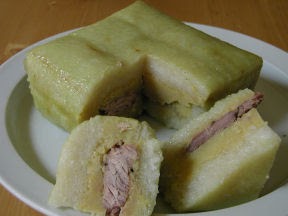
Banh chung

Traditional Tet foods include roasted watermelon seeds, and banh chung and banh tet (sticky rice prepared inside banana leaves).   For instructions on how to you’re your own banh chung and banh tet (including a video with step-by-step instructions), you may wish to go to the Viet World Kitchen site at :


Tet Pole or cay neu


In preparation for Tet, in addition to cleaning their houses, Vietnamese try to pay off all of their debts, so that they will not owe anyone as the New Year starts.  Also, many Vietnamese have a family altar for honoring one’s ancestors.  This altar is traditionally cleaned and new offering placed there on Tet. 


Traditional Tet decorations in one’s house include a decorated cay neu or Tet Pole and small kumquat trees. The first person who visits on Tet is considered an important omen for the coming year.  As a result, people invite someone they think can bring good fortune (for example, a very upbeat friend).  Being invited for this is a high honor.  

TSAGAAN SAR AND BITUUN


In Mongolia (and in China among the 4.3 million ethnic Mongolian minority), the holiday is celebrated as Tsagaan Sar. 

Mongolians are usually insulted if Tsagaan Sar is called “Chinese New Year.”  This is for two reasons.  First, the Mongolians believe that Tsagaan Sar predates the Chinese celebration, and strongly reject any Chinese influence.  Second, though this is no longer the casw the Communist leadership of China in the 1960’s tried to stamp out the religiously significant holiday among its Mongolian minority, persecuted its practitioners, and unsuccessfully attempted to rename the holiday “Cattle Breeders’ Day.”  This persecution ended with the liberalization of China, but has left very bad feeling not only among those Chinese citizens of Mongolian descent, but throughout the nation of Mongolia as well.

Mongolian buuz

Mongolian airag
Tsangaan Sar is a time of family gatherings and exchanging gifts. While the Chinese avoid meat on the first day of the New Year, the Mongolians do eat meat. Indeed, the most traditional meal of Tsangaan Sar is buuz, which are dumpling filled with beef or mutton. People also have airag, which is fermented mare’s milk.

Palden Lhamo
The celebration of Tsagaan Sar actually begins on the preceding day with Bituun. This is a day of cleaning houses and barns. In Mongolian Buddhist tradition, candles are lit at altars to symbolize the enlightenment of samsara  (the continuous cycle of life and death).  Bituun is also when people make amends with each other and settle disputes from the previous year. Finally, on Bituun,  the Buddhist Dharmapala (protecting, vengeful diety) named Palden Lhamo visits people’s homes. She arrives on horseback and people leave three pieces of ice on their doorsteps to quench its thirst.


TIBETAN AND BHUTANESE LOSAR

In Tibet and Bhutan, the lunar new year holiday is called Losar. Lo means "new" and sar means "year." Losar is also the name used for the holiday among the Sherpa and Tamang people in Nepal and the Bhutia people of the Indian state of Sikkim.


Masked performer in Losar play
In the Buddhist monasteries in Tibet , the day preceding Losar is a sort of winter equivalent to spring cleaning.  The monasteries are cleaned thoroughly, then decorated festively.  Losar itself is an important  religious observance.  Indeed, the last two days of the old year are considered a holiday -- called Gutor -- whose sole purpose is cleaning and other preparation for the first day of Losar. Special rituals are led by the Dalai Lama on Losar itself, followed by lamas, reincarnated monks and secular officials. On the first day of Losar, people traditionally bathe and go to the Temple to pray. Plays are put on in which masked performers enact the conquest of good over evil.

The second day of Losar – called King Losar Day -- is a secular celebration with gatherings of family and friends.  Traditionally, people eat dumplings with scraps of paper or bit of wood in them on which are written fortunes for the coming year.

Many Bhutanese traditionally travel attempt to travel to Tibet if possible.  In Tibet the holiday lasts 15 days; for Tibetan Buddhists in exile in India, the holiday has been shortened to 3 days; while Tibetan Buddhists in North America have customarily reduced the celebration to the first day of Losar only.

KOREAN SEOLLAL


Children wearing han bok at Seol
In Korea, people celebrate the New Year as Seollal (Solnal or Seol).  Customarily people not only clean the house for Seollal, but bathe first thing in the morning to clean themselves as well.  Many Koreans – and especially children --dress in (Solnal or Seol).  Customarily people not only clean the house for Seollal, but bathe first thing in the morning to clean themselves as well.  Many Koreans – and especially children --dress in (Solnal or Seol).  Customarily people not only clean the house for Seollal, but bathe first thing in the morning to clean themselves as well.  Many Koreans – and especially children --dress in ).  Customarily people not only clean the house for Seollal, but bathe first thing in the morning to clean themselves as well.  Many Koreans – and especially children --dress in han bok (the traditional Korean outfit). 


In contrast to the Chinese who use red on their New Year, most Koreans avoid red.  Likewise, where many Chinese avoid meat on the first day, fried meats are a traditional food for Seollal in Korea. That said, arguably the most popular Seollal dish is Duk gook (traditional Korean rice cake soup) for the morning meal. The traditional alcoholic drink called gui balk sul is drunk on Seollal as well; it is believed to make one’s hearing better… and by extension make one more aware during the coming year. In many Korean families, children show various forms of respect to parents and grandparents. For many Koreans, the most important tradition of Seollal is making offerings at the family altar, often including a seh bae or bow to the floor.  The types of offerings and where they are placed on the altar are complex and highly ritualized.

Traditional Seollal altar (left)
Performing seh bae (center)
Duk gook (right)
The game of yut
Seollal is also a time for having fun.  Adults and children often participate in family activities, such as kite flying (yeonnaligi) or playing games together. Throughout the 15 days of celebration, people traditionally play a game called yut (or yutnori) which is a sort of gambling game that uses four sticks (which is unusual in Korea where 4 is in all other things considered an unlucky number).

Also, Seol often includes visits to fortune-tellers for insight into the coming year. The 15th day concludes the celebration with the celebration of Daeboreum.  Unlike China or Vietnam, there are no lanterns involved.  Since Daeboreum occurs on the year’s first full moon, many people consider it important to be the first to see the moon rise.  Some people climb hills or even mountains to be the first to see the moon. 


Yakshik
A widespread custom (and far more common custom than mountain climbing) eating yakshik (a traditional concoction of sesame oil, honey, pinenuts and sticky rice)  One recipe for yakshik is available at the Asian Supper website: 

http://asiansupper.com/recipe/yaksik-sweet-sticky-rice

Finally, eating nuts is traditional, with the custom of cracking them with one’s teeth for the holiday.


JAPANESE OSHOGATSU


Officially, the Japanese do not celebrate the Lunar New Year. In 1873 in the midst of the modernization campaigns of the Meiji Restoration. the Japanese officially moved their traditional Lunar New Year celebration of Oshogatsu from the beginning of the lunar calendar to January 1 of the secular Gregorian calendar.


Joya no kane ceremony
at Shinnyo-do Temple, Kyoto
Nevertheless,  the Japanese continue to mix the old Oshogatsu traditions with the secular New Year and hold to the 12-animal cycle.  At the same time, in many Oshogatsu is still celebrated in rural areas at the beginning of the Lunar New Year. For example, in rural areas of Japan, the joya no kane ritual in which which people ring the great bells in Buddhist Temples 108 times (for eliminating the 108 earthly desires) on the actual Lunar New Year's Day while in the rest of Japan the bell-ringing occurs on New Year's Eve.

Even on the secular New Year, Japanese practice many of the same customs as the rest of Asia. As the Japanese site Family Customs explains:


Like other Asian New Year traditions, adults give money to children on New Year' Day. It is called "otoshi-dama" or the "new year treasure." Children also play various games to usher in the New Year. A popular game is "Furuwarai" which is the American version of pin-the-tail-on-the-donkey. http://familyculture.com/holidays/japanese_new_year.htm   


CONCLUSION

I have likely missed many cultures. Please share yours with me.

As always I welcome your input -- positive and negative -- and I hope
you find this valua
,ble. If you DO like this, please help spread the word and tell others. 


Gung Hay Fat Choy! (Chinese: May prosperity be with you!) 
Saehae bok manhi baduseyo! (Korean: May your receive many New Year's blessings!)
Lo Sar Bey Tashi Delek! (Tibetan: A New Year of prosperity and good will!)
An khang thịnh vượng! (Vietnamese: Security, good health and prosperity!) 


Clip Art Sources

Zodiac animals, ivory netsuke, Japan, American Museum of Natural History, New York


Banh chung: http://www.vietworldkitchen.com/blog/2008/02/tet-sticky-rice-cakes-banh-chung.html

Cay neu Tet pole:  http://v2.lscache6.c.bigcache.googleapis.com/static.panoramio.com/photos/original/32190086.jpg

Mongolian flag: http://www.mapsofworld.com/images/world-countries-flags/mongolia-flag.gif

Mongolian buuz: http://traditionscustoms.com/sites/default/files/buuz_mongolia.jpg

Mongolian airag:  http://upload.wikimedia.org/wikipedia/commons/4/41/Airag_2.JPG

Palden Lhamo: http://en.wikipedia.org/wiki/File:PaldenLhamo.jpg

Masked performer in Losar play: http://www.buddhachannel.tv/portail/spip.php?article11474

Children wearing han bok at Seol: http://bohemiantraveler.com/2011/02/my-korean-lunar-new-year/#

Korean altar, man doing seh bae, and duk gook: "Celebrating Soellal (Lunar New Year) in Korea," Official Site of Korea Tourism: http://english.visitkorea.or.kr/enu/SI/SI_EN_3_6.jsp?cid=941952
The game of yut: http://en.wikipedia.org/wiki/File:Korea_yut_pan.jpg

Yakshik: http://asiansupper.com/files/imagecache/recipe_page/119-yak-shik-sticky-rice-dates-nuts1.jpg

Joya no kane ceremony at Shinnyo-do Temple, Kyoto: http://www.kyotoguide.com/ver2/event/event%20currentevent-.htm


Tuesday, January 10, 2012

Year of the Black Water Dragon: Business Impact

Monday, January 23 marks the start of the Asian Lunar New Year  or Chinese New Year. It is the beginning of the year 4709 (in some traditions, 4710) in the Chinese system, which is the Year of the Water Dragon.

Today's post is the first in what will be a series of posts discussing the Asian Lunar New Year in general and the Year of the Dragon in particular. Today, we will look at some of the business impact of the event. Future posts will look at the background and significance of the Asian Lunar New Year from both cultural and religious perspectives as well as the significance of the Year of the Dragon itself this year. Other posts will discuss ways in which this holiday is celebrated in different cultures. A final post will point out major Year of the Dragon celebrations and parades around the world.

World's Busiest Travel Day

The Asian New Year

The Asian New Year is arguably the most widely celebrated holidays on the planet, whatever the year. Because the celebration generally means that families gather together, the holiday is annually the single busiest travel day. For example, during the Chinese New Year last year in 2011, an estimated 2.556 billion passenger trips took place within the PRC alone.
PRC officials estimate that 3.2 billion people
will be traveling in China
for the Year of the Dragon
http://www.chinainternetwatch.com/865/cny-2011-travel/

This year, the rush has already begun, with the official Chinese travel season starting on Sunday, January 8.  PRC government officials estimate that this year there will be 3.2 billion travelers in China.
 
This puts considerable pressure on China's travel infrastructure.  Speaking to Agence-France Presse news, China's chief transportation official Liu Tienan estimated record numbers for the Year of the Dragon, indicating that the People's Republic of  China would see 2.55 billion road passengers (an 11.6% increase) and 32 million air trips (an 10.8% increase).


Year of the Dragon Baby Boom and Marriages

As will be discussed in upcoming posts, people born in the Year of the Dragon are generally considered natural leaders and merit respect and honor. It is therefore a very auspicious year in which to be born. As a result, the Year of the Dragon results in a baby boom in East Asian countries every 12 years.  As China Radio International explained in a recent broadcast:


Experts predict births will climb by five percent because the icon of China's emperors symbolizes power and wealth. The emerging dragon year baby boom in the country is expected to provide lucrative business opportunities for infant-products makers and early-learning institutions from home and abroad.

Mark Tanner cartoon's take on
Year of Dragon baby boom
Nor is this at all limited to the PRC. Baby booms are expected throughout East Asia. Singapore
is expecting between a 10-20% increase in babies for the year and Taiwan is expecting a 20% increase.  The trend is entirely predictable each time the Year of the Dragon appears in the 12-year cycle.. As the Taipei Times notes:
Statistics from the Ministry of the Interior showed that the first dragon-baby boom in Taiwan occurred in 1976, with a total of 425,000 babies born that year — 50,000 more than in 1975. In the next year of the dragon, 1988, 342,000 babies were born, 208,000 more than in 1987. In 2000, the most recent year of the dragon, 202,000 more babies were born than in 1999. http://www.taipeitimes.com/News/taiwan/archives/2011/05/16/2003503374


Likewise, Vinicy Chan explained in Bloomberg Business Week, sales are expected to spike in China for a wide range of products including strollers, baby chairs, diapers and baby formula. For the full article, please see http://www.businessweek.com/printer/magazine/year-of-the-dragon-may-give-chinas-economy-a-lift-12082011.html

Indeed, the impact has already been felt. For example, Taiwan’s fertility clinics hit record numbers in 2011 as parents tried to ensure that they would have children in the Year of Dragon. Relatedly, elite hospitals in Hong Kong, Singapore, Shanghai and Seoul have all experienced bookings, as have nearby hotels. As an example, the Korea Herald reported that reservations for February 2012 increased by 130 percent at the Seoul Palace Hotel and by 30 percent each at Westin Chosun Hotel and J.W. Marriott Hotel compared to the same month this year. Other venues where reservations did not dramatically increase yet are closely observing the fuss about the black dragon year. 
  http://www.koreaherald.com/lifestyle/Detail.jsp?newsMLId=20111230000343
Another reason for the increased hotel reservations is that it is also considered good luck to marry during the Year of the Dragon. The Wall Street Journal, for example, reported that marriages in China are expected to spike by 12% in the Year of the Dragon.  In Hong Kong alone, 60.000 couples have already registered to be married over the year. Throughout China, couples have been encouraged not only from the good fortune of the Dragon Year but from the added good fortune of the leap year in the spring. As Isabel Steger in the Wall Street Journal explains:

Not only is it a Dragon year, but it’s also a leap year, according to the Chinese lunar calendar, with 13 months. The extra month is to synchronize the lunar year, which has 354 days, with the astronomical year, which has 365.25 days. The extra month makes it possible to have two “springs” in the year, which is auspicious. In Chinese, the word “spring” has connotations of fertility. http://blogs.wsj.com/chinarealtime/2012/01/06/hong-kong-developers-look-to-the-dragon/


Gold Sales and the Year of the Dragon

Also affected by the Year of the Dragon is the price of gold. Since the Year of the Dragon is associated with wealth, many gifts given at the time will be made of gold to reinforce the symbolism. This, in turn, affects the demand for gold. Indeed, the International Business Times of Singapore reported a 20% increase in sales among jewelers and private mints.
http://au.ibtimes.com/articles/272816/20111226/gold-buying-up-singapore.htm

 
Mint of Singapore
Year of Dragon commemorative coins
 In the PRC, Bullion Street and other gold sales monitors report that shops selling gold bars, gold dragons and related gold items have been so heavy that by the first week of January many retailers have been unable to meet demand. Additionally, jewelers and small shops that never before had sold gold bars are now opening up sections devoted to doing so for the course of the New
Year.

Perth Mint Year of Dragon gold coin


Mint of Niue
Year of Dragon Commemorative Piece
Special Year of the Dragon gold coins have been issued in limited editions by the Perth Mint in Australia, the Singapore Mint, the Royal Canadian Mint, the People’s Bank of China, tje New Zealand Mint, and Monnaie de Paris, the Mint of Finland, and the Mints  of the tiny Pacific nations of Niue and of the Cook Islands.


Other Business Impacts

Because dragons and tigers are compatible animals in the Chinese zodiac, Tiger Beer is running special promotions to capitalize on this. Sean Koh, marketing manager for Tiger Beer explained at the Year of the Dragon promotion launch:
The potent union of the Tiger and the Dragon is symbolic to an auspicious celebration this Chinese New Year. http://www.mmail.com.my/content/88391-time-tiger
Consumers buying Tiger beer (or its partner beers of Guinness, Anchor and Heineken) have the chance of winning one of 90,000 prizes of gold sets or cash. The promotion is directed at the Year of the Dragon celebrations, having started in mid-December and will run through February 6.


Nike has released a special "Year of the Dragon Pack" which they describe in a press release as follows:

Nike's Year of the Dragon Pack
All of the shoes will include iconography that pertains to the Chinese New Year and the cultural effect it has on its people. For example, the Nike Air Force 1 actually uses a black silk texture to symbolize Chinese royalty.  The Air Jordan 2012 takes the number 9, which is a sign of power and achievement, and tie that in to Michael himself.  Kobe is a little more multicultural, drawing from his Italian roots and his love of Kung Fu movies for his Nike Zoom Kobe 7 entry.  But Kevin Durant might be headliner of this pack since he was born in 1988, a Year of the Dragon.  There will also be a Nike Destroyer Jacket that comes in a special pack with the Air Force 1. http://www.examiner.com/nike-in-national/nike-year-of-the-dragon-pack-officially-revealed
Kikkoman soy sauce has published a special (and quite extensive) Year of the Dragon celebration booklet, with accompanying video and recipes. For the US version, please see  http://www.kikkomanusa.com/homecooks/offers/downloads/pdfs/kk_CNY2012.pdf

Rolls-Royce
dragon-embroidered headrest
For the Chinese elite market, Rolls Royce has begun selling special dragon-themed commemorative vehicles. These are enhanced with dragon embroidered interiors and hand-painted coachlines with themes adapted from Forbidden City designs. This is Rolls-Royce's first such special issue car for China, and points to its growth in that market (which is now its second largest market after the United States).
Finally, the Year of the Dragon is associated with risk-taking. Consequently, entrepreneurship and venture capital investments traditionally may also be affected positively in East Asia.


Check Back for More

I hope this has whetted your appetite. Please check back for more in the coming days when you can read about the background and significance of the Asian Lunar New Year, the significance of the Year of the Dragon, how the holiday is celebrated in different cultures and where to find major Year of the Dragon celebrations and parades around the world.

Gung Hay Fat Choy! (May prosperity be with you!)


Further Reading

Agence-France Presse, "China prepares for record Lunar New Year travel" (English version at ABS-CBN News), http://www.abs-cbnnews.com/global-filipino/world/01/14/11/china-prepares-record-lunar-new-year-travel

Rahu Basu, "Rolls-Royce Presents Exclusive Year of The Dragon Collection," http://www.zigwheels.com/news-features/news/rollsroyce-presents-exclusive-year-of-the-dragon-collection/9309/1

Bullion Street, "'Dragons' to lead China's gold sales in 2012," http://www.bullionstreet.com/news/dragons-to-lead-chinas-gold-sales-in-2012/728
            CRI- English edition, "Emerging Dragon Year Baby Boom,"
            http://www.taipeitimes.com/News/taiwan/archives/2011/05/16/2003503374
Vinicy Chan, "China Investors Rush Into Baby Care for Year of Dragon: Retail," Bloomberg BusinessWeek,http://www.businessweek.com/news/2011-11-30/china-investors-rush-into-baby-care-for-year-of-dragon-retail.html

Vinicy Chan, "Year of the Dragon May Give China's Economy a Lift," Bloomberg BusinessWeek, http://www.businessweek.com/printer/magazine/year-of-the-dragon-may-give-chinas-economy-a-lift-12082011.html

Anastasia Hendrix, "Most auspicious year could prompt baby boom," http://www.holymtn.com/astrology/BabyBoom.htm

Park, Min-young, "Wedding and baby boom expected for 'Black Dragon" year," Korea Herald, http://www.koreaherald.com/lifestyle/Detail.jsp?newsMLId=20111230000343
Kerry Rodgers, "World Mints Mark Year of the Dragon," World Coin News, http://www.numismaster.com/ta/numis/Article.jsp?ad=article&ArticleId=24515

Isabella Steger, "Hong Kong Developers Look to the Dragon," Wall Street Journal,
http://blogs.wsj.com/chinarealtime/2012/01/06/hong-kong-developers-look-to-the-dragon/
Esther Tanquintic-Misa, "Forthcoming Lunar New Year Spurs Gold Buying in Singapore," International Business Times, http://au.ibtimes.com/articles/272816/20111226/gold-buying-up-singapore.htm
Malay Mail, "Time for a Tiger," http://www.mmail.com.my/content/88391-time-tiger
Chinese travel photo: http://www.chinainternetwatch.com/865/cny-2011-travel/

Han Chang-duck illustration of Dragon Year pregnant woman and bride & groom: http://www.koreaherald.com/lifestyle/Detail.jsp?newsMLId=20111230000343

Mark Tanner Year of Dragon baby boom cartoon: http://marktanner.com/blog/year-of-the-dragon/

Wednesday, November 9, 2011

Some Musings on Palestine, Israel, Northern Cyprus and More

A Case Where Reader Comments Are More Interesting Than The Article

I read an article in the Economist's November 5, 2011 issue called  "One side gets even lonelier." http://www.economist.com/node/21536644 The article itself was not all that illuminating, focusing in pretty standard fashion on the opposition to Israeli PM Netanyahu's actions in the West Bank.  What I found fascinating was the high volume of comments (170 as I write this) posted by readers on the Economist's comment site for the article. Many of these were as I would expect, ranging from ranting diatribes against Israel to fervent defenses of Israel and much of the range in between.  

One of these comments, though, made it worth scanning the other 169. This was an analysis posted by a reader named "equilibrium."  I know nothing about him or her, but "equilibrium"'s comment really made me stop and reassess my position on the Israeli-Palestinean situation.

The main point of the comment is not the legitimacy of Israel's position in the West Bank or Palestine's legitimacy in calls for statehood. It is not about Palestine's refusal to recognize Israel's right to exist or Israel's refusal to recognize Palestine until such a right to exist is provided. It says nothing about Jerusalem, about UNESCO's recognition of Palestine, about the illegality of new settlements and so forth.  It never addresses the Hamas and Fatah factions within Palestine or the divisions within Israel regarding Israeli PM Netanyahu's policies. In short, it says little of substance about the main issues.

North Cypriot flag
 
Palestinean flag
What the comment from "equilibrium" DOES provide, though, is a well-thought-out, neutrally-written comparison between the situation in Northern Cyprus and in Palestine. The comparison is apt in my opinion (though no two situations are the same by any means). What "equilibrium" then asks is why so little focus settles on the Northern Cyprus situation and why so much focus settles on Palestine.

"Equilibrium's Comment"

I would like to hear your comments on what "equilibrium" wrote, which is as follows:

"The reason why I like to analyze the the Cyprus issue is because I think it is a valid litmus test in order to determine whether those who condemn Israel are impartial or anti-Semitic.

Both cases are very similar. A war involving Greece, Cyprus and Turkey breaks out in 1974 resulting in Turkey illegally occupying part of Cyprus resulting in large numbers of Greek-Cypriots fleeing the north. Over the next 35-40 years tens of thousands of Turks settle occupied northern Cyprus illegally with many Greek Cypriots claiming that their land is being confiscated. In addition, Turkey built a wall separating the island in two.

In my opinion, it makes no sense why there is an intense worldwide focus on the Israeli occupation of the West Bank while there is much less intensity on the Turkish occupation of Cyprus even though both cases are similar. One way to explain it is that in today's world it is no longer acceptable for countries to make anti-Semitic laws so the only way for certain individuals to vent their anti-Semitism is to find reasons to condemn Israel. While I don't consider objective criticism of Israel to be anti-Semitic, it is peculiar that those who condemn Israel for the settlements, the West bank wall etc, don't even care about the Turkish settlements and the separation wall in Cyprus.


One possible answer is an anti-Semitic excuse to bash Jews."

http://www.economist.com/comment/1115885#comment-1115885

My Thoughts

Playing the X Card  

I am often hesitant when anyone plays the "X" card, whether that be the "racism card" or the "sexism" or -- as in this case -- the "anti-Semitism" card. It tends usually to shift the focus of the conversation from the point at hand to one of defensiveness. Instead of hearing what is or is not valid in a position, playing the "X" card ends up having the response devolve into cries of "I'm not a racist!"or  "I support women's rights!" or "Lots of my friends are Jews!" This is the "How dare you!" response.
The Comparison of Northern Cyprus to Palestine: How Valid Is It? 


West Bank Settlements
In many respects, the comparison of Northern Cyprus to Israeli settlements in the West Bank of Palestine that "equilibrium" suggests is accurate. Both situations are largely viewed as illegal by most of world opinion. Both cases resulted in significant refugee populations.  Both cases involve divisions of culture, language and religion. Both cases remain difficult to settle because of the backing of countries outside of the disputed areas. And both cases have been around for a long time (1988 with the declaration of an independent Palestine by the PLO;  1983 with the claims of an independent Northern Cyprus).
Divided Cyprus
In many respects, the comparison of Northern Cyprus to Israeli settlements in the West Bank of Palestine is, however, not parallel. Aside from Turkey, no nation recognizes Northern Cyprus' right to exist; by contrast, 127 nations already formally recognize Palestine as a state and even Israel itself recognizes the need for recognition of a Palestinean state. Relatedly, Northern Cyprus recognizes Southern Cyprus' right to exist. Indeed, under the Annan Plan referendum of 2004, 64.9% of Turkish Cypriots voted to reunite with Southern Cyprus in a federal state (along the lines of Canada or Belgium) while 75% of Greek Cypriots in the south refused any such compromise. This is quite the opposite of the Israeli-Palestinean situation in which Palestine officially does not recognize Israel's right to exist, constituting a major stumbling block in negotiations. Moreover, while relations between the two Cypruses are far from good, there is little ongoing terrorism from Northern Cyprus against Southern Cyprus, while the acts of terrorism from not only the West Bank but from Gaza against Israeli civilians are very frequent and cause an ongoing (and justifiable) distrust. Finally, whereas the border between Turkish and Greek Cyprus is unfriendly and armed, that border is stable. By contrast, Jewish settlements into Palestine are ongoing and represent a continual force of instability in what a final border might actually be were negotiations ever to succeed.


Why Is There So Much Relative Attention on the Palestine-Israel Conflict?

The issue raised by "equilibrium"'s post, therefore, legitimately does raise the question: why does world opinion focus so intently on the Palestinean situation and so little on the Cypriot situation?  Both are in the same region of the Eastern Mediterranean. Both are intractable. Both have caused considerable hardship for refugees and both have resulted in open conflict.


Disputed Western Sahara
Sahrawi Arab Democratic Republic Flag
The case for "equilibrium"'s claims of something else involved -- perhaps, in truth, anti-Semitism --becomes even more likely when one considers the lack of world response to many other similarly disputed nationality disputes. For example,  the UN sees the occupation of the former Spanish Sahara by Morocco illegal and the UN still officially categorizes the region as a non-self-governing territory of Spain, even though Morocco has occupied it since 1975. Although with nowhere the same level of force as in Palestine or Northern Cyprus, the UN has tried to intervene through negotiated settlements-- as have several European nations and the United States --without success. Morocco has faced an ongoing intifadah from the Polisario Front since then with ongoing bloodshed. The Polisario Front declared independence in 1976, and since then 81 nations (as well as the African Union) recognized the territory as the Sahrawi Arab Democratic Republic. Yet there is no world attention.  
Taiwan flag

 
Kosovo flag

One can make a similar case for several other disputed countries with varying levels of recognition. These would include the Republic of Kosovo (recognized by 85 countries) and Taiwan (officially recognized by only 23 nations, though many non-recognizing states such as the US are its allies). In both cases, a powerful nation opposes the existence of each country: Kosovo is strongly opposed by Russia and Taiwan is strongly opposed by the People's Republic of China. Yet even with nations as powerful as Russia and China in the mix, neither Kosovo nor Taiwan regularly receives the world's attention in anywhere near that of the Palestine. 
Abkhazia flag

South Ossetia flag
Even when the legitimacy of the countries involved are considerably more disputed, world attention seems oddly absent relative to that of the Israel-Palestine dispute. Here one could point to the statuses Abkhazia, South Ossetia, Chechnya, Transistria and Tibet. Where is the comparable attention to Abkhazia and South Ossetia? Both have considerable levels of violence and both of which are recognized -- and hotly disputed -- by several foreign countries. One could make a case for the lack of world attention regarding Chechnya or Transnistria as well, although these are countries with no external recognition. Indeed, it seems that the only one of the disputed nations just described that has anything close to the attention of Palestine would be Tibet, although the demands are China are minimal compared to the demands on Israel in this situation, so I am not sure that is so accurate a claim.

Is the Focus on Israel a Form of Anti-Semitism? Is "Equilibrium" Right?

I certainly don't believe that all criticism of Israel even remotely constitutes anti-Semitism. The policies of Israel are hotly contested within Israel and it seems unlikely that Israelis themselves would be motivated by anti-Semitism.

That said, personally, I think "equilibrium" is onto something in his "possible answer" of a more acceptable "excuse to bash Jews." I am not positive of that but I willing to give it considerable thought.

So those are my thoughts. What are yours?