Welcome to the David Victor Vector Blog

Welcome to the David Victor Vector blog. This is blog that covers religious observances around the world international affairs and global business. This blog describes religious holidays for most major religions as well as raising issues dealing with globalization, international business ethics, cross-cultural business communication and political events affecting business in an integrated world economy. I look forward your discussion and commentary on these articles and subjects. Enjoy!

Sunday, September 12, 2021

Yom Kippur 2024

Yom Kippur for 2024 begins at sunset on Sunset, October 11 and continues through one hour past sunset on Saturday October 12. All employees, students and faculty requesting so should be accommodated. 

Yom Kippur is the Jewish Day of Atonement. It is a day to, in which "you shall afflict your souls" (Leviticus 16:29) and -- as the name indicates -- to atone for one's sins throughout the preceding year. 

Together with Rosh HaShanah (which occurs 10 days earlier), Yom Kippur forms part of what are called the High Holy Days. The days following Rosh HaShanah and leading up to Yom Kippur are called the Days of Awe. As the culmination of the High Holy Days, Yom Kippur takes a special prominence. For more on this, please see my post on Rosh HaShanah. 


Yom Kippur: Conclusion of the High Holy Days

On Rosh HaShanah, Jews traditionally believe (whether figuratively or literally depending on their interpretation) that God opens the Book of Life (Sefer Chaim) and writes in it the fate of each person including "who shall live and who shall die." 

On Yom Kippur, that fate in the Book of Life is sealed.  Starting with Rosh HaShanah, through the Days of Awe and until the close of Yom Kippur, Jews believe that repentance, prayer and acts of lovingkindness (the somewhat lacking but rough translation of the Hebrews words tshuvah, tefillah and tzedakah) are able to "avert the stern decree." The decision is sealed and set at the conclusion of Yom Kippur.


Importance Given Yom Kippur

Generally speaking, Yom Kippur can be considered the most important day of observance in Judaism. 

Among observant Jews, traditionally, the weekly observance of the Sabbath on Saturdays is the most important Jewish holiday. In practice, though, for many Jews who do might not regularly attend weekly Sabbath services, do attend services on the High Holy Days, and, especially, on Yom Kippur.  (Please note that I am in no way attempting to take a stance on what is or is not proper observance for any religion in these updates, but rather simply trying to make the general community aware of the various religious practices as they affect activities for employees, students or others).

Dating Yom Kippur

Yom Kippur, like all Jewish holidays, appears to wander in the secular calendar.  This is because the secular calendar is not consistent with the Jewish calendar. In the Jewish calendar, though, the holiday actually occurs on the same day of the Jewish calendar (the 10th day of the Hebrew month of Tishri). 

Also, as the Jewish calendar is based on the moon, the day begins with sunset and ends with sunset. Traditionally, the holiday does not close until an hour past sunset to ensure that the sun has unarguably already set. This is a practice of adding an additional hour is usually observed by Orthodox and Conservative Jews but less often observed by Reform and Reconstructionist Jews.

The Fast

Yom Kippur is a complete fast day. This is a 25-hour fast that begins before sunset on the eve of Yom Kippur and continues until nightfall of the following day. Throughout Yom Kippur Jews, Jews abstain from 
  • eating or drinking anything (including water)
  • wearing perfume or lotion
  • bathing
  • having sexual relations
  • wearing leather shoes (some Jews include any leather)
Most Jews interpret the fast to include abstaining from smoking as well. 

As with all Jewish fasts, health takes precedence over the fast. Women in childbirth or women who have given birth within the past three days are, for example, explicitly forbidden to fast even if they want to do so. Likewise children under nine are explicitly forbidden to fast even if they want to do so. Women who are pregnant and children between 9 and 13 are permitted to fast but must break the fast if they feel weak. Similarly, people with diseases requiring that they eat regularly (such as diabetes) or with conditions of weakened health are permitted to fast but are required to break the fast if they feel their health is being affected.

On Yom Kippur, Jews are prohibited from work of any kind. This includes writing, using the phone or computer, physical labor and the like. 

Because playing music is prohibited as well, the holiday concludes only after sunset so that it is possible to blow the shofar  (or ram's horn). Please see the post on Rosh HaShanah for more on this.


Yom Kippur Service

Length of Service

Yom Kippur is the longest worship service in the Jewish calendar. This holds true for all branches of Judaism. 

While the length of services varies from one branch of Judaism to another, it is not uncommon for Orthodox and Conservative Jews to spend almost the entire day in the synagogue, leaving only to sleep at night. Even in the sometimes shorter Yom Kippur services of many Reform and Reconstructionist branches of Judaism, most worshippers still spend the vast majority of the day in services at the synagogue or temple.

Kol Nidre Service

The Kol Nidre Chant

The service on Yom Kippur eve is centered on the Kol Nidre prayer. The prayer takes its name from its first two words which are Kol Nidre, meaning "all vows" in Aramaic.

The prayer begins very soon after the evening service begins. This is because, to be valid, the Kol Nidre prayer must be recited before sunset.

The Kol Nidre Tune

The Kol Nidre chant is among the oldest tunes in the Jewish liturgy, and its melody is intended to echo the sounds of sighing or sobbing. The origin of the current tune dates to at least the late 13th Century with the so-called melodies of "MiSinai" (literally "from Sinai"). The "MiSinai" melodies are a group of 52 liturgical melodies of which by far the most notable is Kol Nidre Chant. Music historians date nearly all of the "MiSinai" music back to Maharam of Rothenberg (who lived from 1220-1293). That said, it is neither known how old the melodies were when Maharam of Rothenberg learned them nor if any of the "MiSinai" melodies post-dated him (since the tunes themselves were handed down without being written down for centuries).

While most versions of the Kol Nidre chant have a common origin in the "MiSinai" melodies, considerable variation exists within the interpretation of the music. Thus, there are, for example, German, Bohemian and Polish versions with minor differences. Additionally, each cantor or singer of the tune also adds a unique style as well.

Three regional variations of the Kol Nidre tune


In Classical Music

Ludwig van Beethoven first brought the tune of the Kol Nidre prayer was popularized to the non-Jewish world in 1821 (although never credited so indirectly) as the basis of the central theme of the sixth movement of his String Quartet No. 14 (Opus 131).
 
Cellist Yo-Yo Ma recorded a famous version of 
Bruch's Opus 41 Kol Nidre for Cello and Orchestra
The Kol Nidre tune was first explicitly brought to the non-Jewish world 60 years later through Max Christian Friedrich Bruch's 1881 Opus 41 (Kol Nidrei). This piece features a variation inspired by the main tune of the chant played on cello backed by a full orchestra. 

To hear Yo-Yo Ma's 2005 performance of this piece, please listen to

http://www.npr.org/player/v2/mediaPlayer.html?action=1&t=1&islist=false&id=4955739&m=4955759

Other classical composers to include at least part of the Kol Nidre tune in their works are Arnold Schoenberg (in 1938 with Opus 39, Kol Nidrei) and most recently John Zorn's 1996 Kol Nidre for String Quartet.
Johnny Mathis recorded Kol Nidre 

In Popular Music

In the area of popular culture, Kol Nidre has also been frequently featured. In the early beginnings of film, Al Jolson sings a version of the prayer in the 1927 movie The Jazz Singer. 

In popular music, recordings of Kol Nidre have been made by such varied singers as Perry Como, Neil Diamond and Johnny Mathis.


The Content of the Kol Nidre Chant

The content of the Kol Nidre chant itself is less of an actual prayer than a dry legal formulation. The wording is as follows:

All vows ("kol nidre"), obligations, oaths, and anathemas, whether called 'ḳonam,' 'ḳonas,' or by any other name, which we may vow, or swear, or pledge, or whereby we may be bound, from this Day of Atonement until the next (whose happy coming we await), we do repent. May they be deemed absolved, forgiven, annulled, and void, and made of no effect; they shall not bind us nor have power over us. The vows shall not be reckoned vows; the obligations shall not be obligatory; nor the oaths be oaths. (translation from the Jewish Encyclopedia).

Because Judaism teaches to take any vow with the utmost seriousness, the purpose of the prayer is to be forgiven from any rash vows made to God in the coming year that one can not fulfill. The Kol Nidre prayer does not absolve one from vows made to other people; only vows made between the worshipper and God.


Debate Over Kol Nidre

Much debate exists over the prayer even within the Jewish community. This debate was  carried on throughout the Middle Ages and into modern times on theological grounds. In modern times,several leaders in the early period of the Reform Movement in the 19th Century attempted to abolish the prayer, but for different reasons than those traditionally argued but instead as a means of disarming its use for excuses of anti-Semitism (see below).

Versions of the Kol Nidre Chant: Liturgical Differences

The Kol Nidre chant is one of the oldest in Judaism, dating back in some version at least to the time of Amram Gaon during his leadership of the Jewish Talmud Academy of Sura (which means between 857 and 875 CE). Some sources suggest that this version itself was simply set down from a far earlier earlier version. In the prayer book (siddur) of Amram, the prayer is in Hebrew, not Aramaic (and thus is called Kol Nedarim vs. Kol Nidre). 

The Kol Nidre Chant
in the Machzor of Worms, Germany 
(ca. 1270-1280)
The Hebrew version was still widely used in the Roman Mahzor (prayer book) dating to the 1480's.  In the Hebrew version, the vows were absolved for the vows broken during preceding year (rather than the potentially unmet vows of the coming year). The Hebrew version was still the standard version for the Jews of Italy and Romanian (or Balkin) before their extermination during the Holocaust. Some of the surviving members of these communities continue this tradition of reciting the Hebrew version.

The majority of Jews, however, recite the Aramaic version. That said, the version of the prayer differs depending on one interpretation or the other. One formulation of the prayer (called the old version) retains wording regarding the vows being from the preceding year while a second formulation (called the new version) carries the modification from the past year to the coming year. The "new version" dates to the early 1100's when the French Rabbi Meir ben Samuel (called the Ram) modified it.  

The Jews of Spain  rejected the modifications of the "new version."  The descendants of this Jewish community are called Sephardi Jews (from the Hebrew for Spanish).  Today Sephardic Jews continue to recite the "old version" of the Aramaic prayer. The Ashkenazi Jews (the name for the Jews who settled in Central and Eastern Europe), by contrast, recite the "new version" of the Aramaic prayer.

The Sephardi and Ashkenazi Jews today, though, are no longer geographically determined. Sephardic Jews are no longer to be found in Spain (Jews were only permitted to return to Spain in 1968), but are spread around the world. For more on this, please see my post on Tisha B'Av at

http://davidvictorvector.blogspot.com/2012/07/tisha-bav.html

Following the forced expulsion of the Jews from Spain in 1492, Sephardic Jews were distributed far from Spain, especially in the Netherlands, Morocco and (before the Jewish expulsions from most Arabic countries following the founding of Israel in 1948) from North Africa and the Middle East. Similarly, Ashkenazi Jews are similarly spread around the world, after the upheavals first of the 19th century Russian and Ukrainian pogroms, followed by the Holocaust and then the post-WWII persecution under the Soviet era. 

Today in the United States, Canada, Argentina, France, Australia and Israel, the two traditions live side by side. In some congregations, as a compromise, the prayer is repeated in both versions. 

Anti-Semitism and the Kol Nidre Chant
 
It is important to clarify here that the Kol Nidre forgiveness of vows deals only with vows between worshippers and God. It does not negate vows between the one making the vow and any other person. The reason it is important to emphasize this is the long history of anti-Semitism associated with the misunderstanding of the Kol Nidre chant.  As the Jewish Encyclopedia explains:
The "Kol Nidre" has been one of the means widely used by Jewish apostates and by enemies of the Jews to cast suspicion on the trustworthiness of an oath taken by a Jew... so that many legislators considered it necessary to have a special form of oath administered to Jews ("Jew's oath"), and many judges refused to allow them to take a supplementary oath, basing their objections chiefly on this prayerhttp://www.jewishencyclopedia.com/articles/9443-kol-nidre#anchor9
Attacks on Jews using Kol Nidre as a supposed proof of Jewish duplicity or untrustworthiness has a very long history. The earliest formally recorded accusation in a court dates back to 1240 when Jehuel of Paris was brought to trial to defend charges based on the Kol Nidre prayer. 

In many European countries throughout the Middle Ages through the emancipation of the Jews in the 19th Century, Jewish testimony was either given extra restrictions or prohibited altogether based, at least in part, on the excuse that the Kol Nidre prayer made their testimony untrustworthy. 

Well into modern times, the use of Kol Nidre chant to justify anti-Semitism was widespread ranging from Henry Ford's anti-Semitic diatribe in the International Jew (1921) through the citation of the prayer in anti-Semitic Nazi propaganda. 

It continues to be a staple among dozens of anti-Jewish hate groups today, as exemplified by the title of Pastor Mark Downey's 2009 sermon "Why We Hate Jews, Part 3: Lies Kol Nidre" on the Kinsman Redeemer Ministry site (I have chosen to withhold the web links here so as not to further promote such hate-mongering).  

Other Yom Kippur Prayers and Practices

Extra Service Components

As mentioned before, Yom Kippur is the longest prayer service in the Jewish calendar. Yom Kippur has five parts (for Reform and Reconstructionist Jews) or six parts (for Orthodox and Conservative Jews rather than the usual three of daily prayer in Judaism.

In daily prayer, traditionally Judaism has only three services: Evening Prayers (Ma'ariv, in this case with the additional Kol Nidre service), Morning Prayers (Shacharit) and Afternoon Prayers (Mincha). On Kippur, there are five (rather than three) services. To the three just mentioned are added the so-called Additional Prayer Service (Musaf) which is also recited on the other major holidays as well as the Closing Prayers (Ne'ilah) which are recited only on Yom Kippur. 

Ne'ilah
Roses were given out at 
Ne'ilah in Germany 
before the Holocaust

The Closing Prayers or Ne'ilah last for roughly an hour and are said while standing the entire time as the day draws to an end. Because of the full day of intense prayer accompanied by fasting, many people may feel faint or weak. By Jewish law, anyone who feels this way must sit down. 

In several cultures, specific Nei'ilah traditions arose to add strength in the final hour of the fast. For example, it is the custom of Jews in Chile to pass around an orange or lemon in which cloves have been placed so that the scent will give strength as the hour grows late. 

Similarly, for centuries it was the custom of the Jews of Germany to hand out roses to the women of the congregation to fortify them with its fragrance. Today, following the annihilation of Germany's Jews, some congregations regardless of origin continue this practice as a way of keeping alive the memory of those killed in the Holocaust.

Avodah Service

In Orthodox and Conservative Judaism, there is also a special addition called the Avodah. This is not a prayer service in the same way as the other five but rather a form of re-enactment of the Temple service in ancient times. In the Avodah service, the descendants of the priests (the Kohanim) of the Temple in Jerusalem (more or less) conduct a version of what would have been the service done at the Temple had the Roman not destroyed it in 70 CE. The word "avodah" is Hebrew for work, referring to the work of the priests. 

Other Special Prayers

While Yom Kippur is full of special prayers, three are perhaps particularly noteworthy: 

  • the Ashamnu (short confessional
  • the Al Cheyt (long confessional and 
  • the Unetaneh Tokef (more or less a prayer of being judged).  

It is customary to strike one's breast
during the Yom Kippur confessionals
All of the confessional prayers are in the second person plural ("we"). This communal confession serves many purposes, and is subject to much commentary in Judaism. Among these is the belief that by communally confessing, each person recognizes his or her responsibility for others. Thus, even if the individual worshippers may not have felt that they have committed this or that particular transgression, they remain culpable for not preventing others from doing so. Another often-cited commentary on the plural confession is that it allows the individual who may be too ashamed to confess a particular transgressing in public to confess it aloud to God as part of the whole congregation. In any case, while reciting the group confession, the individual also may include private petitions simultaneously.

The Short Confession or Ashamnu

The Ashamnu takes its name from the opening word of the prayer "ashamnu" which means "we have transgressed" or "we have incurred guilt."  The Ashamnu prayer consists of 24 lines written as an acrostic (that is the opening letter of each line begins with each successive letter in the Hebrew alphabet -- the Hebrew equivalent of an A to Z set of lines were the prayer to have been in English). 

The Ashamnu is said out loud by the entire congregation in the first person plural form (e.g., "We have transgressed, we have betrayed, we have stolen, we have spoken falsely" and so on). 

The Ashamnu is recited while standing with one's head bowed. With each item, the worshipper strikes his or her chest to imprint the words on the heart. 

The Long Confessional or Al Cheyt

 
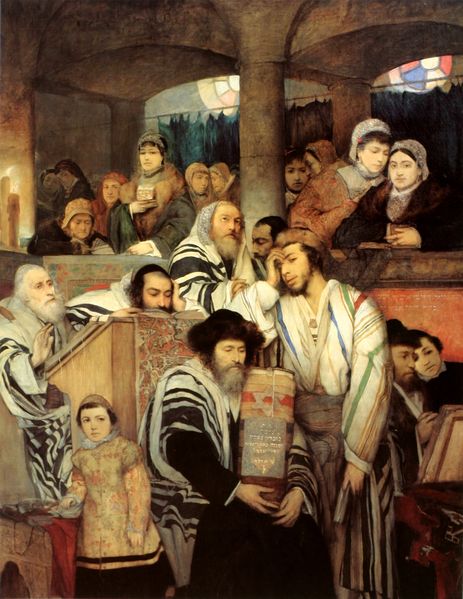
 Maurycy Gottlieb
 Jews Praying in the Synagogue on Yom Kippur (1878)
Tel Aviv Museum of Art
The Long Confession or Al Cheyt takes its name from the opening words of each of the 48 lines of the prayer "Al Cheyt" which means "For the sin" in Hebrew. The 48 lines of the Al Cheyt prayer all begin with the phrase "For the sin which we have sinned against You..." with the following word forming a double acrostic (double alphabetical listing). 

The prayer is recited 10 times during Yom Kippur. As with the Ashamnu, the Al Cheyt is recited while standing with one's head bowed and with the worshipper striking his or her chest to imprint the words on the heart. 

Significantly, of the 44 sins recited, 40 deal with sins of person against person and only 4 deal with sins of person against God. Particular importance is given to confessing sins of speech, of which 12 of 44 are concerned (e.g., "for the sin which I have committed against You through harsh speech" or "for the sin which we have sinned against You for deceiving a fellow human being", etc. ).

Unetaneh Tokef 

Probably the best-known prayer of both Rosh HaShanah and Yom Kippur services after Kol Nidre is the Unetaneh Tokef prayer. The opening words of the prayer from which it takes its name means something along the lines of "We shall ascribe..." which leads into a longer introduction describing Yom Kippur as a Day of Judgement.  

The central section of the poem deals with judgement (see below). The prayer then closes with God's attributes and the worshippers' helplessness and ends with a recognition of God's enduring nature.

All parts of the Unetaneh Tokef are important but the middle part of the prayer is perhaps the most widely-known outside of Jewish circles. This part of the prayer deals with the balance of one's behavior resulting in the decision of who shall be inscribed in the Book of Life (Sefer Chaim) and who shall die and in what manner.

The wording of this section of the Untaneh Tokef prayer is as follows:

On Rosh Hashanah will be inscribed 
and on Yom Kippur will be sealed 
how many will pass from the earth 
and how many will be created; 
who will live and who will die; 
who will die at his predestined time 
and who before his time; 
who by water and who by fire, 
who by sword, who by beast, 
who by famine, who by thirst, 
who by upheaval, who by plague, 
who by strangling, and who by stoning. 
Who will rest and who will wander, 
who will live in harmony and who will be harried, 
who will enjoy tranquility and who will suffer, 
who will be impoverished and who will be enriched, 
who will be degraded and who will be exalted. 
But Repentance, Prayer, and Charity 
avert the severe Decree!”  
(translation from: http://www.ou.org/chagim/roshhashannah/unetanehtext.htm )


Leonard Cohen's "Who By Fire"
is based on the Unetaneh Tokef  
This is because the prayer is commonly discussed in general theological discussions. It may also be known through its adaptations (as with Kol Nidre) in secular music, as in Leonard Cohen's "Who By Fire" song.

Although central to all branches of Judaism, considerable debate exists among them regarding how literally one should take the words of the prayer. These range from very literal among Haredi Jews to entirely symbolically among Reconstructionist Jews, with considerable variation in between.


Ending the Service and Breaking the Fast

The Yom Kippur service concludes with a single blast of the shofar. This is followed by a (usually rapidly recited) Havdalah service. "Havdalah" in Hebrew means "separation" and is used to mark a separation for all Jewish holidays from the ordinary days of the week.

After this, most congregations break the fast at the synagogue or temple before people leave with some sort of light food and beverage (cake and juice, for example). After this people go home or gather at the houses of relatives or friends for a larger meal to break the fast.

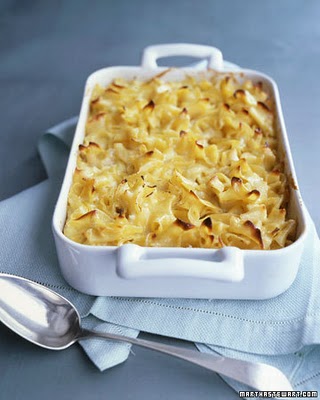
Egg noodle kugel
What people eat at the break fast meal differs from tradition to tradition. That said, most traditions break the fast with a dairy meal (as opposed to a meat meal) as this is easier to digest on an empty stomach. Often the meal is laid out in a buffet style featuring easy-to-provide offerings such as bagels with smoked fish and cream cheese. 
 
Many traditions  include eggs or dishes made with eggs as a symbol of the birth of a new year. Egg noodle pudding (called lukshen kugel) often sweetened with raisins is a common choice.  For a recipe for sweet egg-noodle kugel, please see http://kosherfood.about.com/od/dairymaindishes/r/kugel_noodle_d.htm 

Cheese blintz
Finally, it is common to feature sweets, honey and jams to symbolically represent the coming of a "sweet" or good year. A popular choice for this is the cheese blintz, a sort of Jewish cheese-filled sweet crepe. For a recipe for cheese blintz with blueberries, please see:

http://www.epicurious.com/articlesguides/holidays/highholydays/yom-kippur-recipes-kugels-blintzes/recipes/food/views/Cheese-Blintzes-with-Blueberry-Sauce-232828


Conclusion

Yom Kippur is a very important holiday within Judaism, and this is only a brief overview. Nearly every aspect of the holiday's practice and liturgy have been subject to centuries of debate. It is not my intention in any way to suggest that either this post is a comprehensive coverage of these or that I am in any way taking a stand on any of these. Please feel free to share your comments.

L'Shanah Tovah! To a Good Year Ahead!


Further Reading

Marsha Bryan Edelman, Reform Judaism Magazine, "Sounds of Kol Nidre," http://reformjudaismmag.org/Articles/index.cfm?id=1274

Chabad.org, "What Is Yom Kippur?": http://www.chabad.org/holidays/JewishNewYear/template_cdo/aid/177886/jewish/What-is-Yom-Kippur.htm

Irene Connelly, "No streaming, no singing: here’s how High Holidays will work in Modern Orthodox synagogues," The Forward, August 7, 2020, https://www.google.com/search?client=firefox-b-1-e&q=Orthodox+Judaism+high+holiday+streaming

Rhodora Dagatan, Toptens.com, "Top 10 Traditions on Yom Kippur": http://www.tiptoptens.com/2011/10/07/top-10-traditions-on-yom-kippur-day/

Dan Ehrenkrantz, PBS.org Relgion and Ethics Newsweekly, "Interview with Rabbi Dan Ehrenkrantz" (on the Yom Kippur service): http://www.pbs.org/wnet/religionandethics/episodes/september-26-2008/rabbi-dan-ehrenkrantz/648/ 

Encyclopedia Brittanica, "Kol Nidre":  http://www.britannica.com/EBchecked/topic/321300/Kol-Nidre
Holidays.net "The Jewish Holiday of Yom Kippur":   http://www.holidays.net/highholydays/yom.htm

Ellen Frankel, Jewish Reconstructionist Federation, " "A Reconstructionist D'var Torah: Yom Kippur Unetanah Tokef -- In the Wake of the Decree":  http://www2.jrf.org/recon-dt/dt.php?id=195

Lewis Eron, Jewish Reconstructionist Federation, "A Reconstructionist D'var Torah: Yom Kippur Eleh Ezkarah -- Sacrifice and Martyrdom": http://www2.jrf.org/recon-dt/dt.php?id=196

Sherwood Goffin, The Kosher Spirit, "Kosher Music":  http://www.kosherspirit.com/Article.asp?Issue=17&Article=217
Jewish Encyclopedia, "Kol Nidre," http://www.jewishencyclopedia.com/articles/9443-kol-nidre

Avi Lazerson, Jewishmag.com, "Customs and Traditions of Yom Kippur": http://www.jewishmag.com/47mag/yomkippur/yomkippur.htm


Elazar Meisels, Partners in Torah, "Yom Kippur in 60 Minutes (or Less)": http://www.partnersintorah.org/jewish-holidays/yomkippur

Shaul Rosenblatt, Aish.com, "Yom Kippur: A Day of Reconciliation": http://www.aish.com/h/hh/yom-kippur/theme/48970706.html?s=mpw

Shraga Simmons, Scribd.com, "Exploring the Al Chet Prayer": http://www.scribd.com/doc/6390128/Al-Chet-Prayer

Liam Stack, "For a Second Year, Jews Mark the High Holy Days in the Shadow of Covid," New York Times, September 6, 2021, https://www.nytimes.com/2021/09/06/nyregion/nyc-jewish-high-holy-days.html

Arthur Waskow, The Shalom Center.com, "Al Cheyt: For the Misdeeds We Have Done Before You": https://theshalomcenter.org/node/238

Michael Weiss, Slate.com, "The Anti-Semite's Favorite Prayer" http://www.slate.com/articles/life/faithbased/2008/10/the_antisemites_favorite_jewish_prayer.html


Clip Art Sources:

Opening banner: http://www.theholidayspot.com/yomkippur/

Book of life with scales:  http://www.rats2u.com/clipart/holidays/clipart_holiday3.htm

Yom Kippur star:  http://www.catch-allclipart.com/holiday/yom_kippurclipart.html

No eating clip art: http://www.tiptoptens.com/2011/10/07/top-10-traditions-on-yom-kippur-day/

Three regional variations of the Kol Nidre tune: http://d5iam0kjo36nw.cloudfront.net/V07p542001.jpg

Yo-Yo Ma: http://www.npr.org/templates/story/story.php?storyId=4955739

Johnny Mathis Kol Nidre album: http://www.bangitout.com/uploads/6Johnny_Mathis_Kol_Nidre_single_copy_2.jpg

Kol Nidre in the Machzor of Worms, Germany: http://en.wikipedia.org/wiki/File:Kol_nidre_in_the_machzor_of_Worms.jpg

Worshipper striking breast: http://www.tiptoptens.com/2011/10/07/top-10-traditions-on-yom-kippur-day/

Book of Life: http://www.torahtots.com/holidays/yomkipur/booklife.htm

Leonard Cohen album: http://www.technodisco.net/img/tracks/l/leonard-cohen/1221589-leonard-cohen-lover-lover-lover--who-by-fire.jpg

Rose clip art: http://bestclipartblog.com/clipart-pics/pink-rose-clip-art-3.png

Maurycy Gottlieb,  Jews Praying in the Synagogue on Yom Kippur (1878): http://photos1.blogger.com/blogger2/7536/1681/1600/yom_kippur_3.0.jpg

Egg noodle kugel: http://hungrygerald.com/wp-content/uploads/2011/12/kugel.jpg

Cheese blintz: http://www.epicurious.com/articlesguides/holidays/highholydays/yom-kippur-recipes-kugels-blintzes/recipes/food/views/Cheese-Blintzes-with-Blueberry-Sauce-232828

Closing clip art: https://blogger.googleusercontent.com/img/b/R29vZ2xl/AVvXsEjP_CXTsXzl_Bx33_zNgAdibxB66RNNs0h_dSXH5ettUVgmVbiSCx8n1lQhouXFsKUZxmLLeYup5-Htv4obxw_AyIKrsnoBs_QuAoycipI1frp7NKT-OQsS2cJd9AHeFZTOIL4hvANjl1E/s1600/yom_kippur.jpg

Monday, April 12, 2021

Ramadan 2021: Observances, Worldwide Customs and the Pandemic


The Islamic obs
ervance of the holy month of Ramadan (رمضان) for 2021 begins on (or near to, depending on the sighting of the moon) the evening of Thursday, April 12 and ends on the evening of Saturday, May 12 with the concluding holiday of Eid al Fitr.   

As with all Islamic holidays, the actual date depends on the sightability of the moon. While the most commonly accepted date for 2021 is for sunset of April 12, some debate exists among certain sects as to whether the sighting of the moon should be on the same day as the sighting of the moon in Mecca or the day following. Because I have received criticism for stating one date only in the past, let me state clearly here that this overview is meant to be informational only and is in no way intended to indicate that one view or the other is correct.

All students, employees and faculty who request it, should be accommodated. For most Muslims, the first and last days of Ramadan are usually spent in worship and students, employees and faculty should be excused from activities if requested. Some Muslims also observe an exclusion period in the mosque (Iʿtikāf ) during the last 10 days of Ramadan and may need accommodation. 

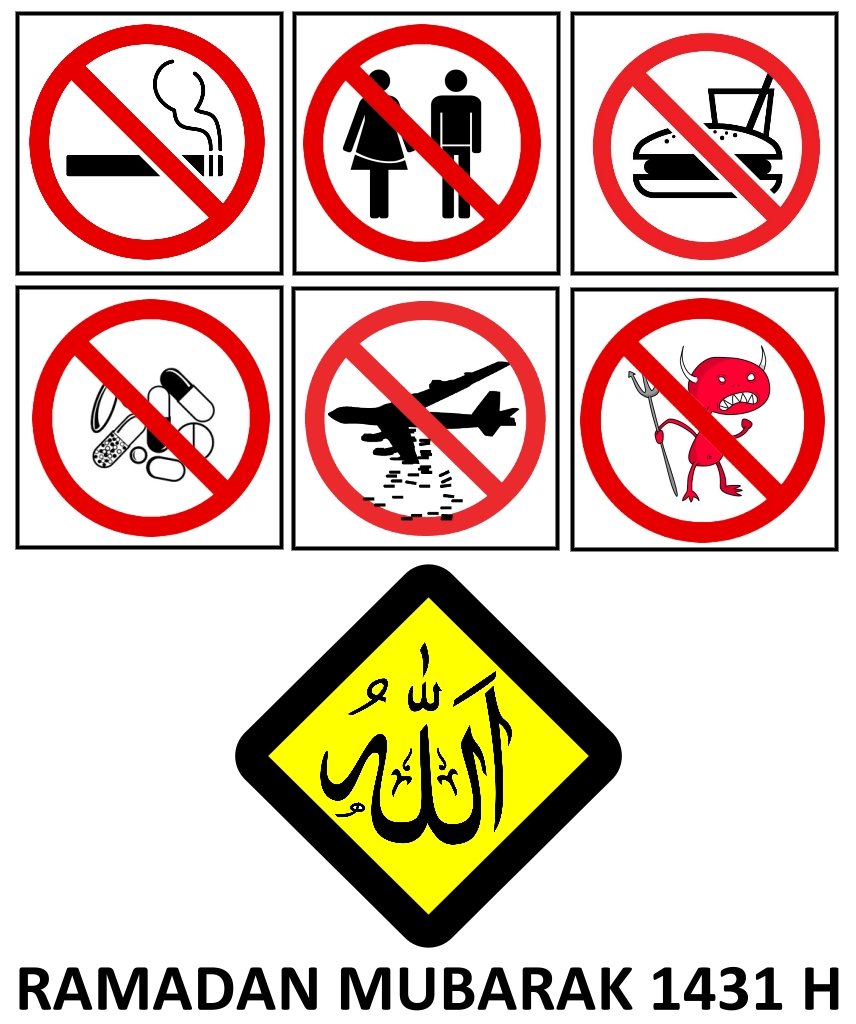
Importantly, during the entire month of Ramadan, believers fast during the daylight hours. Part of accommodation should therefore include discouraging others from eating or drinking in class or in other settings where attendance is mandatory. Consideration should also be given to requiring attendance at meetings where food is served (as in serving meals or snacks during the meeting).

Ramadan: Islam’s Holy Month

Ramadan is a time of worship and contemplation in Islam. Ramadan is observed by all sects.  The month of Ramadan – the ninth in the Islamic lunar calendar -- is also when it is believed the first verses of the Koran were sent down from heaven in 610 CE.

It should be noted, however, that this was not the Koran in its entirety which was revealed through the Prophet Mohammed (عليه السلام) during a 23-year span (only concluding in 632 CE).

Shared Ramadan Observances

While Ramadan customs vary from culture to culture, almost all Muslims share in common the observances of fasting, prayer and the conclusion of the month with Eid al-FitrThe observance of Ramadan is a central practice of the faith, and its observance is one of the Five Pillars of Islam.

Fasting or Sawm (صوم‎)

Muslims observing Ramadan fast during daylight hours. The fast includes all food, drink, recreational drugs, sex and tobacco. Most Muslims also consider the fast to include a ban on evil thoughts, gossip, lying, cheating and fighting from dawn to sunset. 

Those observing Ramadan will usually want to break their fast at sunset.  Breakfast or lunch meetings, snacks brought for a class and the like should be reconsidered accordingly. Also, even employees, students and others who may not always observe the prayer at the setting of the sun (Maghrib) may do so during this month (note that if it is not possible for students to pray at the appointed times, they are permitted to pray as soon as they can after that – which might, for example, affect an student’s willingness to stay after class or an employee to stay late for a project). Each day the fast is broken with prayer and a meal called the iftar (إفطار ).

Taraweeh ( تراويح‎) and the Recitation of the Koran

In the evening following the iftar it is common for many people to go to the mosque for Taraweeh or night prayers. Many also go to visit family and friends and recite the prayers together there. Some schools of thought consider Taraweeh compulsory while others consider the prayers voluntary but strongly encouraged. The actually number and nature of the pairs of rakaʿāt recited also vary according to sect and custom. Because feelings run very deeply on this issue and I do not wish to in any way appear to endorse one practice or another, it may be best to refer to the reading lists at the end of this post to read about these different views.

Many Muslims recite out loud the whole Koran during the month of Ramadan. This is in imitation of what the Prophet Mohammed (عليه السلام) during his lifetime. Some families have a tradition of gathering together as an extended family or in groups of friends to recite the Koran as a group activity. In nations with Muslim majority populations or in which Islam is the state religion, the recitation of the Koran is often broadcast over radio and television stations. 

Iʿtikāf ( اعتكاف‎)

Lailat ul Qadr
Though not a requirement, many Muslims choose to go into a state of Iʿtikāf or seclusion (usually in a mosque) for a period during Ramadan. This is most commonly for the last ten days of Ramadan so that they can be praying and reading the Koran on Lailat ul Qadr.  Lailat ul Qadr or the Night of Power was the night in which the first verses of the Koran were revealed to the Prophet Mohammed (عليه السلام. The Koran teaches that  "Lailat  ul Qadr is better than a thousand months" (Sura 97: 3) and so prayers are much greater in power then. Nevertheless, the actual night of Lailat  ul Qadr remains unknown, except that it occurs within the last ten days (some believe last five days) of Ramadan.


Conclusion of Ramadan with Eid al-Fitr

Depending on sightability of the moon, the evening of Thursday, May 12 will be the start of  Eid al-Fitr. The festival marks the end of the month-long fast of Ramadan and, indeed, the Arabic (عيد الفطرtranslates as "Festival of the Breaking of the Fast." Eid al-Fitr is sometimes called "Lesser Eid" to differentiate it from Eid al-Adha (or "Big Eid" written about separately here).  

Eid al-Fitr is traditionally a time for meals with the extended family and friends that lasts for two or three days.
Palestinian ghraybeh
  Customarily, people break the fast with sweets, so sometimes the holiday is known as "Sweet Eid". The sweet foods represent the "sweet" end to Ramadan. These sweets vary from country to country. In Turkey and Bosnia, baclava is traditional (although what constitutes proper baclava varies). In the eastern Mediterranean, cookies (biscuits) are the central treat though again the type of cookie varies. Ghraybeh (Palestinian Eid cookies) are S-shaped shortbread stuffed with pistachios.  More foods are described below.


Muslims also give Zakat  ( زكاة‎) or alms to the poor throughout Ramadan. Muslims especially give alms to the poor in honor of Eid. This is called Zakat al-Eid.  Typically, people give a donation (in food or cash or both) to the poor. Many Muslim communities set up charity tables and public food kitchens or booths for the poor  Eid al-Fitr comes at the end of a month of particular piety and dedication to God, the holiday is also a time for giving forgiveness and praying for peace and unity.

The traditional Arabic greeting for the Eid is “Eid mubarak” which more or less translates as “Blessed Eid” or just “Happy Eid” (which can be said as well, of course).

Ramadan and the COVID-19 Pandemic 


This year in 2021 for Ramadan -- as was the case last year in 2020 -- Muslims must consider how the global COVID-19 pandemic will affect the holy month.

Restrictions around the world demand social distancing, curfews and stay-at-home lockdown laws in place to fight the spread of the virus. This, in turn, restricts gatherings for iftar and public charity tables and centers. These are now banned or heavily curtailed in most countries. Likewise Ramadan in many countries is a time of crowded street stalls and bazaars selling food, clothing and more. These too have been shut down or heavily limited because of the need to curb the spread of the virus.

For example, Oman, at the most extreme lockdown , has banned tarawih prayers and iftar gatherings altogether while prohibiting all nighttime commercial activities and even the use of vehicles. Oman is also closing its borders to all non-Omanis throughout Ramadan.  

Almost as restrictive is Qatar, which is dealing with a far worse COVID-19 wave than in 2020. Qatar has limited gatherings to a maximum of 5 people and only for those who are fully vaccinated. And while Qatar allows mosques to remain open during the day, as in Oman, mosques are prohibited from holding tarawih prayers. Nighttime curfews will remain in place.

Jordan has closed mosques for Friday prayers throughout Ramadan and instituted a curfew from 7:00 PM to 5:00 AM -- one of the longest curfews in place. By way of contrast, Algeria's curfew runs from 11:00 PM to 4:00 AM while even with its strong precautionary measures, Qatar's curfew runs only from 9:00 PM to 4:00 AM. 

Tunisia has banned all public and private gatherings and, while stopping short of a nationwide lockdown, has closed all weekly markets and increased enforcement of social distancing and mask-wearing for the Holy month.

In the United Arab Emirates, tarawih and isha prayers at mosques are restricted to no longer than 30 minutes. Gatherings are limited only to members of the same family already living in the same house while iftar meals at mosques, in tents and in (or in front of) homes and restaurants are banned altogether. 

Saudi Arabia is allowing mosques to remain open this year, although Friday sermons are limited to 10 minutes and tarawih prayers to 30 minutes. Those entering Mecca to perform umrah will be closely monitored for valid permits (including proof of complete vaccination) and for maintaining social distancing and mask-wearing. These standards contrast markedly to last year when the KSA ordered not only the shortening of prayers with public attendance at the Two Holy Mosques at Medina and Mecca, but the closure of all other mosques. Saudi Arabia will again prohibit iftar or other public gatherings at mosques, tents or outside banquets.  This year's opening, however, remains tentative as Dr. Nasser Tawfiq explained “With the continued increase in COVID-19 infections in the Kingdom, a decision may be made to prevent prayer in mosques.”

Islam's third holiest place, the  al-Aqsa Mosque in Jerusalem, is also open this year when it had been closed to public attendance in 2020. The Waqf (which oversees the mosque) has encouraged people to be vaccinated before attending but does not appear to have an enforcement system in place.

Iran, following its Naw Ruz (see my earlier post) has found itself in the center of a fourth surge, this time of the highly contagious UK COVID-19 variant. As a result, Iran has imposed for most of the country a 10-day lockdown that began on April 10 and so in force at the start of Ramadan. 

Indonesia has banned the traditional Mudik, or mass migration to home towns, for 2021. Traditionally Indonesia -- the nation with the world's largest Muslim population -- sees roughly 30 million people traveling over the last five days of Ramadan.

Morocco and Turkey have called for tarawih prayers at home but will maintain their current lockdowns.

Lebanon is keeping all mosques, but with 30% capacity limits. 

Some major Muslim countries have, however, bucked the trend and left open or re-opened mosques. Iraq has no restrictions and Egypt only restricts staying overnight in their mosques. Afghanistan has left everything up to the individual worshipper. Kuwait maintains a night-time curfew but has only restricted mosques for women. Malaysia, which in 2020 had closed Ramadan bazaars and tarawih prayers, has allowed both this year (although with safety protocols still in place). 

Bangladesh has actually reversed its lockdown for Ramadan. After a month of mosques being closed during the pandemic, Bangladesh -- the country with the fourth largest Muslim population -- has re-opened all mosques for the Holy Month.

Pakistan, which has the world's second largest population has kept mosques open with minor limitations. These include bringing one's own prayer rug, limiting mosque attendance to those under 50 and restricting iftar at mosques. Yet last year, most Pakistanis flouted the restrictions and concerns of lack of enforcement remain strong for this year as well.
 
Finally, in Muslim-minority countries mosques (as most religious sites such as churches and synagogues) will remain closed for Ramadan as in Belgium, France, limited in number of attendees or closed during night hours as in the Netherlands, or left to individual communities. In other countries, mosques are opened but Islamophobic attacks have become so pervasive that many worshippers may fear attending services. This is especially the case in Australia where roughly 1/3 of the nation's mosques have been targeted by hate crimes.
 
What follows in the section below is a description of traditional Ramadan traditions in different countries. Almost all of these include public gatherings. Likewise the discussion above regarding joining in groups to break the fast and to go to the mosque involve large gatherings as well.  Beyond the share observances described above, customs vary from country to country. Only a few of these are described below (but please add in the comment section those from your own traditions). 


Ramadan Customs Around the World


Beyond the share observances described above, customs vary from country to country. Only a few of these are described below (but please add in the comment section those from your own traditions). 

Albania

Ramadan (in Albanian Ramazani) has particular significance in Albania. Under Communist rule, Albanians were prohibited from signs of worship. Ramadan was significant, though, since fasting could not be detected by the atheist authorities. With the end of the repressive regime of Enver Hoxha in 1991, though, public worship for Muslims and Eastern Orthodox Christians alike began to flourish. It is significant that virtually no religious conflict occurs between Muslims and Christians in Albania (unlike the neighboring countries of the former Yugoslavia where religion had not been banned). Indeed, at Ramadan, Muslim children now commonly share trays of Ramadan treats with their Christian counterparts just as the Christian children share Easter eggs with their Muslim friends. It is also not uncommon for Muslims to be invited Christians to their homes to break the fast with them even though the Christians were not fasting, and some Christians hold meals for breaking the fast in their own homes for their Muslim friends.
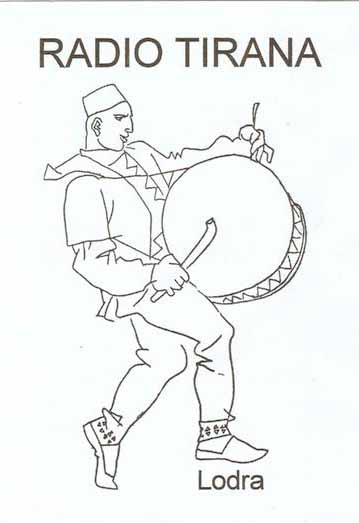
Since the fall of Communism, the Ramadan drumming of the lodra through the streets is common again. The lodra is the national instrument and appears on images for Radio Tirana. Men go through the streets beating a lodra so that people wake up to eat can eat before the sun rises. The man returns beating the lodra as the sun sets to announce the breaking of the fast. 
Albanian byrek
While Albanians offer a wide variety of food in different parts of the couuntry to break the fast, one of the most common Ramadan specialties is byrek. This is a a fried pastry made of phyllo dough and stuffed with spinach, meat or milk curd. People eat byrek cold or heated up depending on preference. A recipe for Albanian byrek is available at 

Egypt

Egypt comes alive at night during Ramadan. Shops, often closed during the day, stay open into to 3:00 or 4:00 in the morning and buildings are strung with lights and other decorations.

Fanoos lanterns for sale
in Cairo
Children celebrate Ramadan with a fanoos or traditional Ramadan lantern. These lantern are constructed of tin with colored glass (or sometimes plastic) panes through which shines the light from a candle placed in side.

One particularity for Egypt is fairly modern as Egypt grew to become center for Arabic-language television. To mark Ramadan, the Egyptian entertainment industry introduces over half of all Egyptian TV serials produced each year.

Ful medames
Special foods also mark Ramadan in Egypt. Traditionally, Egyptians begin their morning meal with ful medames. Often considered Egypt's national dish, ful medames dates back to the time of ancient Egypt and the Pharaohs. The dish is made of fava beans simmered together with olive oil, lemon juice, garlic and other spices. One recipe for ful medames is available at:


The traditional Ramadan drink of Egypt is called Qamar el-din. This is made from sheets of dried apricot paste boiled in water.

India and Pakistan

Hands decorated with henna
In India and Pakistan, Muslim girls traditionally dress festively with gold or multicolored bracelets and bangles. It is common for Ramadan in general -- and especially for Eid--  for girls to paint each others’ hands with mehndi (henna designs). 

Samosas

While Ramadan foods vary from region to region throughout India and Pakistan, one food common to iftar throughout both countries is the samosa.  A samosa is a fried, triangle-shaped pastry stuffed with any number of fillings. These can include vegetables, meat, chicken, potatoes and more.This accompanied with a dipping chutney of, from among others, mint, coriander, tamarind.  In fact, there are so many varieties of samosas, that an entire site is dedicated to them at


Indonesia

Bedug
The end of the day's fast in Indonesia is traditionally heralded by pounding of the bedug, a special drum for the occasion. Even in urban areas where an actual bedug may not be played, broadcasts of the sound of the drum are broadcast over radios and televisions. On the last night of Ramadan (called Lebaran), bedug players are often joined by large groups of musicians who play well into the night in a celebrative parade.


Panjat pinang pole-climbing 


In many Indonesia towns and especially in Jakarta, panjat pinang pole-climbing competitions are held at Ramadan. The poles are made from nut trees that have been smoothed down and covered with grease. No one person is usually able to climb the pole, so the climbing is usually a group effort. At the top of the pole are a collection of small prizes called panjat pinang. When someone reaches the top and grabs any of the prizes, they share them with those who helped them up the pole.

At the end of Ramada on Eid al-Fitr (called Idul Fitri in Bahasa Indonesia), it is customary in most Indonesian villages to go on Mohon Maaf visits following morning prayers. Mohon Maaf comes from the phrase “Mohon Maaf Lahir Batin” which means "forgive me from the bottom of my heart for my wrongdoings in the past year." Generally, the visits go in order of the most senior member of a family down and at each house, with food provided at each stop along the way. 

 Indonesians trapped in traffic 
in Karawang at conclusion of Eid al-Fitr
Many Indonesians have roots in the countryside even if they live in the large cities. This poses a special problem for Indonesia each year at Ramadan, as millions of people leave the cities for their hometowns. While many people in other countries leave for their hometowns as well at Ramadan, the situation is arguably at its most extreme in Indonesia. The expatriate information site "Living in Indonesia" estimated that last year for Ramadan 2011 over 7 million people left Jakarta alone to go visit their traditional homes. The crush of traffic at both the beginning and end of Ramadan therefore predictably overtaxes the national transportation infrastructure each year.


Malaysia

Malays shopping for flowers
for Ramadan
For Malays, people traditionally visit not only living relatives but also to visit graveyards to visit those relatives who have passed on. Ramadan is often a time of brightly-colored decorations and clothing among Malays. Many people decorate their homes with flowers and women in particular often wear colorful headscarves.  

A Ramadan Bazaar
in Kuala Lumpur
Throughout Malaysia on Ramadan, it is common to see "Ramadan bazaars." These are Ramadan counterparts to the year-round Malaysian night markets (pasar malam). Instead of opening at night, though, the Ramadan markets open in the late afternoon as people buy their food for the evening post-fasting meal. It should be noted that in Malaysia's multicultural society, the Ramadan bazaars are very popular with non-Muslims and Muslims alike.


Qatar


Qatari children dressed for Garangao
Qataris celebrate the 14th day of Ramadan with a special celebration called Garangao. The night of  Garangao is a children's celebration. Children dress in traditional clothing, sing a special Garangao song for their families at home and are rewarded with sweets. 

After this, the tradition is somewhat akin to the North American Halloween as the children go door to door for what is called a "nutting night out" as the children collect nuts and other treats from neighbors. Some Kuwaiti children, like their counterparts in Qatar, also celebrate Garangao in the middle of the holy month.


Kuwait

Firing the cannon
at Naif Palace
Since the arrival of the first cannon in Kuwait in 1907, it has been a tradition at Naif Palace in Kuwait City to fire a cannon shot to mark the end of the fast. It is customary to bring children to the gather around the cannon before iftar so they can celebrate in the blast. In recent years, the children have been joined by tourists -- both Muslim and non-Muslim alike -- for whom the blasts have become a Ramadan attraction. 

Luqmat Al-Qadi
On the eve of the first night of Ramadan, Kuwaitis celebrate with a pre-Ramadan festivity called Graish. At Graish, people gather with family and friends and welcome the holiday with the foods traditional to Ramadan in Kuwait. These include dates and special sweets such as Luqmat Al-Qadi. Luqmat Al-Qadi are balls of dough mixed with saffron, cardamom, milk and butter that are boiled in fat and then rolled in syrup or sugar.  A recipe for Luqmat al-Qadi can be found at:


Incidentally during Ottoman times,  Luqmat al-Qadi made its way from the Gulf countries to Turkey as lokma and Greece as loukmades.   Luqmat al-Qadi is also the source from which the Indian and Pakistani gulab jaman originally derived.

Kyrgyzstan

Traditionally at Ramadan, the Kyrgyz accompany their evening meal with drinks made from special Ramadan kurut. kurut is a dried yogurt ball.


Ramadan kurut balls
Osh Bazaar, Bishkek
Normal kurut are fairly small and extremely salty. By contrast, the special Ramadan kurut are roughly the size of someone's fist and are much salty. While regular, small-sized kurut are available all year long where they are sold throughout the country in plastic jars, the special Ramadan kurut are much harder to come by, and as a result are a special thing for most Kyrgyz.  These special Ramadan kurut are sold only in the Osh Bazaar in the capital city of Bishkek.

The Kyrgyz use Ramadan kurut to make a variety of Ramadan beverages. The balls are dissolved in carbonated water and mixed with tomatoes and onions for a savory drink. The balls are dissolved in hot water and mixed with sugar and creamy oil for a dessert drink. In either case, the kurut drinks are special for the holiday and represent a one-time-a-year tradition.

Mauritania

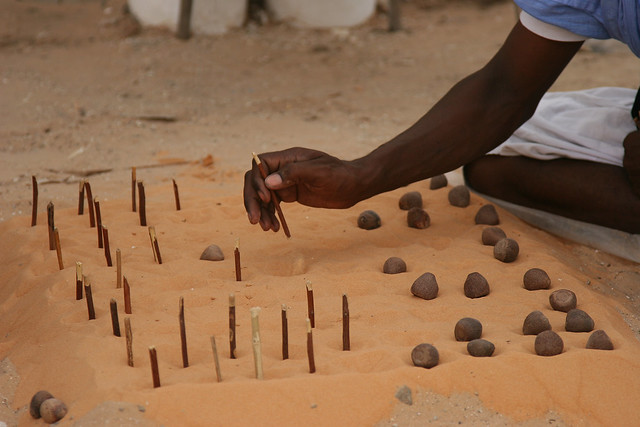
Ramadan in Mauritania is a time when traditional games are played, especially among women. 
What is particularly unusual in this tradition is that the games are primarily played by women in what is otherwise a primarily male-oriented society when it comes to competitions.

As the Mohamed Yahya Abdel Wedoud in his article "Mauritanians mark Ramadan with traditional games and neighbourly visits" explains: 
After prayers, traditional games such as ekrour and essik dominate the Ramadan nightlife, especially for women. Women throughout the country form teams and compete with each other.

Mauritanian woman playing traditional Ramadan game  
Morocco


A Morrocan n'far blowing his horn
In Morocco, a tradition exists in which a n'far (a special Ramadan equivalent to a town crier) walks down the streets playing a long, one-note n'far horn (similar to a brass vuvuzela) in the morning to wake everyone up in time for the last meal before sunrise. In many towns, being selected as the n'far is a high honor and usually bestowed upon an individual who knows everyone in the neighborhood well.


Moroccan chebbakia
Morocco is famous for its many special Ramadan treats, especially sweets. These include the anise and sesame-seed bread called qrashel, the turnover-like briwat, the crepe-like baghrir, and especially that most famous of all Moroccan sweets: the honey-soaked, sesame-sprinkled chebbakia. 
One recipe for chebakkia can be found at http://moroccanfood.about.com/od/tipsandtechniques/ss/How_to_make_Chebakia.htm

Turkey

Ramazan (the Turkish name of Ramadan) is generally a festive time throughout Turkey. Buildings and trees, especially in rural areas, are decorated with colored lights and booths are set up for the month selling traditional foods, religious books and a wide variety of Ramazan specials. 

 Lokum (Turkish delight)
Throughout the small towns of Turkey and even in some larger cities, special Ramazan drummers go through the street banging on drums. Their purpose is  to wake people before the sun rises so they have time to eat. 
The three days after Ramazan concludes is celebrated with the Sugar Festival (Şeker Bayramı) when -- as the name suggests -- sweets and candies are eaten. Traditionally, in addition to offering sweets to friends and family at home, children go from door to door ask for candy.  Most famous of the many sweets offered is lokum, known through most of the world as "Turkish delight."  A recipe for the treat can be found at


Concluding Comment

As with all of my commentaries, this overview is meant only as an informational message. It in no way is meant to suggest that one interpretation is in any way better than another regarding how to celebrate Ramadan  

That said, I am open to your input. Please feel free to share your comments for improvement (or support for that matter) with me. Ramadan Mubarek!


Want To Know More?


Murray Candle, "Ramadan: A Mosaic of Traditions Around the World," http://murraycandle.wordpress.com/2012/07/11/ramadan-a-mosaic-of-traditions-around-the-world/

Emel, ""Ramadan Across the Globe," http://emel.com/article?id=88&a_id=2446


Michael A. Fredericks, AllMalaysia.com, "Ramadan," http://allmalaysia.info/2011/08/19/ramadan/


Holidays.net, "Ramadan," http://holidays.net/ramadan/

Huda, About.com, "What is Ramadan?" http://islam.about.com/od/ramadan/f/ramadanintro.htm

Living in Indonesia, "Ramadan and Lebaran in Indonesia," http://www.expat.or.id/info/lebaran.html


Muhajabah.com, "Ramadan FAQ http://www.muhajabah.com/ramadan-faq.htm

Juliette Schmidt, OnIslam.net, "In Ramadan: A Journey Around the World," http://www.onislam.net/english/culture-and-entertainment/traditions/448896-ramadanaroundtheworld.html

TheEid.com, "Ramadan," http://www.theeid.com/ramadan/

Morocco World News, "Ramadan Life and Traditions in Ramadan," http://www.moroccoworldnews.com/2014/06/132599/ramadan-life-and-traditions-in-morocco/


Clip-Art Credits


Opening clip art: http://i1.squidoocdn.com/resize/squidoo_images/250/draft_lens19160628module157196200photo_1330258970aaa__a.jpg

Ramadan fast clip art (adapted from): http://fc09.deviantart.net/fs71/f/2010/224/f/3/RAMADAN_MUBARAK_1431h_by_bx.jpg

Mosque clip art: http://www.clker.com/cliparts/8/2/2/f/1282647222988584111mosque.svg.med.png

Lailat ul-Qadr clip art: http://sapnamagazine.com/wp-content/uploads/2010/09/laylat-al-qadr.jpg

Radio Tirana lodrahttp://web.mclink.it/MJ0350/libera/tirana/tiran19.jpg
Albanian byrekhttp://en.wikipedia.org/wiki/File:Evb%C3%B6re%C4%9Fi.jpg

Egyptian fanoos lanterns for sale: http://www.touregypt.net/featurestories/ramadanlanterns.htm

Henna hands: http://www.america.gov/multimedia/photogallery.html#/30145/multi_ramadan/

Samosa: http://recipesnest.com/wp-content/uploads/2010/12/samosa.jpg

Palestininan ghraybeh: 
https://palestineinadish.com/recipes/ghraybeh-with-pistachios/

Bedug drum: http://1.bp.blogspot.com/_kXYte55FGyo/SKQqfZtVKkI/AAAAAAAAAN8/wTs3t3m6iMo/s320/bedug.jpg
Panjat pinang pole climbers: http://www.odditycentral.com/pics/panjat-pinang-a-slippery-tradition-of-thailand.html

Indonesians trapped in traffic in Karawang at conclusion of Eid al-Fitr: http://i.telegraph.co.uk/multimedia/archive/01712/ramadan-indonesia2_1712808i.jpg

Ramadan flowers for sale in Malaysia:  http://www.america.gov/multimedia/photogallery.html#/30145/multi_ramadan/

Ramada Bazaar, Kuala Lumpur, Malaysia: http://allmalaysia.info/2011/08/19/ramadan/

Qatari children dressed for Garangao: http://www.cbq.com.qa/NewsDetails.aspx?id=344

Iftar cannon, Naif Palace, Kuwait: http://www.q8nri.com/home/2010/08/17/iftar-cannon-a-source-of-attraction-in-kuwait-in-ramadan/

Luqmat al-Qadi: http://en.wikipedia.org/wiki/File:Loukoumades.jpg

Ramadan kurut balls, Osh Bazaar, Bishkek: http://students.sras.org/what-bishkek-eats-for-ramadan/