Welcome to the David Victor Vector Blog

Welcome to the David Victor Vector blog. This is blog that covers religious observances around the world international affairs and global business. This blog describes religious holidays for most major religions as well as raising issues dealing with globalization, international business ethics, cross-cultural business communication and political events affecting business in an integrated world economy. I look forward your discussion and commentary on these articles and subjects. Enjoy!

Sunday, February 12, 2012

Parinirvana or Nirvana Day

Introduction

Dai-Batsu Buddha Shrine, Kamakura, Japan
February 8 or 15 (depending on which tradition one observes)  is the Buddhist holiday of Parinirvana or Nirvana Day. Note that while February 15 is the date for most Mahayana Buddhists, in some traditions, Parinirvana is observed on February 8 this year. In Canada, regardless of tradition, the holiday is officially observed on February 15.  

Nirvana Day marks the day in 483 BCE when Siddhārtha Gautama – the Buddha – died.  The Sanskrit word parinirvana or the equivalent Pali word parinibbāna refers to the death of physical body of anyone who attains enlightenment. The use of the word Parinirvana or Parinibbāna to refer to a holiday generally refers to the death of Siddhārtha Gautama -- Lord Buddha – as the first person to attain enlightenment.   

Theravada and Mahayana Buddhism
regions
Nirvana Day is celebrated primarily by Mahayana Buddhists. There are two major schools of Buddhism: Mahayana (with its offshoot of Vajrayana Buddhism) and Theravada. It should be noted that while the death of the Gautama Buddha is important in both branches of Buddhism, the event is celebrated as a holiday in the Mahayana (vs. Theravada) tradition. Theravada Buddhists usually celebrate this event in May as part of the the holiday of Vesak. Mahayana Buddhism is most traditionally associated with the Buddhist traditions of China, Tibet, Korea, Japan, Mongolia, Bhutan, Cambodia Vietnam and northern India.

Mahayana Buddhists celebrate the Buddha’s death as something joyous. It is not a sad event. This is because, in dying, the Buddha attained nirvana. Through his death, the Buddha left the world with his final lessons on achieving freedom from earthly existence and the cycle of suffering.

As a holiday, Parinirvana is an opportunity not only to rejoice in the death of the Buddha but also a day to recall those who have died among one’s relatives, friends and teachers. This, in turn, is used as a time to reflect on one’s own mortality and to be mindful of one’s own life in the face of the inevitability of death.

Two Versions of the Mahaparinirvana

Sakyamuni Buddha
Po Lin Monastery, Lantau Island
Hong Kong 
The death of the Buddha is described in two different versions, both with the same name. The Sanskrit Mahaparinirvana Sutra is the main sutra on which Mahayana Buddhism relies. Thereravada Buddhists, in turn, rely on the Pali language version known as the Maha-parinibbana Sutta.  To avoid confusion, the Mahayana version is frequently called just that: the Mahayana Mahaparinirvana Sutra.

For an English version of the Mahayana Mahaparinirvana Sutra, please see Kosho Yamamoto’s translation at


Yamamoto’s translation is the first full translation of the Mahayana Mahaparinirvana Sutra that has been widely accepted.

To compare this with the Theravada Pali language Maha-parinibbana Sutta, please see the translation of Francis Story’s English rendition of Sister Vajira version posted at the Buddhist Publication Site at:


While these two versions both describe the last days and final teachings of Gautama Buddha, and both describe his death and parinirvana, it is important to re-emphasize that the two scriptures differ significantly in content and structure.

Bhutanese Buddha
Indeed, while Theravada and Mahayana Buddhism share a great deal in common, the teachings of the Buddha in his final days presents one source of significant differences. This is an important distinction since in both traditions, the Mahaparinirvana text lays out in greatest detail the central principles of Buddha-dhatu (also called “Buddha nature” in English, Tathāgatagarbha in Sanskrit and Bussho in Japanese).

For more on the shared principles as well as the differences between Theravada and Mahayana Buddhism, I recommend that you read see Ankur Barua and M.A. Basilio’s excellent overview “Similarities And Differences Between Theravada And Mahayana Buddhism” at


Because the holiday of Parinirvana is primarily a Mahayana Buddhist holiday, the version of the Buddha’s death and the related passages quoted here are from the Mahayana scripture.


The Death of the Buddha

Foreknowledge and Delay of Death

 Death of the Buddha
Exterior of Daeungjeon Shrine
Jogyesa Temple complex, Seoul
Siddhārtha Gautama attained enlightenment at age 40, becoming the first person to attain buddhood. From this point, he acquired the title of the Buddha, meaning “Enlightened One.”  For more on Lord Buddha’s enlightenment, see the entry on this blog for Bodhi Day at


Buddha cave painting, 8th century
Dunhuang caves, Gansu Province, China

At the point of his enlightenment, the Buddha had the ability to enter Nirvana immediately, and be free from the cycle of attachment and suffering. He chose, however, to stay in his earthly existence to share the truth of enlightenment with those who would listen. For the next 40 years following his enlightenment, the Buddha traveled around northern India teaching and receiving those who sought understanding.

Because he had complete enlightenment, the Buddha knew exactly when and how he would die. He told his disciples that he would die at 80 far in advance of his death.

Cunda and the Final Meal

At 80, the Buddha became severely ill as he had foretold. For some time, he began to suffer from sharp abdominal pains. In the Theravada version of his death, Lord Buddha had sent his followers away for a set time during which his body began to fail. In this version, he willed himself to remain so that his followers could learn from him in his death.  In the Mahayana version, this is less clear. In both versions, in the days leading up to his death, the Buddha – weak and still suffering from intestinal pain -- was surrounded by his disciples in Kushinigar, the capital of what was then the nation of Malla, which is now the town of Kasia in the modern Indian state of Uttar Pradesh.

Buddha receives his last meal
from the metalsmith Cunda
In his last day, the Buddha traveled with his disciples to the village of Pava where he rested in the mango grove owned by a pious metalworker named Cunda. The Buddha requested his personal attendant, the great disciple Ānanda, to procure an offering of food from Cunda. Unknown to Ānanda or to Cunda, but known to the Buddha, this offering will be the last meal of the Buddha. Cunda provides two meal offerings. One is of general food and the other -- the meal eaten by the Buddha -- is called sukaramaddava which means “boar’s delight” but the content of which is debated. In some (though not all) Mahayana tradition this meal is one of “pig truffles” (that is, of truffles found by a pig); in Theravada (and some Mahayana) traditions, this meal is one of pork.

Whatever the actual last meal is, the food is contaminated. Knowing that eating Cunda’s offering will kill him, the Buddha willingly eats the meal. The Buddha, however, prevents any of those around him from eating the sukaramaddava. Instead he asks his disciples to bury the remainder of his own meal and insists that they eat only from the other food that Cunda has offered. The Buddha then enters into a discussion with Cunda about the nature of the two offerings, then answering questions that the artisan raises. The Buddha then blesses Cunda for the offering. This discussion is recorded in the Cunda Sutra.

Kushinigar Temple
is on the site of
the Buddha's mahaparinirvana
The Buddha soon after eating Cunda’s food becomes violently ill. Despite this, the Buddha insists on traveling to the city of Kushinigar, approximately nine miles away from Pava. Throughout the journey, the Buddha grows weaker and weaker and is in great discomfort with terrible stomach pains. Colored lights emanate from the Buddha’s mouth and other phenomena suggesting that all is not normal.

The Last Teaching Beneath the Sala Trees

Once in Kushinigar, the Buddha bathes in the Kakuttha river and rests under a grove of sala trees. The Buddha then turns to Ānanda and expresses concern for Cunda:


The Buddha next asks Ānanda to
please make a couch ready for me with its head to the North between two big sala trees. I am tired and I want to lie down.

Sala tree (Shorea robusta) in bloom
Also called sal or shala trees, the species gave
shade both at the birth and death of the historical Buddha

When the Buddha lies down, although February is not the right season for it, the sala trees burst into bloom and begin to shower the Buddha with flower petals.

The request to rest under the sala trees is significant as Queen Māyā of Sakya -- the Buddha's mother -- had given birth to him beneath a sala tree.


The Buddha then says
Ānanda the two big sala trees are scattering flowers on me as though they are paying their respects to me. But this is not how I should be respected and honoured. Rather, it is the monks or nuns, or the men or woman lay followers, who live according to my teaching, that should respect and honor me.

 Now it may happen that some people may make Cunda regret having given me the meal that made me sick.  Ānanda, if this should happen, you should tell Cunda that you have heard directly from the Buddha that it was a gain for him. Tell him that two offerings to the Buddha are of equal gain; the offering of food just before his supreme enlightenment and the offering of food just before he passes away. This is the final birth of the Buddha.

 Death of the Historical Buddha (Nehan)
Kamakura period (1185–1333), 14th century
 Metropolitan Museum of Art, New York
 

Once the disciples have gathered beside him, the Buddha lies on his right side in what is called the lion position, with his legs one on top of the other and his head supported in his hand.  This is the position in which all representations depict the reclining Buddha. The Buddha then asks his disciples if they have any last questions, and no one among those gathered speaks. The Buddha then utters his last words:

Now, monks, I declare to you: All conditioned things are of transient nature; Strive on untiringly with diligence.

At this point, the Buddha died and enters mahaparinirvana.

Parinirvana Observation

The commemoration death of the Buddha on Nirvana Day, as mentioned before, is a joyful occasion even if the day is also often quite solemn. The joyfulness of Parinirvana focuses on celebrating the Buddha’s escape from the cycle of suffering of the soul with the soul’s final freedom to achieve Nirvana. The solemnity centers on using the day to contemplate one’s own mortality, one’s own path to nirvana and the illusion of permanence in the material world. Nirvana Day is also a time for remembering those among one’s family, friends and teachers who have passed away.

On Parinirvana, people go to the temple where the recite portions of the Mahaparinirvana Sutra, sing special chants and meditate. During this time, the lighting in the temple is intentionally kept very dim. At the conclusion of the chants and meditations, the room is made bright. This symbolizes the enlightenment of the world through the Buddha’s teachings.

Nirvana Day in many areas is also traditionally a day for distributing gifts of money, clothing and other goods, especially to monks and nuns, but also to the needy.


Dum Alu

Many regional traditions have particular foods associated with Nirvana Day. In northern India, people traditionally eat Dum Alu (or Dum Aloo). This is made of potatoes (alu means potato in several northern Indian languages) in a rich spicy gravy. A recipe for Dum Alu can be found at


Udon Miso Soup

In Japan, some people mark the day by eating Udon Miso Soup. Udon are flat, wheat noodles.  A recipe for Udon Miso Soup can be found at


Concluding Comments

As with all posts on this blog, this overview is meant only to give a superficial overview of a widely celebrated holiday. This blog makes no intention of suggesting that one interpretation or religious text is correct or incorrect. The intent here is to be informative.

As always, I welcome your comments either here on the blog. Please share your traditions and customs.

Happy Nirvana Day! Blessed Parinirvana!

Want to Read More?

Buddha, Karen Armstrong, Penguin: 2004


“The Buddha’s Last Meal,” Buddha Dharma Education Association/Buddha.net, http://www.buddhanet.net/e-learning/buddhism/lifebuddha/2_29lbud.htm


“How to Celebrate Parinirvana Day,” Helium How-To Guides

“The Life of the Buddha,” Souled Out.org., http://souledout.org/wesak/storybuddha.html

“The Mahaparinirvana Sðtra and the Origins of Mahayana Buddhism,” Sasaki Shizuka, Japanese Journal of Religious Studies, 1999. 26:1-2, http://nirc.nanzan-u.ac.jp/publications/jjrs/pdf/539.pdf

“Nirvana Day,” About.com Buddhism,  http://buddhism.about.com/od/buddhistholidays/a/nirvanaday.htm


“Parinirvana Day of Shakyamuni Buddha,” The Jade Turtle Records, http://jadeturtlerecords.blogspot.com/2011/03/parinirvana-day-of-shakyamuni-buddha.html

“Parinirvana of Gautama Buddha,” Ramalingam, Relijournal, http://relijournal.com/buddhism/parinirvana-of-gautama-buddha/

Clip Art Sources

Dai-batsu Buddha Shrine, Kamakura, Japan. This is my own photograph. Please give credit if you wish to copy it.

Theravada and Mahayana Buddhism regions map: Buddha.net,  http://www.buddhanet.net/e-learning/buddhistworld/schools1.htm

Sakyamuni Buddha, Po Lin Monastery, Lantau Island, Hong Kong This is my own photograph. Please give credit if you wish to copy it.

Bhutanese Buddha. From the 2008 traveling exhibition "The Dragon's Gift: The Sacred Arts of Bhutan,"  http://www.buddhistchannel.tv/picture/upload/bhutan-art.jpg

Death of the Buddha, Exterior of Daeungjeon Shrine, Jogyesa Temple complex, Seoul: This is my own photograph. Please give credit if you wish to copy it.

Buddha 8th century Dunhuang cave painting:  http://dunhuang.mtak.hu/en/large-ch-53-1.htm

Kushinigar Temple: Buddhist Temples -- Path to Salvation: http://www.buddhist-temples.com/kushinagar.html

Sala trees: J. M. Garg, http://en.wikipedia.org/wiki/File:Sal_(Shorea_robusta)-_flowering_canopy_W_Picture_117.jpg

Death of the Historical Buddha (Nehan), Kamakura period (1185–1333), 14th century, Metropolitan Museum of Art, New York:   http://www.metmuseum.org/toah/works-of-art/12.134.10


Wednesday, February 1, 2012

Candlemas, Presentation of the Lord, Imbolc, Hypapante, Trndez and Groundhog's Day


February 2 is a day of religious observance for several Christian religions, Neo-Paganism and Wicca as well as the secular American holiday of Groundhog Day.

While Groundhog Day does not matter regarding class, staff or faculty accommodation, the holidays of Candlemas  (Roman Catholic, Episcopalian and Anglican), the Presentation of the Lord (Evangelical Lutheran) and of Imbolc (Wiccan and Neo-Pagan) are of importance and may require accommodation. 

 In the Eastern Orthodox Church, the same holiday is celebrated as the Presentation of Christ into the Temple, as Hypapante (Greek Orthodox) or as Trndez (Armenian Orthodox). 

February 2: A Shared Date

Candlemas, the Presentation, Imbolc and Groundhog’s Day all share a common date, even though the Orthodox tradition seems to come at a different time in most year.  Be aware that while in 2019, this is celebrated on February 2 as with the Western Christian counterparts, usually the date for these Eastern Orthodox faith comes later. This year, however, the Gregorian (Western or secular) and Julian (Eastern Orthodox) calendars align. In the Julian calendar, though, the date is still shared (it is only calculated as arriving at a different time).

The oldest of these holidays, is the neo-Pagan and Wiccan holiday of Imbolc. This holiday predates Christianity and falls on the quarter solstice, which is February 2 (beginning on February 1 in some traditions).  This is one of the four principle festivals of the Celtic tradition.

Candlemas in the Roman Catholic, Episcopalian and Anglican Churches falls on February 2.  In the Roman Catholic traditions of Ireland and Scotland, February 1 is the Feast Day of Saint Brigid (who, with Saints Columba and Patrick, is one of the three patron saints of Ireland).

In most Eastern Orthodox traditions, the holiday of the Presentation of Christ into the Temple (or Hypapante) is also February 2 in their own Julian calendar system. However, since the dates of the Julian calendar usually fall at a later date than their counterpart in the Gregorian calendar, this corresponds to the secular calendar date of another date (for example, February 15 in 2013). It is important to note that in the Julian calendar which the Eastern Orthodox Churches follow, this date actually is February 2.   

The Armenian Orthodox and Armenian Apostolic Churches celebrate their version of the same holiday – called Trndez, Tiarn'ndaraj,or Tearnandarach – over a span of three days, culminating on February 2 (in the Julian calendar).

The Relationship of Imbolc to the Dating of Candlemas and the Presentation of Christ

That the date of Imbolc in Wicca and Neo-Paganism is on Candlemas is not a coincidence. The holiday of Imbolc has always been on February 1 or 2 (depending on varying astronomical calculations), marking the halfway point between the Winter Solstice and the Spring Equinox.

Imbolc predates Christianity in the Celtic lands by centuries. The designation of Candlemas on the same date as Imbolc arose from an effort by the early Church to repurpose the pagan holiday.

In Ireland and Scotland, this is even more evident. In Ireland and parts of Scotland, Imbolc was celebrated as the holiday for worshipping the ancient Celtic grain goddess Brigid.


With the conversion of Ireland to Christianity, the Church assimilated the cult of the goddess Brigid with Saint Brigid (also called Saint Bridget, Saint Brighid and Saint Bride). Saint Brigid was the founder of the first convent in Ireland, and died in 525. Neither the date of her birth or death is formally known, but February 1 – the same day as the Festival of the Grain Goddess Brigid -- became assigned by tradition as her feast day at some point after her death with February 1. As with most saints of her period, Saint Brigid was never formally canonized, but became accepted as a Saint through practice and tradition. To this day, in Ireland and parts of Scotland, Candlemas is celebrated as Saint Brigid’s Day (Lá Fhéile Bríde in Gaelic).  

It should be noted that many in the Eastern Orthodox traditions point that, while Candlemas may have repurposed Celtic pagan traditions in northwest Europe, they would not have had an effect on religious practices so far to the east. This is true, and the Feast of the Presentation is separate entirely from the Imbolc practices.

It is the dating of the holiday that is arguably related. The Feast of the Presentation was a minor holiday of unclear dating before the 4th Century. The earliest references to the holiday are among the oldest celebrations recorded in Christianity, with references dating back at least as early as a sermon of the early Orthodox bishop Methodius of Patara in 312.  For Methodius and several others, though, the Feast of the Presentation fell on or around February 14. The date was moved to February 2 when Pope Saint Julius I during his papacy (337-352)  officially set the date of Christmas as December 25 to repurpose the pagan holidays associated with the Winter Solstice. For more about this, please see the post on Christmas Day

http://davidvictorvector.blogspot.com/search?updated-max=2011-12-26T14:54:00-05:00&max-results=10  ). 

The Presentation, by definition, had to follow 40 days later, fixing the date for the holiday as February 2. 

Groundhog’s Day

The secular holiday of Groundhog’s Day in the United States and Canada has its roots in Imbolc as well. The customary Imbolc practices of using animals to predict the date for planting (e.g., when winter would end) carried over into Candlemas. Following the Reformation with its efforts to eliminate Roman Catholic traditions, many Protestant countries that retained substantial Catholic populations such as Ireland, Scotland and many of the German states, simply repurposed the animal-based divinations as secular folk traditions to avoid punishment or condemnation by Protestant church or government official.

These folk traditions centered on watching the behavior of hedgehogs in the Old World and were carried over as folk traditions to North America where the hedgehogs were replaced by groundhogs for the same divination purposes. The North American tradition says that if a groundhog emerges on February 2 in clear weather and can see its shadow, Spring will come late. If the weather is cloudy and the groundhog sees no shadow, then six weeks more of winter will follow. 


The popularity of the secular holiday for weather divination served the same function in the largely Protestant United States and Canada, which had the same concern of any religious association with pagan animal divination but wanted to incorporate the popular folk traditions of newly immigrating Protestants coming from areas such as Ireland, Scotland and Germany with large Catholic influence (as well as immigration from Catholic themselves). As a result, Groundhog’s Day as a secularized Imbolc celebration became prevalent as large-scale immigration from Ireland and Germany to North America began in the 1840’s. The first recorded references to Groundhog’s Day date to February 1841 in Berks County, Pennsylvania.
 Groundhog Day (1993)

Groundhog Day celebrations are held in dozens of locations across the United States and Canada. By far the largest is the celebration at Punxsatawney, Pennsylvania where the groundhog Punxsatawney Phil predicts the weather. This was the subject of a popular 1993 movie Groundhog Day (which, I might add, is one of my personal favorite movies). The movie starred Bill Murray and Andie MavDowell and tells the story of a man destined to live the same day -- Groundhog Day -- over and over again in Punxsatawney during the Groundhog Day Festival there.


Christian Religious Significance

The religious significance of the holiday is essentially the same whether it is celebrated in the Eastern Orthodox, Armenian Apostolic, Roman Catholic, Evangelical Lutheran, Anglican and Episcopalian churches (and regardless of whether called the Presentation, Trndez, Hypapante, or Candlemas).

In all of these Christian traditions, the holiday marks the day that Mary and Joseph took the baby Jesus to the Temple in Jerusalem on the 40th day following Jesus’ birth. This was to fulfill two commandments in Jewish law. These were the commandments in the Jewish Torah to redeem one’s the firstborn child (Exodus 13:12-13) and to make an offering for purification 40 days after the birth of a son (Leviticus 12:2-4).

The New Testament describes the event as follows:

 And when the days of her purification according to the law of Moses were accomplished, they brought him to Jerusalem, to present him to the Lord;
(As it is written in the law of the LORD, Every male that openeth the womb shall be called holy to the Lord;)  Luke 2: 22-23
 
Icon of Simeon with the baby Jesus
in the Temple in Jerusalem
When Mary and Joseph are at the Temple in Jerusalem, they encounter a man named Simeon. In both Roman Catholic and Eastern Orthodox traditions, Simeon is canonized and is known as Saint Simeon. In the Orthodox tradition, he is also known as Simeon the God-Receiver. In Protestant traditions, he is known as Simeon the Righteous. In all traditions of Christianity, Christians believe that the Holy Spirit had promised Simeon that he would not die before seeing the coming of the Messiah. When Mary and Joseph bring the baby Jesus to the Temple, Simeon took the baby from them and proclaimed the Song of Simeon  (also traditionally known from its opening words from the Latin Mass as the Nunc dimittis). The Nunc dimittis remains a part of many Christian services, and is a central part of the Compline or Night Prayer Service in the Roman Catholic, Anglican, Episcopalian and Lutheran liturgy.

  Simeon with Jesus
by Lorenzetti Ambrogio

The Song of Simeon in the Anglican Book of Common Prayer goes as follows:

Lord, now lettest thou thy servant depart in peace : according to thy word.
For mine eyes have seen : thy salvation,
Which thou hast prepared : before the face of all people;
To be a light to lighten the Gentiles : and to be the glory of thy people Israel.

Saint Simeon’s Saint Day is February 3, the day after Candlemas.


Christian Traditions

Western Christian Traditions of the Feast of Presentation and Candlemas

Since the Second Vatican Council in 1965, the official name for the holiday in the Roman Catholic Church has been the Feast of Presentation of the Lord.  That said, throughout much of the Roman Catholic world, the holiday is still informally and widely

In the Roman Catholic, Anglican and Episcopalian Churches, the holiday is traditionally celebrated with a blessing of candles brought to the church. The candles represent Christ bringing light into the world. It is from this special mass involving candles that gives the name Candlemas (Candle Mass)  or some version of the name in other languages (such as Fête de la Chandeleur in French or Día de la Candelaria in Spanish).  Traditionally, believers then take these blessed candles back home with them and bring them out during bad weather when they are lit as a source of divine protection. This tradition is clearly evident in the Polish popular name for the holiday of Matki Bożej Gromnicznej (roughly, Mother of God Who Protects Us From Thunder).

Mexico and Guatemala

In Mexico as well as Guatemala and in some areas of other Central American nations, Día de la Candelaria is a particularly important holiday.

Generally, a party is thrown for the extended family on Día de la Candelaria or shortened simply to Candelaria.. Traditionally, a fruitcake ring is served at the gathering on the Day of the Three Kings (El Dia de los Reyes) on January 6 (please see the earlier blog post  at 


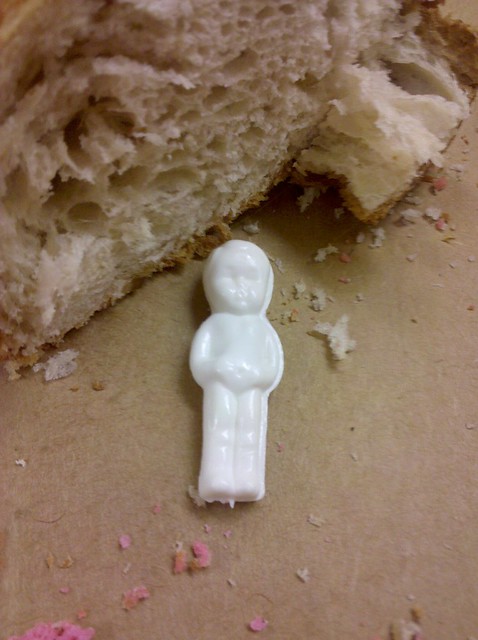
Jesus in the Rosca de Reyes

The cake – called Rosca de Reyes or King’s Cake -- has a baby Jesus figure hidden inside. Whoever gets the piece of cake with the baby Jesus must throw a party on February 2 for Día de la Candelaria.

 Niño Dios
dressed for Candelaria
Many people in Mexico and Guatemala keep a niño Dios (or Christ child figure) in their homes. This niño Dios is the central figure of nativity scenes around Christams and the Dia de los Reyes but is kept in the home year round. On Día de la Candelaria, many people change the clothing of their niño Dios and take it to the church to be blessed.

In Mexico, the traditional food dishes for Día de la Candelaria are tamales.  Tamales are filled pockets made of masa corn dough and steamed or boiled in a corn husk. For  Día de la Candelaria a whole variety of tamales are traditionally served ranging from savory to spicy to sweet fillings.


France

In France, Candlemas is called the Fête de la Chandeleur or simply Chandeleur. Again, this refers to the candle-lighting ceremonies at church.

Flipping crêpes for luck
is a Chandeleur tradition
The holiday is also known as the Jour des Crêpes, since the major tradition there is the making and eating of crêpes, a sort of very thin pancake, usually filled with different things from savory to sweet, and sometimes simply covered with sugar with no filling.  A tradition is to hold the crêpe pan in one hand and a coin in the other. The person making the crêpe then flips it high in the air. If the person can catch the crêpe perfectly in the pan, the family will have a prosperous year.

Though nowhere near as elaborate as the North American Groundhog Day, the French use the day of Chandeleur to predict the weather in folk sayings. The belief is that if there is snow on the ground on Chandeleur, there will be 40 more days of winter. The saying for this goes:

Chandeleur couverte, quarante jours de perte (Chandeleur covered, forty days lost)

The counterpoint to this is that if one sees dew on the morning of Chandeleur, then winter will soon be over. The saying for this goes


Rosée à la Chandeleur, hiver à sa dernière heure (Dew on Chandeleur, winter’s at its last  hour)
German-Speaking Lands

In German, the holiday is known as Mariä Lichtmess (or Mary’s Light-Mass).  As with other countries, the lighting of candles is part of the traditions although the holiday is more closely associated in the German-speaking areas of Europe with Mary than with the Christ child. In Liechtenstein, Mariä Lichtmess is a national holiday.
Blessing of the Candles, Heiligenkreuz Cistercian Abbey, Austria

In rural Bavaria and in the Fünfseenland, one traditionally lights a candle for every person in the home. Each person’s candle has his or her name written on it. Though this tradition has somewhat receded, traditionally, each person then prayed the rosary after lighting the candle. If the candle flickered while the prayers were said, this predicted bad health in the coming year; if the candle blew out during the prayers, this foretold grave danger or death.

 Blasiussegen
At the end of services in German-speaking countries, and especially in southern Germany, is a special blessing known as Blasiussegen (the blessing of Saint Blaise). The holiday is associated with the vigil of Saint Blaise held on the same day.   Blasiussegen takes the form of the priest giving the Sign of the Cross above the forehead of the worshiper as the recipient stands between (or holds in each hand) two twisted candles that are lit. The blessing -- a highly popular part of the service --  imparts protection from injuries of the throat, and especially from the swallowing of fishbones.

Another tradition for Mariä Lichtmess was a business one. Until 1918 in Germany, Mariä Lichtmess was the official day that farm laborers and housemaids were paid in full by their employers. In several regions, by law, both farm laborers and housemaids were committed to work for their employers through February 2. On  Mariä Lichtmess, though, they could leave their employment. Less honorable employers would, however, would withhold any wages that were unsettled if their employees chose to leave.

As in France and North America, German folk sayings use the holiday to predict the weather. Indeed, these Bauernregeln (folk sayings, literally farmers’ rules) are the source of Groundhog’s Day taking root in North America coming with these sayings first among German immigrants first in Pennsylvania and then spreading elsewhere.

One of these Bauernregeln goes

Ist's zu Lichtmess mild und rein
wirds ein langer Winter sein.

If Lichtmess is mild and pure
Then there will be a long winter.

Another of these Bauernregeln goes
Wenn's an Lichtmess stürmt und schneit,
ist der Frühling nicht mehr weit;
ist es aber klar und hell,
kommt der Lenz wohl nicht so schnell.

When it is stormy and snowy on Lichtmess
Then Spring is not very far;
But if it is clear and bright,
Then Spring won’t come so quickly.

Eastern Orthodox Traditions of the Feast of Presentation of Christ into the Temple

 Major-Archbishop of Kiev Lubomyr Husar at Candlemas
Eastern Orthodox Christians celebrate February 15 (February 2 in the Julian Calendar) as the Feast of the Presentation of Christ into the Temple. This is one of the 12 Great Feasts of the Orthodox Church. Another name for the holiday is the Meeting of the Lord. In Greek, the word Meeting is (in transliteration) Hypapante which is the name that Greek Orthodox Christians frequently give for the holiday. In Ukrainian and Russian, the holiday is often called Stritennya and Sreteniye respectively.

In the entire Eastern Orthodox calendar, the Presentation of Christ into the Temple is the only double Great Feast. This is because it jointly combines the Great Feast of Mary (Theotokos) with a Great Feast of the Lord.

The observance of the holiday begins with a minor feast (the forefeast) on the eve of the holiday that includes an all-night vigil, with a special set of prayers. This is followed at 6:00 AM on the morning of the Presentation of the Lord Feast Day with a blessing of the candles. As in the Western traditions, the candles represent Christ bringing light into the world. As with Roman Catholic and Anglican traditions, Eastern Orthodox Christians save these candles to use throughout the year to protect them during bad storms

Armenia Trndez

In both the Armenian Apostolic Church (or Armenian Orthodox) and the Armenian Catholic Church, the equivalent holiday to Candlemas is celebrated as Trndez (meaning "God be with you" and also known as Diarnt’arach or Tearnendarach meaning "Come before God")The main celebration is on the night of February 13 (Trndez Eve) and the day February 14.

Unlike most of the other Christian traditions which have somewhat surreptitiously repurposed pagan traditions for Candlemas, both the Armenian Apostolic and the Armenian Catholic Churches make it clear that  Trndez is clearly a Christianization of an ancient Armenian pagan tradition. Armenians claim to be the oldest Christian nation to have formally adopted Christianity (a claim contested by Ethiopians and Chaldean Christians). That said, the Armenian Christian tradition saw no need to hide the repurposing of the pre-Christian customs of the nation when Armenia officially adopted Christianity as its national religion in 301 AD. This simply followed the syncretistic religious customs of pre-Christian Armenia that had adapted various foreign elements such as Persian Zoroastrianism with its own local shamanistic customs. The overlay of Christianity on these practices was seen as a natural progression of faith.


Trndez bonfire in Yerevan, Armenia
In both traditions, in addition to the service in church and the lighting of candles there, there is a custom of lighting bonfires. It is this bonfire that has the ancient pre-Christian lineage. At the same time of year for centuries before the adoption of Christianity, Armenians had lit bonfires in the central areas of their villages at this time of the year. The ancient Armenians worshiped the fire as the birth of the fire diety Vahagn as a way to encourage the warmth of the sun to return. The pagan holiday was also dedicated to the god of knowledge Mihr. Of all the pre-Christian gods, Mirh was the one most associated with lovingkindness.  Since the national conversion in 301, the fire became repurposed to represent not the gods of fire, sun, knowledge and lovingkindness, but the warmth of the love of Jesus.  As Ter Adam Makaryan, an Armenian priest, explains:
The tradition of making a bonfire resembles the Lord’s light and warmth, and it must not be confused with pagan rituals, when fire was idolized and worshipped.http://armenianow.com/arts_and_culture/35560/trndez_armenian_church_holiday
The fire in the center of town was, in turn, moved to the grounds of the church.

Since pagan times and in Christian worship to the present day, the custom has been to take a branch and light it from the central fire and bring the fire to near their home. There, Armenians set a small fire over which they jump in a cleansing of sin. 

The holiday is also associated with newlyweds. In traditional arranged marriages, before the wedding day, the future bride and groom could not see each other. At Trndez, though, the newlyweds would meet and jump over the fire together.


Neo-Pagan and Wiccan Religious Significance

The religious significance of Imbolc comes as the marking of the midpoint between the Winter Solstice (Yule) and the Vernal Equinox (Ostara). The name Imbolc comes from the Old Gaelic i mbolg meaning “in the belly” referring to the pregnancy of sheep. In all of the early pagan traditions, the holiday of Imbolc was tied to the coming of Spring. In this regard,  the emergence of flowers or the appearance of animals from their dens were all used to divine the the likely timing of the end of winter. While the calendrical significance of Imbolc are held in common, the way in which it is celebrated vary from tradition to tradition.

In many Neo-Pagan traditions and especially in that of Celtic Reconstructionist Neo-Paganism, the holiday honors the Goddess Brighid, the daughter of the All-Father God Dagda. Brighid is associated with the coming of life of dormant plant-life and Imbolc is the time of year when the earliest flowers and plants may, depending on the mildness of the winter, begin to appear. Brighid is also associated with the promise of future harvests and thus serves as a Grain Goddess as well.

In the British neo-Pagan traditions, Brighid is associated with all things of a higher state. In this tradition, Brighid significantly is symbolized by fire since flames rise to the heights. The parallel to the candles of Candlemas or notable in this regard. Brighid in governing the aspiration to a higher level, though, is associated not only with flames but with poetry (which elevates language), craftmanship and metalworking (which lifts unformed material and metal to a higher state of beauty and usefulness) and esoteric or druidic rites (which raise up human knowledge).  

On Imbolc (and especially on Imbolc Eve), Brighid is believed to visit homes and walk through the fields and visit homes. In many neo-Pagan traditions, people will burn a fire in Brighid’s honor. When the fire dies out, the ashes are smoothed evenly. In the morning, believers then check for signs in the ashes that indicate that Brighid has visited them.

Brighid doll
In both the Roman Catholic Irish tradition of Saint Brighid’s Day and in the neo-Pagan traditions, some practices are shared. For example, girls in both traditions make a Brideog (or little Brighid) out of straw and sleep with it on the eve of the holiday. Likewise, on the evening before the holiday, girls leave strips of cloth outside the door for Brighid (as either Saint or Goddess) to bless.   On Saint Brighid’s Day/Imbolc, the girls then either dress their Brideog in the cloth or wear the cloth themselves and (in either case) go from door to door where neighbors invite them in a treat the Brideog with shows of honor and respect. Both of these traditions are likely to date to the pre-Christian era.


In Wicca, Imbolc is a fire festival marking the midpoint between Winter Solstice and Vernal Equinox, and thus heralding the beginning of the end of winter. In Wicca, as in the Neo-Pagan traditions, Imbolc honors the Goddess Brighid. In Wicca, the emphasis on Brighid, however, tends more to focus on the role of women and uses the holiday to emphasize the role of women in general and the Goddess in particular.

Conclusion

As with all of these religious posts, the comments here are meant only to share some common traditions of worship for varying religions. This blog has not intent to suggest the proper or improper traditions for worship of any sort. In the same manner, this blog does not in any way intend to pass judgment on any belief.

Happy Imbolc! Happy Candlemas! Happy Presentation of Christ! Happy Groundhog’s Day!


Want to read more?

On Candlemas and the Presentation of the Lord  in general

David Bennett, "Candlemas (Presentation of the Lord): Candlemas History, Information, Prayers, Resources, Traditions, & More," Church Year:  http://www.churchyear.net/candlemas.html

"Feast of the Presentation of the Lord," Liturgical Year on Catholic Culture.org :http://www.catholicculture.org/culture/liturgicalyear/calendar/day.cfm?date=2011-02-02

"Presentation of Christ in the Temple," Greek Orthodox Archdiocese of America:  http://goarch.org/special/listen_learn_share/presentation/index_html 

Scott P. Richard, "The Presentation of the Lord -- Candlemas," Catholicism: About.com: http://catholicism.about.com/od/holydaysandholidays/p/Presentation.htm

Rich Simpson, "Eve of Candlemas," http://rmsimpson.blogspot.com/2011/02/eve-of-candlemas.html


On Día de la Candelaria

Suzanne Barbezat, "Día de la Candelaria," Mexico Travel: About.com: http://gomexico.about.com/od/festivalsholidays/p/dia_candelaria.htm


"Día de la Candelaria," Redescolar:
http://redescolar.ilce.edu.mx/redescolar/efemerides/febrero/trad-2.htm
(In Spanish only)

On Chandeleur

Laura K. Lawless, "French Candlemas - La Chandeleur - Crêpe Day: Learn about the French celebration of Chandeleur," About.com French Language:  http://french.about.com/od/culture/a/chandeleur.htm

"L'histoire de la Chandeleur" (French only), Alimentations-France.com: http://www.alimentation-france.com/alimentation/histoire/chandeleur.html

On  Mariä Lichtmess

"German Customs in February," About.com German Language: http://german.about.com/library/blbraeuche_feb.htm
Manfred Becker-Huberti, "Mariä Lichtmess oder Fest Darstellung des Herrn" (in German only)http://www.religioeses-brauchtum.de/fruehjahr/marialichtmess_1.html
Dieter Vornholz, "Mariä Lichtmess" markiert die deutlich zunehmende Helligkeit" (in German only), Gaebler Info und Geneaologiehttp://gaebler.info/sonstiges/lichtmess.htm  
On Trndez
Lilit Arakelyan, "Trndez: Christian Armenians celebrate feast of purification," Armenia Nowhttp://armenianow.com/arts_and_culture/35560/trndez_armenian_church_holiday

"Armenian traditions- Trndez and Diarnt’arach," Notes of a Spurkhaye: http://tamarnajarian.wordpress.com/2012/02/13/armenian-traditions-trndez-and-diarntarach/

"Celebration of Trndez (Candlemas Day)," Armenia Travel Bloghttp://barevarmenia.com/travelblog/trndez-2/

"Trndez: Pagan Holiday Celebrated in Armenia," Demotix, http://www.demotix.com/news/1052779/trndez-pagan-holiday-celebrated-armenia#media-1052625

On Imbolc and Brighid

Akasha, "Imbolc Lore," Wicca.com: http://www.wicca.com/celtic/akasha/imbolclore.htm

Alexander Carmichael, "Sloinntireachd Bhride," Carmina Gadelica, Vol. 2: http://www.sacred-texts.com/neu/celt/cg1/cg1074.htm

Waverly Fitzgerald, "Celebrating Candlemas," School of the Seasons: http://www.schooloftheseasons.com/candlemas.html

Gwas, "Imbolc -- The Seeds of Life Are Planted,"  Hedge Druid.com: http://www.hedgedruid.com/2011/01/a-hedge-druids-imbolc/

 Seamas O'Cathain,"The Festival of Brigit the Holy Woman," Celtica, School of Celtic Studies, http://www.dias.ie/images/stories/celtics/pubs/celtica/c23/c23-231.pdf

Patti Wiggington, "History of Imbolc," Paganism/Wicca: About.com: http://paganwiccan.about.com/od/imbolcfebruary2/p/Imbolc_History.htm


Clip Art Sources

Opening candles http://rmsimpson.blogspot.com/2011/02/eve-of-candlemas.html

Imbolc Brighid image http://www.hedgedruid.com/2011/01/a-hedge-druids-imbolc/

Groundhog sees its shadow  http://speechinmotion.com/blog/wp-content/uploads/2012/01/shadow.jpg

Groundhog Day movie http://en.wikipedia.org/wiki/File:189656~Groundhog-Day-Posters.jpg

Simeon receiving the baby Jesus icon  http://orthodoxwiki.org/images/1/1e/Simeon.jpg

Presentation of the Lord by Lorenzetti Ambrogio http://www.abcgallery.com/L/lorenzetti/alorenzetti24.html

Jesus in the Rosca de Reyes http://farm3.staticflickr.com/2745/4252368951_aaf7c9afaa_z.jpg

Niño Dios dressed for Candelaria http://redescolar.ilce.edu.mx/redescolar/efemerides/febrero/trad-2.htm

Blessing of the Candles, Heiligenkreuz Cistercian Abbey, Austria: http://en.wikipedia.org/wiki/File:Maria_Lichtmess.jpg

Blasiussegen: http://ordinariateexpats.wordpress.com/2012/02/02/2nd-february-candlemas/


Flipping crêpes for luck https://picasaweb.google.com/lh/photo/HGt789ABeXWFMxPHTNBTQw?feat=embedwebsite

Major-Archbishop of Kiev Lubomyr Husar at Candlemas: http://eirenikon.wordpress.com/

Trndez bonfire in Yerevan, Armenia: http://tamarnajarian.wordpress.com/2012/02/13/armenian-traditions-trndez-and-diarntarach/

Brighid http://www.daydreamerart.com/images/brigidweb2.jpg

Bridghid doll http://www.daydreamerart.com/images/brigidweb2.jpg