Welcome to the David Victor Vector Blog

Welcome to the David Victor Vector blog. This is blog that covers religious observances around the world international affairs and global business. This blog describes religious holidays for most major religions as well as raising issues dealing with globalization, international business ethics, cross-cultural business communication and political events affecting business in an integrated world economy. I look forward your discussion and commentary on these articles and subjects. Enjoy!
Showing posts with label Kumbh Mela. Show all posts

Friday, January 17, 2025

Maha Kumbh Mela 2025

This week — beginning last Monday January 13, 2025​ and running through​ Wednesday February 26 marks the bathing rite pilgrimage in India of the Hindu and Jain Maha Kumbh Mela or Grand Kumbh Mela at Prayagraj. ​

The most auspicious day for is the Mauni Amavasya (or silent new moon day) on January 29, 2025. The BBC's Geeta Pandey estimates that on the single day between 50 and 60 million people will bathe at the confluence of the Yamuna and Ganges. Over the course of the entire 45-day Maha Kumbh Mela, officials estimate that 400 million people will take part over the full 45 days. The AP estimated that 15 million people entered the waters on the first day alone.  in a 4000 hectare (15.5 sq. mi/49 sq. ki) area. 

Devotees at the juncture of the Yamuna and Ganges river
Adnan Abidi/Reuters

The last Maha Kumbh Mela took place 12 years ago in 2013. The 2013 Maha Kumbh Mela marked the 12th occurrence of the12-year pilgrimage. Thus the 2013 event marked the end of a 144 year-cycle. However, due to disagreements of astronomical events affecting the dating, many believe that the 2025 event is the true Maha Kumbh Mela. 

Thus the 2025 Maha Kumbh Mela is either the actual end of the 144-year cycle or is the first Maha Kumbh Mela in the new 144 year cycle, and represents the transition to a new era. Please note that I personally take no stance on this controversy and do not wish to offend others in sharing this debated date.  ​ 

In all Kumbh Mela pilgrimages, Hindu pilgrims take a ritual bath (shahi snan) in the river, which earns merit and/or washes away sin for the worshiper​.​ Many different traditions involve prayers, group singing, religious discussions and feeding the thousands of monks and Naga Sadhu holy people who gather there. 

Naga Sadhus are digambara ("sky-clad") who neither own nor regularly wear clothes as they have renounced all possessions. Naga Sadhus cover themselves in ashes and let their hair grow untouched (so usually ending up as very long dreadlocks). They are at once the most pacifist worshippers in Jainism and Hinduism and yet warriors who protect sacred sites and temples by their presence alone but also with their tridents (trishul). Because their blessings carry good karma, the Maha Kumbh Mela is characterized by millions seeking such blessings.

Naga Sadhus with trishul at 2013 Maha Kumb Mela
Photo by Adnan Abidi, Reuters

There are four sacred Kumbh Mela pilgrimages. They occur four times over a twelve-year cycle. Each takes place at a holy river site where Hindus believe that drops of amrita (divine nectar) fell at the four spots. These are Prayag, Nashik, Ujjain and Haridwar. All involve a ritual dip in the River Ganges to wash away bad karma.

The Kumbh Mela Pilgrimage 

In all Kumbh Mela pilgrimages, Hindu and Jain pilgrims take a ritual bath in the river, which earns merit and/or washes away sin for the worshiper​.​Many different traditions involve prayers, group singing, religious discussions and feeding the thousands of monks and Naga sadhu holy people who gather there. 

There are four sacred Kumbh Mela pilgrimages.  They occur four times over a twelve-year cycle.  Each takes place at a holy river site where Hindus believe that drops of amrita (divine nectar) fell at the four spots. These are Prayag, Nashik, Ujjain and Haridwar. All involve a ritual dip in the River Ganges to wash away bad karma. 

Largest Gathering of People in History

The event is expected to break the record for the largest gathering of people in one spot in history.  The Indian government estimates that 400 million people will take part over the full 45 days. By way of comparison, the population of the world's third most populous nation -- United States --is only 328 million people. 


The AP estimated that 15 million people entered the waters on the first day alone.  To put this in perspective, the annual hajj pilgrimage to Mecca (the largest annual gathering of people anywhere) numbered 1.83 million in 2024. In 2023, the hajj broke its all-time record with 2.5 million people. Six times that record number entered the waters of this year's Maha Kumbh Mela on its first day. 

Special Needs of the Gathering

Safety and Crowd Control

Safety and public calm has been another priority for over 70 years ago with the Kumbh Mela stampede of February 3, 1954, the first Kumbh Mela following India’s independence. Estimates on the stampede vary greatly, ranging between Memish et al.'s estimate of 500 dead to  PM Narendra Modi claimed that "thousands of people were killed in the Kumbh stampede in Allahabad." Both of these estimates were made in 2019, with Memish et al.'s published in the academic journal The Lancet and PM Modi's in a 2019 campaign speech.
 
Regardless of the actual death toll, the stampede was the worst in India's post-independence history. The 1954 stampede was blamed on the absence of adequate crowd control forces coupled with the excitement from the visit of politicians such as PM Jawaharlal Nehru. 

As a result, politicians have been banned from giving speeches at the gatherings ever since.  
Despite precautions, a stampede leaving 42 dead broke out at the train station on Sunday, February 10, 2013.  This was the first instance of stampede since the 1954 tragedy. 

Crowd control extends beyond stampede precautions. Issues such as getting lost, jostling others, and tracking troublemakers. To address this concerns, the organizers have provided, as Outlook's Anjali Rawat notes, "QR codes for vehicles and RFID wristbands for pilgrims will streamline entry and exit, reducing congestion and improving safety" and "Pilgrims who consent to GPS tracking through a mobile app can receive location-based alerts, ensuring they stay informed about nearby facilities."

Terrorist Precautions

Since the Mumbai attacks from Islamist terrorists in 2008, special terrorist task forces have regularly been a part of all subsequent Melas and large crowd events in India. Adding even more to these concerns, the Sikh separatist leader Gurpatwant Singh Pannun of the outlawed Sikhs for Justice Movement has publicly threatened -- twice (with the last on January 6) -- to disrupt the Maha Kumb Mela, As India Today's Shivani Sharma records, the "Khalistani terrorist" has threatened to "kill Hindutva ideology" and “Mahakumbh Prayagraj 2025 will become a battlefield”.    

Security forces have implemented a seven-tier security plan to monitor those entering the area, and eliminating a vehicles from the central zones. Additional Director General (Prayagraj Zone) Bhanu Bhaskar explained this to The Economic Times: "We have implemented a robust seven-tier security plan... This includes multiple cordons—outer, inner, and isolation—along with district and inter-state checkpoints. Prominent public places, including religious spots across the city, have been brought under strict security measures."
 
Senior superintendent of police (Mahakumbh Nagar), Rajesh Dwivedi, told the Hindustan Times: “A robust and hi-tech security system is in place. With the global spotlight on the Mahakumbh, the Mahakumbh Nagar police have gone into full alert mode ahead of the New Year celebrations.” Dwivedi explained that to ensure a safe and secure experience for devotees, 37,611 policemen are being deployed. Among these, 22,953 policemen are for the fair area, 6,887 for the Prayagraj Commissionerate, 7,771 for the GRP, and 1,378 women police officers.

Drone shot of the Sangam area ahead of the Mahakumbh 2025   


Kapil Dixit in the Times of India explains that the Mela will be protected by a "network of 2,751 CCTV cameras, including 328 AI-enabled cameras" and stationery and underwater drones. 


Water Supply

Drinking water is a continuous concern at all Kumbh Mela gatherings. It is in this area that the government has expressed some concern.  To prepare in advance for the crowds, the Uttar Pradesh Jal Nigam (urban) authorities installed a network of 1249 km (776 miles) of pipeline with 56,000 water connections, 85 tube wells and 30 generators. 


Ganges Clean-Up

In an effort to ensure that the Ganges water quality is safe, the Uttar Pradesh Pollution Control Board undertook a massive two-month clean-up effort. As Gaurav Saigal reported in the Hindustan Times, "is now flowing swift, in one of its cleanest forms seen in many years." 

This accomplishment is all the more notable considering that on November 6, 2024, the National Green Tribunal Justice Prakash Shrivastava ruled that a study of 42 locations at the site (as reported in The Economic Times): "clearly discloses the fact that the water quality is deteriorating on account of the discharge of sewage or sullage into the river Ganga," and the GTJ ruled that the Uttar Pradesh state government had to make the water suitable for bathing at the time of the Kumbh Mela. In a remarkable effort, as Saigal reported: "change in water quality came after industries in 23 districts were asked to close operations and 34 untapped drains were diverted for filtration at the temporary sewage treatment plants (STPs)." Additionally, officials have gradually released fresh water from the Narora Dam and elsewhere have gradually on an as-needed basis to maintain safe water quality for bathing devotees.
 
Devotees take a dip in the Ganga at Prayagraj
(HT File Photo)


Sanitation and Disease Control 
 
The special needs for preparing for the pilgrimage are handled through India’s Mela Administration. Particular care is given to prevent the spread of disease. There have been no major outbreaks of disease since care to public health became a priority following an outbreak of cholera at the 1892 Kumbh Mela. 

To this end, in 2025, according to Kapil Dixit in The Times of India, 10,000 sanitation workers clean up the 150,000 toilets and urinals set up for the crowds. Sanitation official, in turn, monitor each facility for safety and cleanliness with QR codes.   Because the Indian government has committed to green activities, the sanitation equipment is eco-friendly, operating, as Dixit explains, "without fuel, or electricity, thereby helping in the reduction of environmental impact." Workers also operate specially-designed battery-operated vacuums to clear the area of litter and other waste.

Five district malaria officers, 45 malaria inspectors and 28 assistant malaria inspectors not only monitor the pilgrims but actively operate specially-designed equipment to keep the area free of mosquitos, flies and other insects. They employ 110 automatic blower mist machines and 107 mini-fogging machines throughout the Mela area.

Health Care Initiatives

The Indian Army and the Mela Administration of Uttar Pradesh state have joint established joint health care operations for the event. Uttar Pradesh state has staffed the entire Mela area with 291 MBBS (western-medical training) physicians and 90 experts in Ayurvedic and Unani (both traditional Indian medical practices) supported by 182 nurses. The Uttar Pradesh government has set up on site a 100-bed hospital, two 20-bed hospitals, and several 8-bed facilities. These state facilities include, as Rawat explains: "separate wards for men, women, and children, as well as dedicated delivery rooms"  as well as special attention to holistic traditional health care: "Special attention is being given to sadhus, saints, and Kalpwasis, who will be observing extended periods of spiritual retreat during the Kumbh."

Additionally, the Indian Army has set up as 50-bed military hospital in the city of Prayagraj, a 45-bed crisis response facility on the grounds and a Class-1 Medical Assistance Post designed to provide with minimal disruption on-the-spot care for minor injuries or illnesses. Finally, the Indian Army has set up a 24/7 mobile evacuation team for critical care and emergency transport based at the Army's Ordnance Depot Fort.  

Further high-tech enhancement introduced for the 2025 Mela is a "dedicated app and AI-powered chatbot in 11 languages will guide pilgrims with information on healthcare facilities, routes, and emergency contacts." Rawat 

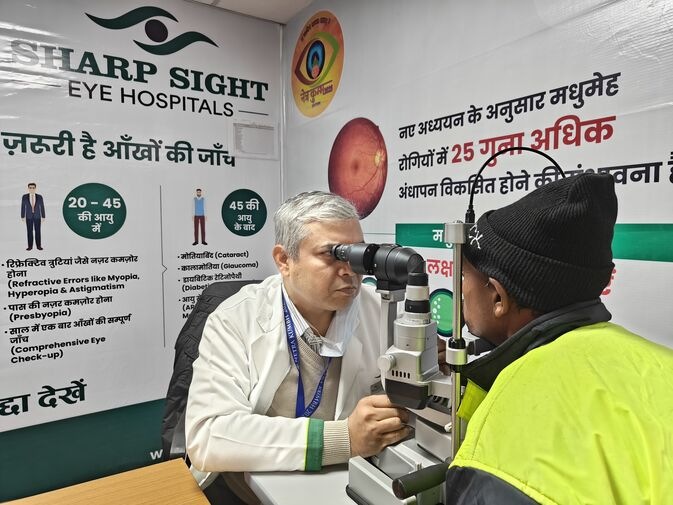
Eye Care Initiative

In a particularly noteworthy initiative, all people at the even will receive free eye, the largest such event in history. In a remarkable Corporate Social Responsibility action, Sharp Site Hospitals working with Netra Kumbh will provide eye care for 50 days. 
Sharp Sight Eye Hospitals at Kumbh Mela

As reported in the CSR Journal, the initiative will

  • Conduct 5,00,000 free eye tests to screen for vision problems and eye diseases.
  • Deploy an expert team of 500 ophthalmologists to offer specialized diagnostics and consultations.
  • Distribute 3,00,000 spectacles to individuals needing refractive corrections.
  • Engage 1,000 optometrists to ensure smooth execution of the initiative.
  • Perform 50,000 eye surgeries for individuals suffering from severe vision impairments, including cataracts and other critical eye conditions.

Conclusion

Hinduism has multiple traditions within it. Many of these traditions vary in their interpretation of the rites and significance of the Kumbh Mela. This post is meant only as a brief introductory overview. It is not intended to indicate any particular practice. 

As always, I welcome your corrections (or praise) and any other input.  

Happy Maha Kumbh Mela! 


Works Cited

“CSR News: World’s Largest Free Eye Check-Up Camp in Mahakumbh 2025 (January 17, 2025), CSR Journal, https://thecsrjournal.in/corporate-social-responsibility-csr-news-worlds-largest-free-eye-check-up-camp-in-mahakumbh-2025/


Dash, Nivedita (November 20, 2024), India TV, https://www.indiatvnews.com/uttar-pradesh/mahakumbh-2025-1-249-km-long-network-of-pipes-to-provide-water-supply-updates-2024-11-20-962557


Dixit, Kapil (January 11, 2025), “10,000 sanitation workers to make Kumbh clean & green,” https://timesofindia.indiatimes.com/india/10000-sanitation-workers-to-make-kumbh-clean-green/articleshow/117134518.cms


Dixit, Kapil (January 13, 2025), “From AI cams to drones, Kumbh Mela site a fortress with 7-ring security,”  https://timesofindia.indiatimes.com/india/with-seven-ring-security-sangam-turns-into-fortress/articleshow/117181725.cms


“Maha Kumbh 2025: Seven-ring security plan turns Prayagraj’s Sangam into a fortress” (January 13, 2025), The Economic Times, https://economictimes.indiatimes.com/news/india/maha-kumbh-2025-seven-ring-security-plan-turns-prayagrajs-sangam-into-a-fortress/articleshow/117198758.cms


“Mahakumbh-2025: Three-tier security for entry to mela area ahead of New Year” (December 26, 2024), Hindustan Times, https://www.hindustantimes.com/cities/lucknow-news/mahakumbh2025-three-tier-security-for-entry-to-mela-area-ahead-of-new-year-101735224176483.html 


Memish ZA, Steffen R, White P, Dar O, Azhar EI, Sharma A, Zumla A. (May 18, 2019),  “Mass gatherings medicine: public health issues arising from mass gathering religious and sporting events.”  The Lancet.  (10185):2073-2084. doi: 10.1016/S0140-6736(19)30501-X. PMID: 31106753; PMCID: PMC7159069.  https://pmc.ncbi.nlm.nih.gov/articles/PMC7159069/#tbl1


Pandey, Geeta, (January 12, 2025), "Millions start bathing in holy rivers at India's biggest Hindu festival, BBC, https://www.bbc.com/news/articles/cvg7gzzx3gno


“PM Modi recalls 1954 Kumbh Mela stampede at election rally in UP (May 1, 2019), The Economic Times, https://economictimes.indiatimes.com/news/elections/lok-sabha/india/pm-modi-recalls-1954-kumbh-mela-stampede-at-election-rally-in-up/articleshow/69129977.cms?from=mdr


Rawat, Anjali (January 7, 2025), “State-Of-The-Art Healthcare For Maha Kumbh 2025: Ensuring Pilgrim Safety, Outlook, https://www.outlookindia.com/brand-studio/state-of-the-art-healthcare-for-maha-kumbh-2025-ensuring-pilgrim-safety


Sheikh Saaliq (January 14, 2024), “Millions of pilgrims and naked, ash-smeared ascetics take holy dips in India’s mega Hindu festival, AP, https://apnews.com/article/india-maha-kumbh-hinduism-527170e00730b5e2a61a70b7423493ad


Saigal, Gaurav (January 11, 2025), “Mahakumbh-2025: Two months of action later, Ganga water fit for holy dip,” Hindustan Times, https://www.hindustantimes.com/cities/lucknow-news/mahakumbh2025-two-months-of-action-later-ganga-water-fit-for-holy-dip-101736612105117.html


Sharma, Shivani (January 6, 2025), “Prayagraj chalo: Khalistani terrorist Pannun threatens to disrupt Mahakumbh,” India Today, https://www.indiatoday.in/india/story/prayagraj-chalo-khalistani-terrorist-gurpatwant-singh-pannun-threatens-to-disrupt-mahakumbh-2025-magh-mela-2660303-2025-01-06


Sukheja, Bhavya (Dec. 21, 2024), NDTV, Maha Kumbh 2025: Know History, Location, Significance And More, NDTV, https://www.ndtv.com/feature/maha-kumbh-2025-know-history-location-significance-and-more-7302358b


“Water quality of Ganga in UP deteriorating due to discharge of sewage: NGT” (November 9. 2024), The Economic Times, https://economictimes.indiatimes.com/news/india/water-quality-of-ganga-in-up-deteriorating-due-to-discharge-of-sewage-ngt/articleshow/115112215.cms?utm_source=contentofinterest&utm_medium=text&utm_campaign=cppst


Clip Art Sources


Kumbh welcome opening image, Maha Kumbh 2025: Know History, Location, Significance And More, NDTV,Kumbh.gov.in  https://www.ndtv.com/feature/maha-kumbh-2025-know-history-location-significance-and-more-7302358b


Devotees at the juncture of the Yamuna and Ganges riverAdnan Abidi/Reuters 

Devotees take a dip in the Ganga at Prayagraj, Hindustan Times, https://www.hindustantimes.com/cities/lucknow-news/mahakumbh2025-two-months-of-action-later-ganga-water-fit-for-holy-dip-101736612105117.html


Naga Sadhus with trishul at 2013 Maha Kumb Mela Photo by Adnan Abidi, Reuters  https://www.reuters.com/news/picture/naga-sadhus-idINRTR3D6PA/ 


Maja Kumbh Mela devotees: Rawat, Anjali (January 7, 2025), “State-Of-The-Art Healthcare For Maha Kumbh 2025: Ensuring Pilgrim Safety, Outlook, https://www.outlookindia.com/brand-studio/state-of-the-art-healthcare-for-maha-kumbh-2025-ensuring-pilgrim-safety


A drone shot of the Sangam area ahead of the Mahakumbh 2025, Dixit, Kapil (January 13, 2025), “From AI cams to drones, Kumbh Mela site a fortress with 7-ring security,”  https://timesofindia.indiatimes.com/india/with-seven-ring-security-sangam-turns-into-fortress/articleshow/117181725.cms


Sharp Sight Eye Hospitals at Kumbh Mela, “CSR News: World’s Largest Free Eye Check-Up Camp in Mahakumbh 2025 (January 17, 2025), CSR Journal,  https://thecsrjournal.in/corporate-social-responsibility-csr-news-worlds-largest-free-eye-check-up-camp-in-mahakumbh-2025/

Sunday, February 10, 2013

Maha Kumbh Mela


Sunday, February 10 marks the most auspicious day for the bathing rite in India of Maha Kumbh Mela or Grand Kumbh Mela at Prayag.

Although the beginning of the pilgrimage began in 2013 on January 14 and ends on March 10, the highpoint of the event with the Maha Kumbh Mela occurs on Sunday, February 10. This is a special Kumbh Mela that comes just once every 144 years, and represents the transition to a new era.


The Kumbh Mela Pilgrimage

Bathing in the river
In all Kumbh Mela pilgrimages, Hindu pilgrims take a ritual bath in the river, which earns merit and/or washes away sin for the worshiper.  Many different traditions involve prayers, group singing, religious discussions and feeding the thousands of monks and Naga sadhu holy people who gather there.

There are four sacred Kumbh Mela pilgrimages.  They occur four times over a twelve-year cycle.  Each takes place at a holy river site where Hindus believe that drops of “amrita” (divine nectar) fell at the four spots. These are Prayag, Nashik, Ujjain and Haridwar. All involve a ritual dip in the River Ganges to wash away bad karma.

The Kumbh Mela Cycles

As mentioned above, the Purna Kumbha Mela today happens only once every 144 years.

Within the six-year cycles of Kumbh Mela celebrations, are longer cycles. Thus while some form of Kumbh Mela celebration rotates among one of four locations every three years, special Kumbh Mela observances follow a cycle of longer periods. 

The last Kumbh Mela took place in 2010 in Haridwar (the city’s name means “Gateway to God” in Hindi). The New York Times estimated that 500,000 people took part in the ritual bath in the Ganges there, despite being marked by unusually cold weather there that year.

Every six years, Hindus celebrate Ardha Kumba Mela which is celebrated only at Prayag and Haridwar.  The last Ardha Kumba Mela took place at Prayag in 2007. The BBC conservatively estimated approximately 30 million people attended, making it the largest gathering of people in one spot in history.

Every 12 years, Hindus celebrate a Purna Kumbha Mela at Prayag. The last Purna Kumbha Mela took place in 2001.

The Maha Kumbh Mela

Today’s event -- the Maha Kumbh Mela  --  occurs only after the cycle of 12 12-year Purna Kumbha Mela cycles, or once every 144 years. It is the most auspicious of the auspicious days to cleanse oneself at Sangam. The Sangam is the spot where the mythical Saraswati river joins the confluence of the physical rivers of the Ganges and Yamuna. It is considered fortunate even to live during an era in which one has the possibility of experiencing the ritual bathing at Purna Kumbha Mela.


Largest Gathering of People in History

Pilgrims bathing at Maha Kumbh Mela
The event is expected to break the record for the largest gathering of people in one spot in history. Time Magazine estimates upwards of 80 million people. The BBC estimates that the number of people to gather at the banks of the Ganges on the single day of Sunday, February 10, 2013 is expected to exceed 40 million.

Pilgrims approaching the river
To put this in perspective, the annual hadj pilgrimage to Mecca (the largest annual gathering of people anywhere) numbered 3 million last year. The previous record for people gathering at one spot was 30 million people at the Ardha Kumba Mela in 2007 (see below). As another point of comparison, the figure of 80 million people throughout the pilgrimage is approximately the population of Germany, so that were the pilgrims listed as a national population, they would constitute the 14th most populous country in the world. As for the single day event, 40 million people would place the pilgrims’ population as the 30th most populous country in the world, just shy of the population of Spain. To put this in comparison elsewhere, this is twice the population of Australia and almost 8 million more people than the entire population of Canada.

Special Needs of the Gathering

Sanitation and Disease Control 
The special needs for preparing for the pilgrimage are handled through India’s Mela Administration. Particular care is given to prevent the spread of disease. There have been no major outbreaks of disease since care to public health became a priority following an outbreak of cholera at the 1892 Kumbh Mela. 

To this end, in 2013, 6000 sanitation workers clean up after the crowds every day. Time magazine estimates that the sanitation team picks up 56 tons of garbage per day throughout the event. The also bury human waste in 4000 sanitation pits which are sprayed with bleach and DDT. In addition to the sanitation workers, the Mela Administration staffs 250 physicians at 15 field hospitals.

Water Supply 

Workers bringing
extra water supplies
to the Mela site
Drinking water is a continuous concern at all Kumbh Mela gatherings. It is in this area that the government has expressed some concern. The Mela authorities have arranged for 80 million liters of water per day during the event, although estimates are that this comes to just one tap for every 2000 people during the largest press of the gathering on February 10. Various sectors of the Mela site also have leaks in their pipelines and some areas of the makeshift campsites have no pipelines at all. 

Efforts have been made to supplement the exist pipelines with other drinking water sources, although data on how many of these alternatives there are and in what form they take is not available. At the time of this writing, though, the cases of severe diarrhea and related drinking water illness was only 50 people a week, an amazingly low number considering the situation. 

Electrical Grid Maintenance


One major side effect of the Kumbh Mela gatherings has been preparing the four pilgrimage locations with improved electrical grids. For this year’s Maha Kumbh Mela, the Indian government has put up a temporary grid with 45 diesel generators and 53 electrical substations. As Time Magazine observes,
This is particularly awe-inspiring in a country where almost a third of households don’t have enough juice to power a lightbulb.
 
Terrorist Precautions 
Specially-trained Mela
bomb disposal squads
Since the Mumbai attacks from Islamist terrorists in 2008, special terrorist task forces have also been set up throughout the Mela area. For the 2013 event, all people approaching the 20 kilometer Mela area will be screened for weapons before being allowed entry. 

Plainclothes police and specially trained operatives have been placed throughout the crowds. Additionally, special bomb disposal squads have been trained for the event. Finally, medical staff have been equipped with 400 special “Blast and Bomb” kits for treating potential victims of terrorist explosion attacks. 


Safety and Crowd Control

 Mela security and crowd control officers
Safety and public calm has been another priority since the last major disturbance at a Kumbh Mela almost 60 years ago following the Kumbh Mela stampede of February 3, 1954, the first Kumbh Mela following India’s independence. Estimates on the stampede vary greatly, ranging between 300 and 800 people trampled to death, with the Indian government’s estimates at 500 with 2000 injured.  The stampede was blamed on the absence of adequate crowd control forces coupled with the excitement from the visit of politicians. 

As a result, politicians have been banned from giving speeches at the gatherings ever since. Moreover, well-trained crowd control officers have supervised the event ever since as well. In 2013, the Mela Committee has staffed the site with 14,000 police officers trained in maintaining crowd control. 

The 2013 Stampede: Despite all this, sadly this year, a stamped broke out this year at the train station on Sunday, February 10, 2013. News sources are conflicting as I post this, with estimates ranging from 2 to 20 people trampled. This was the first instance of stampede since the 1954 tragedy. 

For more on the 2013 stampede, please see (the highly varied) coverage from the


Hindustan Times (2 reported dead):


Conclusion

Hinduism has multiple traditions within it. Many of these traditions vary in their interpretation of the rites and significance of the Kumbh Mela. This post is meant only as a brief introductory overview. It is not intended to indicate any particular practice.

As always, I welcome your corrections (or praise) and any other input.  

Happy Maha Kumbh Mela!

 
 Want to Learn More?

For more on this year’s festival, refer to the Indian government’s official website for this year’s Maha Kumbha Mela festival at http://kumbhmelaallahabad.gov.in/english/ebooks.html

For the official Maha Kumbh Mela 2013 English brochure, see http://kumbhmelaallahabad.gov.in/pdf/mahakumbh_low.pdf

For the news coverage of this year’s events, some articles of interest can be found at the


To read more about the kumbha mela festivals in general, look at

Astroved (Hindu astrological site) at http://www.astroved.com/festival/kumbha-mela/

  
Clip Art Sources


Workers bringing extra water supplies to the Mela site: http://www.downtoearth.org.in/content/drinking-water-scarce-kumbh-city