Tuesday, February 17, 2026 begins the Year of the Horse. It is the beginning of the year 4724 (in
some traditions, 4725) in the Asian lunar system, which is the Year of the Fire Horse. The Year of the Horse will end on February 5, 2027.
In today’s posting, I would like to share with you some specifics about the Year of the Horse as well as some background to the Asian Zodiac system as a whole.
some traditions, 4725) in the Asian lunar system, which is the Year of the Fire Horse. The Year of the Horse will end on February 5, 2027.
In today’s posting, I would like to share with you some specifics about the Year of the Horse as well as some background to the Asian Zodiac system as a whole.

At the end of this post, I have listed a large range of famous Horse People.
Additionally, you may also be interested in reading three related posts on
1) Lunar New Year Customs around the world at
http://davidvictorvector.blogspot.com/2013/01/lunar-new-year-celebrations-around.html
2) Year of the Horse: Business Impact (2014) at http://davidvictorvector.blogspot.com/2014/01/year-of-horse-business-impact.html Note that I did not update this for 2026, but you can read about the impact from the last Year of the Horse here.
3) List of 145 Year of the Horse Festivals gives 145 major celebrations (parades, galas or other celebrations) for the Year of the Horse in 26 countries beyond where it is officially part of the tradition. Of these, 55 are in the United States, 23 in Canada, 18 in the United Kingdom, 13 in Australia, and 8 in France with the others spread across the globe. You can read this at http://davidvictorvector.blogspot.com/2014/01/year-of-horse-celebrations-around-world.html
In today’s posting, though, we look only at the background to the Year of the Horse specifically and the Asian Zodiac system as a whole.
The Asian Zodiac Briefly Explained
The Lunar Calendar
Because the Asian lunar calendar follows the moon, it seems to move within our solar-based Gregorian calendar. Moreover, the Gregorian calendar does not correspond fully with the Asian lunar calendar. Thus, February 17 marks the beginning of the Asian lunar calendar only this year for the Year of the Horse (for instance, it began last year on January 29, 2029 with the last day of that year -- Year of the Snake -- falling on February 16, 2026).
The Twelve Animals of the Zodiac
The lunar calendar runs on a cycle of 12 years each represented by an animal. The animals all have a balance of compatability or incompatability as represented in their place in the circle of the 12-year cycle. This year is the Year of the Horse.
 |
| The 12 Animals of the Zodiac |
The 12 animals in their order are
- Rat
- Ox
- Tiger
- Rabbit
- Dragon
- Snake
- Horse
- Sheep
- Monkey
- Rooster
- Dog
- Pig
Each animal corresponds to a month of the lunar year. The horse, this year's governing animal, corresponds to the seventh animal in the cycle.
 |
| Horse, Middle Tang Dynasty China, 8th Century CE Los Angeles County Museum of Art |
The Five Elements of the Wu Xing Cycle
Additionally, each 12-year cycle of animals runs on an additional cycle corresponding to the Wu Xing cycle of the five traditional Chinese elements. These are
- metal
- fire
- wood
- water
- earth
 |
| Wu Xing Cycle |
The five elements or earthly branches are in balance with each other, the basis of much of feng shui.
Each element is also associated with a color. In the case of fire that color is red.
Combined, each element combines with each animal over a period of 60 years. The current 12-year animal cycle of Horse combines with the element of Fire. Thus, this year is the Year of the Red Fire Horse.
The five elements or earthly branches are in balance with each other, the basis of much of feng shui.
Each element is also associated with a color. In the case of fire that color is red.
Combined, each element combines with each animal over a period of 60 years. The current 12-year animal cycle of Horse combines with the element of Fire. Thus, this year is the Year of the Red Fire Horse.
Spiritual Importance of the Asian Horoscope
Many followers of the Asian zodiac have a formal religious belief in the importance of the animal element combinations associated with each year in the 60-year cycle. This is clearly the case for those practicing Taoism.
 For Taoists, the New Year is always of religious significance. This because in Taoism, the Lunar New Year's first day is a time when lesser deities or spirits are believed to ascend to the throne of the Jade Emperor (King of Heaven). In Taoist tradition, the 12 animals were in a contest to greet the Jade Emperor; a 13th animal – the cat – was tricked by the rat (about five variations of how exist), which explains why cats have hated rats ever since. A children's version of this story is told in an very pleasant rendition at the Topmarks education site. I encourage you to take a look at this version at http://www.topmarks.co.uk/ChineseNewYear/ZodiacStory.aspx
 |
| The 12 Zodiac animals in their race |
The New Year is a religious event as well for a great number of the sects of Buddhism, and most famously for Tibetan Buddhists. In Buddhist tradition, the 12 animals were in a race to do honor to Lord Buddha on the eve of his death. The rat and cat story is part of this tradition, too. Incidentally, the rat was the first animal to greet Buddha. He did so by helping the ox (which had poor eyesight) find his way across a stream by riding on his head. When the two reach Lord Buddha on the other shore, the rat jumped off the ox’s head, reaching Lord Buddha first. The horse arrived in seventh place.
Additionally, though Confucianism is not technically a religion (but rather a philosophical system), its followers also traditional observe the lunar New Year to show reverence to their ancestors. Because of this, even Christians and practitioners of other faiths in such countries as as Korea or Vietnam

Personality Traits and Asian Astrological Year
Many people attribute a great deal of significance to the personality traits attributed to the animal associated with the year in which they are born. Each animal has its own traits, and then each animal and element combination has their own subtraits. These are explained later in the blog
 |
| Qing Dynasty Jade Horse carrying across the waves a flaming jewel (symbol of Buddha's Doctrine) Asian Art Museum, San Francisco |
 |
| Horse, Circle of the Zodiac (2011) by Ai Weiwei |
 |
| Horse and Rider, Silla Kingdom (6th Century CE) National Museum of Korea, Seoul |
It is important to note that the animal of one’s birth year is not seen as fully able to stand on its own in understanding an individual’s personality traits and tendencies. These must at a minimum, as we have discussed, take into account the associated five elements.
Additionally, East Asian astrologers account for the inner or secret animal assigned by the day of the month and hour of the day on which one is born. In all, there are 8640 combinations (e.g., 12 months, 5 elements, 12 months, 12 times of day).
Chinese Astrology Not A Particular Accurate Term
The system discussed here is often called Chinese astrology. This is a misnomer for two reasons. First, the holiday is far more widely observed than in just China, especially in Korea, Singapore, Bhutan, Japan, Tibet, Mongolia and Vietnam as well as those from these backgrounds living in other countries.
The system discussed here is often called Chinese astrology. This is a misnomer for two reasons. First, the holiday is far more widely observed than in just China, especially in Korea, Singapore, Bhutan, Japan, Tibet, Mongolia and Vietnam as well as those from these backgrounds living in other countries.
I have described the holiday in general in this post. In a future post, I will discuss followed the culturally specific differences in customs at the close of this summary.
That said, for all the culturally diverse places in which the Asian New Year is celebrated, the calendar on which it is based does have its origins in China. The first written records of the calendar and the celebration of the New Year date to China’s Shang Dynasty (1766-1050 BC), although traditionally it is believed to date back to the rule of the semi-mythical Yellow Emperor Huang Di around 2600 BC.
A second reason the phrase Chinese astrology is a misnomer is that the system really has nothing to do with constellations as astrology does in the West. It is less a reading of the stars than an interpretation of the importance of the time, date and year in which one is born. To the extent that when one is born matters to Western-style astrology, there is a correspondence. Moreover, there is another similarity as the five elements in the system, in fact, do correspond with the five planets known in ancient China.
Because of these corresponding commonalities with Western astrology, many people call the Asian system’s combinations of animals and elements the lunar or Chinese “horoscope”. This is a bit of a misnomer, however, not only for the reasons just described but because the way in which people view the two “horoscopes” is very different.
The difference here is that many people (although with many exceptions) in Europe, Australia and the Americas consider the Western zodiac horoscope of star signs (Scorpio, Sagittarius, etc.) to be a form of superstition, a game or something believed only partially.
 |
| East Asian lunar zodiac |
A second reason the phrase Chinese astrology is a misnomer is that the system really has nothing to do with constellations as astrology does in the West. It is less a reading of the stars than an interpretation of the importance of the time, date and year in which one is born. To the extent that when one is born matters to Western-style astrology, there is a correspondence. Moreover, there is another similarity as the five elements in the system, in fact, do correspond with the five planets known in ancient China.
Because of these corresponding commonalities with Western astrology, many people call the Asian system’s combinations of animals and elements the lunar or Chinese “horoscope”. This is a bit of a misnomer, however, not only for the reasons just described but because the way in which people view the two “horoscopes” is very different.
The difference here is that many people (although with many exceptions) in Europe, Australia and the Americas consider the Western zodiac horoscope of star signs (Scorpio, Sagittarius, etc.) to be a form of superstition, a game or something believed only partially.
This is NOT the case with the Asian lunar horoscope cycle, where people follow their sign very seriously. As a result, the system, though it transcends that of any specific religion, should be treated with the respect accorded religious beliefs. In any case, the point here is that in a cross-cultural and inter-religious sense, the issue of lunar horoscope animal element signs should be treated with respect.
The Horse in Buddhist and Taoist Tradition
The horse in Buddhist and Taoist tradition originally not only was the most graceful and strongest runner on land but had great wings with which he soared through the skies and a great skill in the water so that he could swim easily for hours at a time. Because the horse was so talented whether on land, in the skies or in the water, he grew very full of himself and haughty. Man-Ho Kwok in his book on Chinese Astrology (listed in the bibliography below) relates the rest of this Taoist tale regarding the Horse and the Jade Emperor as follows:
The horse in Buddhist and Taoist tradition originally not only was the most graceful and strongest runner on land but had great wings with which he soared through the skies and a great skill in the water so that he could swim easily for hours at a time. Because the horse was so talented whether on land, in the skies or in the water, he grew very full of himself and haughty. Man-Ho Kwok in his book on Chinese Astrology (listed in the bibliography below) relates the rest of this Taoist tale regarding the Horse and the Jade Emperor as follows:
One day he [the Horse] was asked to take a message to the Dragon King of the East Sea. Stopped by the King's guards on his way into the palace, he became furious and kick an unfortunate guard to death. When the Emperor heard of this, he ordered that the horse's wings be cut off and the horse placed underneath a great mountain. After two hundred years of agony beneath the mountain, the ancestor of humanity passed by. Hearing him, the horse cried out that he wished to dedicate his life to serving humanity. The ancestor was moved by this and used magic to free the horse. In thanks, the horse dedicated himself to humans, ploughing the fields, transporting goods and fighting bravely in battle. Consequently, when the animal signs were chosen, the horse was one of the first to be recommended by the people, and was duly appointed by the Jade Emperor in acknowledgement of their works. (Kwok, p. 24)
 |
| Buddha's horse Kanthaka (2nd Century) British Museum, London |
The view of the horse has important positive associations with Buddhism as well. When Prince Siddhartha was not yet the Buddha, among his greatest attachments was to his faithful white horse Kanthaka. Kanthaka took a part in nearly all events in the life of Siddhartha before he renounced the world on his path to becoming Lord Buddha. When Siddhartha renounced all things of the world, Kanthaka died of a broken heart and was reincarnated as a Brahmin.
Special Regional Associations With The Horse
The horse has an especially important symbolic value within both Tibetan and Mongolian Buddhist traditions, both of which have within them the belief in the "wind horse" (lung-ta in Tibetan or khimorii in Mongolian). In both Tibetan and Mongolian traditions, the wind horse helps the soul on its journey to heaven. In China too the horse ties to the very earliest appearance of Buddhism's arrival in the country.
.jpg) |
| Tibetan lung-ta or "wind horse" |
The Horse in Tibetan Tradition
The wind horse in Tibetan Buddhism predates Buddhism as a shamanistic symbol in folk traditions (mi-cho, literally meaning "the religion of humans"). The religious use of the wind horse was not at first considered an accepted element of proper Buddhism (la-cho, or divine religion), but over time the two became interwoven. Today, the prayer flags used to bless their surroundings are called lung-ta, that is "wind horses."
 |
| Tibetan prayer flags or "wind horses" |
The Horse in Mongolian Tradition
In Mongolian Buddhism, the tradition of the "wind horse" (called khimorii or himori in Mongolian) is also a major symbol. Indeed, so central is the wind horse to Mongolian identity it is the central image on the official state emblem of Mongolia.
 |
| State Emblem of Mongolia |
In Mongolian Buddhism, the horse is the symbol of good fortune and the fulfillment of wishes. Mongolian Buddhism is closely interwoven with shamanism that long predates Buddhism arrival in the country, and shamanism is widely practiced throughout modern Mongolian today. In Mongolian shamanism (and through it, associated Buddhism practice), the wind horse is the source of shamanistic power. It resides within the individual shaman (primarily located in his or her chest) and is the source of the shaman's power to do good deeds and to hold psychic power. The wind horse grows stronger with each good deed or good thought of the shaman and grows weaker with each bad deed or bad thought of the shaman. Because the horse is so central to the Mongolian concept of self-identity and good fortune, the Year of the Horse is a particularly propitious year there.
In Mongolian Buddhism, the horse is the symbol of good fortune and the fulfillment of wishes. Mongolian Buddhism is closely interwoven with shamanism that long predates Buddhism arrival in the country, and shamanism is widely practiced throughout modern Mongolian today. In Mongolian shamanism (and through it, associated Buddhism practice), the wind horse is the source of shamanistic power. It resides within the individual shaman (primarily located in his or her chest) and is the source of the shaman's power to do good deeds and to hold psychic power. The wind horse grows stronger with each good deed or good thought of the shaman and grows weaker with each bad deed or bad thought of the shaman. Because the horse is so central to the Mongolian concept of self-identity and good fortune, the Year of the Horse is a particularly propitious year there.
The Horse in Chinese Tradition
The horse as a symbol of Buddhism is among the oldest in Chinese history. In fact, the oldest Buddhist temple in China -- dating to 69 AD -- is the White Horse Temple in Luoyang, Henan Province.
 |
| White Horse Temple Luoyang, Henan Province China |
The White Horse Temple was established by the Chinese Emperor Ming-di of Han after he had a vision of the Buddha and sent representatives to India to find the source of his dream. The representatives returned to Luoyang (at the time the national capital) with two Buddhist monks riding on white horses. The two monks were Dharmaratna and Kasyapa Matanga (in Chinese Zhu Falan and Jia Yemoteng respectively) who came carrying Buddhist scriptures and statues.
Emperor Ming Di had a temple built which he named after the two white horses on which the monks arrived. It was at the White Horse Temple, in turn, where Dharmaratna and Kasyapa Matanga first translated the Sutra of Forty-Two Chapters into Chinese. Because of this, the horse has carried a long association with the introduction of Buddhism to the Chinese world.

Positive Horse Traits
Those born in the Year of the Horse are – on the positive side -- considered to be naturally optimistic, highly innovative and blessed with great charisma and exceptional persuasion skills. As the Buddha Stones site puts it,
 |
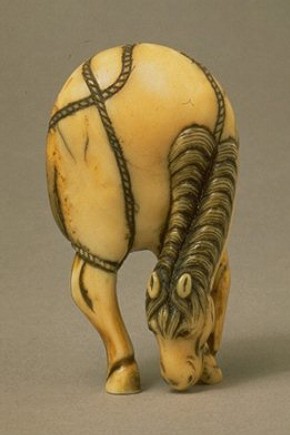
| Netsuke horse 18th Century Japan Victoria & Albert Museum London |
Horses are gifted communicators who can express complex ideas in simple, engaging ways. Their Horse Chinese Zodiac Personality includes natural charisma that makes others want to listen and learn from them. https://buddhastoneshop.com/blogs/news/horse-chinese-zodiac-personality
Another general source -- Chinese Horoscope.com -- summarizes the personality traits as follow:
Horse people are thought to be among the most outgoing of the signs and among the hardest workers. They have great energy but are easily distracted. This is because they are by nature restless, with a strong need to live freely and roam. As one online site explains:
Horse is an active and energetic sign. Horse is the sign of ardor. Those born under this sign are cheerful, full of energy, determined, popular,and smart. His adventurous spirit makes him eager to try new things and treat life like voyage...Free-spirited and open-minded, they are very likable. Their enthusiasm and vivacity make them famous. http://chinesehoroscop-e.com/Horse%20Zodiac.htmlFinally, people born in the Year of the Horse are excellent travelers, comfortable wherever they roam and adaptable to all sorts of cultures and settings they encounter.
Negative Traits
On the negative side, people born in the Year of the Horse are believed to be extremely difficult to characterize, as nearly every attribute is tempered by its opposite.. In other words, as the Suite 101 article "Chinese Zodiac Signs" explains: "People born in the Year of the Horse often have contradictory traits."
For example, while Horse people are extroverted and comfortable in crowds, they often prefer to work alone. Similarly, while they are described as having a strong need for intimacy, they fear being "penned in" without the ability to roam freely.
For example, while Horse people are extroverted and comfortable in crowds, they often prefer to work alone. Similarly, while they are described as having a strong need for intimacy, they fear being "penned in" without the ability to roam freely.
The one straightforward negative trait believers attribute to people born in the Year of the Horse is that they tend to be hot-tempered and narcissistic As one Chinese Astrology site puts it:
The Horse is hot-blooded, hot-headed and impatient. He is a bit of an egoist, well, selfish sometimes, that it is rare for him to interest himself in any problems except his own. And though this egoist works only for himself and for his own success, his work nevertheless benefits everybody. https://12zodiac.com/personality-horse/
Horse people are not only self-absorbed, but revolutionaries and heralds of change to the existing order. It is not a coincidence that, in the list of famous people below, so many are groundbreakers, revolutionaries or first leaders of their countries.

In short, the belief had very real effects, ranging from abortion to child abandonment.
 |
| Horse, Qin Dynasty Terracotta Army Museum, Xian, China |
Year of the Fire Horse Characteristics
 |
| Galloping Horse by Xu Beihong (1895-1953) |
Again, it is worth noting that we should avoid comparing East Asian astrology to that of Western horoscope astrology, as the former is regarded much more seriously than the latter. Keeping in mind the importance that over 1.5 billion people accord Asian Lunar astrology, what major astrologers and geomancers predict shapes business decisions and governmental policies.
Predictions for the Year of the Fire Horse are based on the personality attributes ascribed to the characteristics believed to describe all people born under the Horse zodiac sign. The attributes of fire are then superimposed on this.
Fire and Horse naturally align
Fire and Horse naturally align
In the Wu Xing cycle, when one of the five elements occurs aligns with an animal sign associated with that element, then the characteristics of that animal sign are amplified in that year.
Fire, significantly, is the Wu Xing earthly branch is associated with just two animal signs: the horse and the snake The Year of the Fire Horse takes all of the Horse personality traits and Fire elemental effects and amplifies them. . So the Year of the Fire Horse intensifies the natural characteristics of the horse, or as astrologer Susan Levitt puts it, the result is a "double dose" effect:
2026 is the year of the Fire Horse, giving Horse a double dose of Fire because Horse’s earthly branch is Fire. The element Fire brings love, joy, and excitement, making this the year to discover and develop your passion and what brings you joy. Fire Horse year is excellent for travel and to share your light with others. https://susanlevitt.com/astrology/horse2026/
There is more here though. The central characteristic of years governed by the element of fire is to enflame -- that is to amplify to its fullest the characteristics of any given year's ruling animal sign. Fire is the element of energy and passion that, in other words, enflames and empowers the year it governs. This passion and energy, however, like fire, comes in bursts. Fire as a governing element needs to be carefully managed or it otherwise risks either burning things down or burning itself out.
The Year of the Fire Horse
Since the Horse is the natural sign of great energy and an enflamed and passionate soul, great potential and great risk occur when the Fire and Horse align in the Year of the Fire Horse.
While the personality attributes of people born in the Year of the Horse were described in greater detail above, it is worth explaining how the amplification effect of a Fire on a Horse year works.
Where Horse people Horse people already are able to act very quickly, in the Year of the Fire Horse will favor those with the ability to act almost instantly, or seemingly impulsively. Where Horse people are also perceived as having exceptional persistence and endurance, the Year of the Fire Horse will favor those who are persistent to the point of stubborn. Where Horse People have naturally high energy, the Year of the Fire Horse will favor is anticipated to be a year in overdrive.
Where Horse people have natural charisma and an outgoing personality that natural attracts friendships, the Year of the Fire Horse is seen as favoring those who can persuade followers through the power of their personality.
The Fire Horse Curse
Where Horse People are often impatient and act as change agents, the Year of the Fire Horse will favor those tearing down the structures that "pen them in".
Fire Horse people are seen as not only self-absorbed, but revolutionaries and heralds of change to the existing order. So strong is the belief in this trait that birth rates traditionally go down during the Year of the Fire Horse. For instance, during the last Year of the Fire Horse (1966), birthrates in Japan went down over 25% (see Suzuki and Kashiwase, 2019). While no country showed the Fire Horse "curse" figures as dramatically as that of Japan, the decline in birth rate was apparent in 1966 across East Asia. Using data from the United Nations, the table below shows a "Fire Dragon" drop of 10% in Hong Kong and a notable decline over the previous year in Taiwan, China, South Korea, Vietnam, and Singapore.

In short, the belief had very real effects, ranging from abortion to child abandonment.
Year of the Fire Horse Predictions
It is important to note that virtually no Lunar Year astrologer or geomancer asserts that general predictions for the year are applicable without refinement. As Lidong Yu explains,
This does not mean zodiac culture is meaningless, but rather that its role is cultural and symbolic rather than precise personal prediction... from a professional Feng Shui perspective, this simplified zodiac-based approach is clearly imprecise. While Chinese Feng Shui practitioners also discuss zodiac signs, their analyses are far more complex and often difficult for the general public to understand.
What follows are thoughts on the Year of Horse from several of the world's most followed and influential professional geomancer and Lunar astrologers. While there are literally hundreds -- perhaps thousands -- of astrologers with local followings, those cited here have strong reputations (and consistent accuracy). These are professionals whose predictions are published in major news sources, whose published works are widely bought, and who have large online followings individual followers include government and business leaders, and addresses to professional business and economic associations. Below are predictions for the Year of the Fire Horse from Master Joey Yap (Malaysia), Master Shifu Paul Ng (Canada), Janine Lowe (UK), and Grand Master Raymond Lo (Hong Kong).
Joey Yap is based in Malaysia but arguably has the largest worldwide presence with a social media following of over 10 million with over 200 million video views as of 2026 and his Mastery Academy has a paid student base of over 60,000.
Shifu Paul Ng, Hong Kong-born Canadian since 1968, has been advising governments, business leaders and others for decades. He is a Master at geomancy (feng shui), astrology and metaphysics (and has a BBA degree in computer science). Ng is notable for several famously accurate predictions including the 2011 Conservative Party win in Canada and the resignation of PM Naoto Kan in Japan, the "Year of Health Hazards" that became the global pandemic in 2020, the wars of 2022 (the invasion of Ukraine), the US stock market all-time high of 2024, record "heightened sense of heat" for both 2024 and 2025 both becoming the hottest years on record, and last year the rise of AI and "high tech political struggles" in 2025.
Janine Lowe, the UK-based radio host of "Feng Shui Your Way" which has a following of 14 million world wide in addition to her bestselling books and consulting practice to celebrities, business leaders and others. She is Western in background but focus on Asian Lunar astrology and feng shui only.
Grand Master Raymond Lo is one of the world's only five acknowledged "Grand Master" status holders of the International Feng Shui Association. He is the founder and leader of the Raymond Lo School of Fung Shui and Destiny. He is based in Hong Kong
All of these highly respected people write in considerably more detail. What follows are brief snippets to give an idea.
Again, keeping in mind that it is a mistake for those outside the tradition to downplay the significance of how seriously those within the tradition take the readings of these major astrologers, consider that when Master Joey Yap states in an interview with Jovi Ho in The Edge Singapore that the Year of the Fire Horse will be a year that "reveals and accelerates" favoring movement over inertia, millions take note. His words affect business decisions and government policy. Master Yap warns that the Year of the Fire Horse will be a "wildfire" year that rewards those who are agile and punishes those who hesitate. Ho (2026) https://www.theedgesingapore.com/cityandcountry/feature/fengshui-consultant-joey-yaps-outlook-2026-year-fire-horse
Canada-based Shifu Paul Ng takes this further, balancing the year within the 60-year cycle. Ng explains that this is the Fire-Over-Lake year in that cycle. He indicates a year of great and atypical change in of a once in 60-year occurrence variety:
The “Fire over Lake” hexagram reveals a year of significant global change. Nations will witness profound shifts, and new policies will emerge unpredictably, akin to the flames rising from the lake—powerful yet unpredictable. https://www.paulng.com/dev/CmnNewsUpload_5/2026E.pdf
UK-based Janine Lowe states that the Year of the Horse in general
“amplifies the Horse’s natural independence and restlessness, creating a powerful drive for freedom, self-expression, and breaking away from limitations” https://www.express.co.uk/life-style/life/2165965/chinese-horoscope-February-2026
She then goes on to warn about the particular concerns of a Fire Horse Year, pointing to the past as evidence of a likely future:
“Historically and socially, Fire Horse years often coincide with upheaval, cultural shifts, and bold collective movements, where people feel compelled to challenge authority, redefine identity, and push for radical change,” https://www.express.co.uk/life-style/life/2165965/chinese-horoscope-February-2026
Hong Kong-based Grand Master Raymond Lo likewise points to the past Fire Horse Years as evidence for the likelihood of the coming Fire Horse year:
For example, in the previous Fire Horse year 1906, there is big typhoon bringing devastating damage to the SE province of China, killing over 4000 people, also there was big flooding of the Yangtze river killing over 40,000 people. And in the last Fire Horse year 1966, the Cultural Revolution started in China bringing 10 years of political turbulence and destruction. As such, the fire Horse year of 2026 could also be a year of big changes and challenges in China. http://www.raymond-lo.com/news/100061/year-of-the-horse-forecast-2026
Lo points "the prophecy in China called the 'Curse of the Fire Horse'" that "all through Chinese History... used to bring political turbulence and natural disasters. http://www.raymond-lo.com/news/100061/year-of-the-horse-forecast-2026
Lo goes on to explain that while Fire generally is positive with straightforwardness and greater ease to negotiate, the Year of the Fire Horse produces a Yang Fire that means "we cannot be too optimistic about peace and harmony" and foresees that
there will be impulsive action without careful consideration and planning, leading to open conflicts, hostilities, and quarrels in international relationships bringing war and disharmony. political turbulence, coup d’etat, anti-government activities" http://www.raymond-lo.com/news/100061/year-of-the-horse-forecast-2026
Happy Year of the Fire Horse!
Famous Year of the Horse People
Horse People, as noted above, are naturally charismatic, excellent communicators and outgoing while at the same time strongly opposing feeling "penned in" by existing norms, rules, family values, ideas or governments.
REVOLUTIONARIES AND ACTIVISTS AND POLITICAL FIRSTS

Because Horse People rebel against the existing order, it makes sense that they disproportionately number among revolutionaries and activists and political firsts. Some of these include:
- Gonzalo Abarca, Ecuadoran LGBTQ rights activist largely responsible for Ecuador's decriminalization in 1997
- Carrie Chapman Catt, US suffragette and women’s right activist
- Hugo Chavez, Venezuelan Revolution leader, then President and later dictator 1999-2013
- Carly Fiorina, first US woman CEO of Fortune 20 company (HP) and Republican presidential candidate
- Margaret Fuller, US women’s rights activist, early feminist, first US female war correspondent, and author of Woman in the Nineteenth Century
- Halimah binte Yacob, first woman President of Singapore
- Vladimir Lenin, Leader of the Russian Revolution and first head of Soviet Russia
- Nelson Mandela, South African anti-apartheid activist and first democratically-elected President of South Africa
- Angela Merkel, only woman and only East German to serve as German Chancellor,
- Sandra Day O’Connor, first woman to serve as US Supreme Court Justice
- Sir Lynden Pindling, First Prime Minister and "Father of the Nation" of the Bahamas
- Condaleeza Rice, Rice, first woman to serve as US National Security Advisor and first African-American woman to serve as US Secretary of State
- Theodore Roosevelt, US President who instituted the Anti-Trust policies that created the Progressive Era and whose environmental activism resulted in the world's first National Park System
- Alex Salmond, Scottish Independence advocate who served as the Leader of the Scottish National Party
- Al Sharpton, US civil rights and social justice activist
- Guru Gobind Singh, Tenth (and last human) Guru of Sikhism, founder and General of Khalsa Army, social reformist from Patna Sahib, Moghul Empire (now India)
- Sonia Sotomayor, first Hispanic (and third woman) to serve on US Supreme Court Justice
- Greta Thunberg, Swedish environmental activist
- Emma Watson, English gender equality and fair trade activist, UN Women Goodwill Ambassador and actress (Harry Potter series)
- Boris Yeltsin, first post-Soviet President of Russia
- Zayed bin Sultan Al Nahyan, Founding Father and First President of the United Arab Emirates
As a subset here, the number of Horse People involved in the American Revolution is remarkable. Since this is the 250th Anniversary of the signing of the US Declaration of Independence, it seems fitting to include these Horse People here.
- Ethan Allen, American Revolutionary, Leader of the Green Mountain Boys
- James Bowdoin, American Revolutionary leader and politician, Massachusetts Governor, chronicler of the Boston Massacre, astronomer, scientist, banker, first President of the American Academy of Arts and Sciences, and founder of Bowdoin College
- Abraham Clark, US Founding Father, Signer of the Declaration of Independence for New Jersey Henry Knox, American Revolutionary and 1st US Secretary of War
- Hugh Mercer, Scottish-born American Revolutionary General, victor of both the First and Second Battles of Trenton, killed at the Battle of Princeton Richard Montgomery, American Revolutionary General, killed in the invasion of Quebec
- Lewis Morris, US Founding Father, Signer of the Declaration of Independence for New York
- Thomas Nelson, Jr., US Founding Father, Signer of the Declaration of Independence for Virginia Oliver Wollcot, Sr., US Founding Father, Signer of the Declaration of Independence for Connecticut, Major General serving directly under George Washington, and later Governor of Connecticut
WORLD LEADERS

Current World Leaders
- Andrej Babiš, twice and current Prime Minister of Czech Republic, billionaire founder and owner of Agrofert
- Ron DeSantis, current Governor of Florida
- Recep Tayyip Erdoğan, current President of Turkey
- João Lourenço, current President of Angola
- Alexander Lukashenko, current President/dictator of Belarusian, and the country’s only ruler since independence in 1994
- Santiago Peña Palacios, current President of Paraguay
- Masoud Pezeshkian, current President of Iran
- Abdel Fattah el-Sisi, current President of Egypt
Past World Leaders
- Joe Biden, former US President
- David Cameron, former British Prime Minister under whom the Brexit vote took place
- François Hollande, former President of France
- Jean-Claude Juncker, former Luxembourg Prime Minister and European Commission President
- Helmut Kohl, longest-serving postwar German Chancellor under whom East and West Germany were unified
- Carlos Menem, former President of Argentina
- Enrique Peña Nieto, former President of Mexico
- Nguyễn Xuân Phúc, former President of Vietnam
- Puyi, last emperor of China until his overthrow in 1912
- Serzh Sargsyan, Armenian past President and two-time Prime Minister
- Malcolm Turnbull, former Prime Minister of Australia
SCIENTISTS, MATHEMATICIANS, AND INVENTORS

Because Horse People resist feeling penned in by existing boundaries, they have a high representation among groundbreakers in Science, Mathematics and Inventors.
- Alfred Adler, Austrian psychotherapist and founder of Individual Psychology (Adlerian Psychology)
- Neil Armstrong, US Astronaut, first human to stand on the moon
- Yoriyuki Arima, 18th Century Japanese mathematician who was the first to approximate the value of pi and its square
- Jacob Bernoulli, Swiss mathematician known for his contributions to calculus and discovery the fundamental mathematical constant e
- Karlheinz Brandenburg, German math, electrical engineer, and co-developer of the first MP3 audio data compression method
- Rodney Brooks, Australian roboticist and computer scientist, leading figure in behavior-based robotics, and founding director of the MIT Computer Science and Artificial Intelligence Laboratory (CSAIL)
- Leon Cooper, US physicist, neuroscientist and Nobel laureate in Physics for developing Cooper pairs and his work on superconductivity in Physics, while he co-developed the BCM theory (he was the "C" of Bienenstock–Cooper–Munro) explaining synaptic plasticity and learning in the visual cortex
- Émile Durkheim, French sociologist who established sociology as a distinct academic discipline
- Thomas Edison, US inventor of the phonograph, the incandescent light bulb, and the motion picture camera, and founder of Edison Electric Light Company (later General Electric)
- Christiaan Eijkman, Dutch Nobel Laureate in Medicine, discoverer of vitamins
- Stephen Hawking, English theoretical astrophysicist, cosmologist, author, and director of the Cambridge University Centre for Theoretical Cosmology
- James Hutton, Scottish geologist known as the “Father of Modern Geology” due to his theory on the Earth's formation and evolution
- Katherine Johnson, NASA mathematician, US Presidential Medal of Honor winner, and one of the African-American women who worked as "human computers" made famous years later in the book and movie Hidden Figures
- Shuji Nakamura, Japanese-born Nobel laureate in Physics and co-inventor of the blue LED
- Didier Queloz, Swiss astronomer and Nobel laureate for Physics for the discovery of the first planet outside our solar system
- Sir Peter J. Ratcliffe, British Nobel laureate in Medicine for his work on cell reaction to hypoxia
- Albert Sabin, Polish-born US physician who developed oral polio vaccine
- Theodor Schwann, German biologist who discovered the cell and coined the term metabolism
- George Westinghouse, US inventor of the railway air brake, key figure in promoting AC (over DC) electricity, and founder of Westinghouse Electric
- Norbert Wiener, US mathematician, “Father of Cybernetics”
- Huda Zoghbi, Lebanese-born US geneticist and neuroscientist responsible for discovering the cause of Rett’s syndrome, ASCA1, and several other genetic disorders
BUSINESS FOUNDERS AND ENTREPRENEURS

Horse People do not take orders well feeling the need to lead rather than follow. Restless by nature and often risk-takers, this has led to Horse People having a high representation among business founders. In addition to Thomas Edison, George Westinghouse, Carly Fiorina, and Andreh Babiś listed above, some notable entrepreneurs who are Horse People include
- Jake Burton Carpenter, US Founder of Burton Snowboards
- Warren Buffet, US investor and chairman of Berkshire Hathaway, and philanthropist
- Scott Cawthon, US video game developer
- Soichiro Honda, Japanese founder of Honda Motor Company
- Henry J. Kaiser, US industrialist and philanthropist, founder of Kaiser Shipyards, Kaiser Aluminum, Kaiser Steel and Kaiser Permanente Health Care
- Sid Meier, US entrepreneur and video game developer, creator of Civilization series
- Kevin O’Leary (“Mr. Wonderful”), Canadian co-founder Softkey Software Products, and television personality
- Sir Yue-Kong Pao, Chinese-born British Hong Kong founder of Worldwide Shipping Group (today's BW Group) which through the 1960s was the largest shipping company in the world
- George Soros, Hungarian-born US investor and philanthropist
- Sir David Tang, Hong Kong-British entrepreneur and founder of Shanghai Tang fashion chain
CARTOONISTS

Something about cartoons seems to appeal to Horse People, as seen from the list below:
- Roz Chast, US cartoonist for the New Yorker
- Ted Coombs, digital artist, futurist, AI expert, software developer, author and Guinness World Record for distance roller skating
- Philippe Gelucke, Belgian humorist and cartoonist creator of Le Chat comic strip
- Matt Groening, US creator of The Simpsons and Futurama
- Yokinobo Hoshino, Japanese manga artist and author of graphic novel 2001 Nights
- Salah Jahin, Egyptian cartoonist and poet
- Neal Obermeyer, US editorial cartoonist
- Dav Pilkey, US cartoonist and illustrator, creator of Captain Underpants
- Jean Roba, Belgian cartoonist known for La Ribambelle and Spirou et Fantasio
- Yoshihiro Tagashi, Japanese manga artist
WRITERS
Horse People are natural storytellers and excellent communicators. Some of the major writers born in the Year of the Horse are listed below.
- Chinua Achebe, Nigerian author whose 1958 novel Things Fall Apart is widely considered the seminal work of African literature in English
- Sandra Cisneros, US writer and leading figure in Chicano literature
- Mary Gaitskill, US novelist and short story writer
- Kazuo Ishiguro, Japanese-born British Nobel laureate in Literature
- Selma Lagerlöf, Swedish writer and first woman to win the Nobel Prize for Literature
- Natasha Trethewey, US Pulitzer Prize winning poet
COMEDIANS AND TELEVISION PERSONALITIES

The intense independence streak of Horse People lead them to see the world from a different perspective than most others (the same reason they are so commonly inventors and groundbreakers in science). Both of these skills are foundational for success as comedians and talk show hosts, and the list that follows just how substantial Horse People are among notable comedians.
- Jim Belushi, US comedian and actor
- Josh Blue, US stand-up comedian, Last Comic Standing winner, known for his self-deprecatory humor regarding his cerebral palsy
- Bo Burnham, US stand-up comedian and comedic songwriter
- Sir Billy Connolly, Scottish stand-up comedian and actor
- James Corden, British comedian and talk show host
- Rachel Dratch, US comedian, actor and SNL cast member
- Bill Hader, US comedian, actor and former SNL cast member
- Cindy Kwang-Mei Hsu, US Emmy Award-winning news broadcaster
- Spike Milligan, Anglo-Irish comedian, creator of the BBC Goon Show, and surrealist chaos comedy
- Jack Paar, US comedian, and host of The Tonight Show
- Al Roker, weather presenter and television personality
- Andy Samberg, US comedian, actor and SNL cast member
- Adam Sandler, US comedian and SNL cast member
- Jerry Seinfeld, US comedian, actor. author, filmmaker
ENTERTAINERS: ACTORS, PRODUCERS, MUSICIANS
Horse People as charismatic figures with excellent communication skills, strong perseverance and drive have a higher than usual representation in the entertainment industry.
Actors

- Rowan Atkinson (Mr. Bean), English actor
- Helena Bonham-Carter, English actress
- Jackie Chan, Hong Kong actor and martial artist
- Sean Connery, Scottish actor who was the first and considered by many to be the definitive James Bond
- Tom Ellis, Welsh actor best-known for his role as Lucifer in the television series of the same name
- Harrison Ford, US actor and producer
- James Franco, US actor
- Ha Jung-woo, South Korean actor and director
- James Earl Jones, US actor and one of the few people to have won an EGOT or Oscar, Tony, Emmy and Grammy award
- Jennifer Lawrence, US Academy Award winning actress and producer
- Julianna Margulies, US Emmy Award-winning actress
- Catherine O’Hara, Canadian actress (Schitt’s Creek, Home Alone)
- Margot Robbie, Australian actress and world’s highest paid actress (following 2023’s Barbie)
- Zoe Saldaña, US Academy Award winning actress (for Emilia Pérez) and star in 4 of the top 10 highest-grossing films of all time
- Emmanuelle Seigner, French actress
- John Travolta, US actor
- Kathleen Turner, US actress
- Denzel Washington, US actor, producer and director and two-time Academy Award winner
- Robin Wright, US Emmy Award Winning actress and producer
- Kuzuhiro Yamaji, Japanese actor
Producers, Directors, and Filmmakers

- J.J. Abrams, US filmmaker among the highest grossing filmmakers of all time
- James Cameron, Canadian three-time Academy Award-winning filmmaker (Titanic, Avatar, and Avatar: The Way of Water)
- Joel Coen, film director, producer, screenwriter with 14 Academy Award nominations including four wins (Fargo, Best Original Screenplay; No Country for Old Men, Best Picture, Best Adapted Screenplay & Best Director)
- Kevin Costner, US actor and filmmaker, two-time Academy Award winner for Best Picture and Best Director for Dances With Wolves
- Clint Eastwood, actor and twice Academy Award winning director for Unforgiven and Million Dollar Baby (both of which also won Best Picture)
- Ron Howard, US director and producer, Academy Award winner for Best Director and Best Picture for A Beautiful Mind, seven-time Emmy Award winner, two-time Grammy winner and founder of Imagine Entertainment
- Ang Lee, Taiwanese two-time Academy Award winning filmmaker (Brokeback Mountain and Life of Pi)
- Michael Moore, US filmmaker and political activist
- Martin Scorsese, US filmmaker considered among the most influential of all time
- Barbra Streisand, actor, director, producer, singer songwriter and one of the few people to have won an EGOT or Oscar, Tony, Emmy and Grammy award

- Clay Aiken, US singer songwriter and TV personality
- Elvis Costello, US singer songwriter
- Eun Ji-won, South Korean rapper, singer and leader of the Sechs Kies group
- Aretha Franklin, US singer, songwriter known as the “Queen of Soul”
- Nelly Furtado, Canadian singer songwriter
- Jimi Hendrix, US rock and blues guitarist, singer songwriter whom the Rock and Roll Hall of Fame called in his induction "arguably the greatest instrumentalist in the history of rock music"
- Janet Jackson, US singer
- Joe Jackson, English singer songwriter
- Richie Jen, Taiwanese singer and actor, best-selling Taiwanese musician of all time
- Janis Joplin, US rock and blues singer songwriter
- John Legend, US singer songwriter, pianist and actor
- Annie Lennox, Scottish lead singer of the Eurythmics
- Little Walter, American blues singer songwriter
- Lo Ta-yu, Taiwanese singer songwriter
- Herbie Mann, US jazz flutist
- Sir Paul McCartney, English singer songwriter, and original Beatle
- Pat Metheny, US jazz guitarist
- Moon Hee-joon, South Korean singer songwriter and former leader of the pop boy band H.O.T.
- Rita Ora, Kosovo-born British singer, songwriter, actress and television personality
- David Lee Roth, US lead singer of Van Halen rock band
- Ringo Sheena, Japanese founder and lead vocalist of Tokyo Jihen
- Sudirman, Malaysian singer, songwriter
- SZA (Solána Imani Rowe), US singer songwriter
- Tone Lōc, US rapper
- Usher, US singer and actor
- Eddie Van Halen, Dutch-born US guitarist and co-founder of Van Halen rock band
- Stevie Ray Vaughan, US guitarist, singer songwriter
- Antonio Vivaldi, Venetian Baroque-era composer of The Four Seasons
Want to Learn More
12 Zodiac (January 2026), " Personality-Horse" https://12zodiac.com/personality-horse/
Buddha Stones (August 22, 2025) "Horse Chinese Zodiac Personality: Discover Your True Strengths."
Chinese Fortune Calendar http://www.chinesefortunecalendar.com/5EBasic.htm
Chinese Horoscop-e.com, "Horse" http://chinesehoroscop-e.com/Horse%20Zodiac.html
Chinese Zodiac.org, "Year of the Horse" http://www.chinesezodiac.org/horse#personality
Man-ho Kwok, Chinese Astrology: Forecast Your Future from Your Chinese Horoscope, Tuttle Publishing, 1997.
Theodora Lau, The Handbook of Chinese Horoscopes (6th edition), Collins Reference, 2007.
Susan Levitt, "Horse Year 2014": http://susanlevitt.com/astrology/horse-year-2014/
Susan Levitt, 2026 Fire Horse," https://susanlevitt.com/astrology/horse2026/
Raymond Lo, "Year of the Horse Forecast 2026" (November 15, 2026), http://www.raymond-lo.com/news/100061/year-of-the-horse-forecast-2026
Mou Mei, "White Horse Temple: The First Buddhist Temple in China"" http://www.buddhistedu.org/en/culture/buddhist-culture/218-the-white-horse-temple-first-buddhist-temple-in-china
Shifu Paul Ng, "2026 Year of the Fire Horse Annual Forecast," (January 2026) https://www.paulng.com/dev/CmnNewsUpload_5/2026E.pdf
Janine Lowe quoted in Mia O'Hare (February 3, 2026), Andrea Blazquez (February 3, 2026), “Chinese horoscope February 2026: Predictions for Horse, Tiger, Goat and more”, Express, https://www.express.co.uk/life-style/life/2165965/chinese-horoscope-February-2026
Emi Suzuki and Haruna Kashiwase (January 22, 2019), "The curse of the Fire-Horse: How superstition impacted fertility rates in Japan", World Bank Blogs, https://blogs.worldbank.org/en/opendata/curse-fire-horse-how-superstition-impacted-fertility-rates-japan
Topmarks Education, "Zodiac Story, Chinese New Year." http://www.topmarks.co.uk/ChineseNewYear/ZodiacStory.aspx
United Nations, Department of Economic and Social Affairs, Population Division (2022). World Population Prospects 2022, Online Edition. Estimates of crude birth rate by region, subregion and country, 1950-2021. https://www.un.org/development/desa/pd/sites/www.un.org.development.desa.pd/files/wpp2022_summary_of_results.pdf
David Twicken, Five Element Chinese Astrology Made Easy, iUniverse, 2000.
Suzanne White, The New Chinese Astrology, Thomas Dunne Books, 2009.
Shelly Wu, Chinese Astrology: Exploring the Eastern Zodiac, New Page Books, 2005.
Derek Walters, The Complete Guide to Chinese Astrology, Watkins Publishing, 2005.
Kathryn Wortley (January 2, 2026), "Running hot in 2026: What's in store for the Year of the Fire Horse," Japan Times, https://www.japantimes.co.jp/life/2026/01/02/lifestyle/fire-horse-horoscope-japan/
Joey Yap quoted in Jovi Ho (January 15, 2026), The Edge Singapore, “Fengshui consultant Joey Yap’s outlook for 2026: Year of the Fire Horse,” https://www.theedgesingapore.com/cityandcountry/feature/fengshui-consultant-joey-yaps-outlook-2026-year-fire-horse
Andrea Blazquez (February 3, 2026), “Chinese horoscope February 2026: Predictions for Horse, Tiger, Goat and more”, Express, https://www.express.co.uk/life-style/life/2165965/chinese-horoscope-February-2026Ho-Peng Yoke, Chinese Mathematical Astrology: Reaching Out to the Stars, Routledge, 2003. This is the pre-eminent book on the mathematical science of Asian lunar horoscope calculations. It is downloadable at http://www.ebook3000.com/Chinese-Mathematical-Astrology--Reaching-out-for-the-stars--Needham-Research-Institute-Series-_130932.html
Lidong Yu, "BingWu Year" (January 2026), https://vocal.media/education/zodiac-signs-and-feng-shui-1
Clip Art Sources:
Opening Year of the Fire Horse image, my own digital creation
The 12 Animals of the Zodiac: http://creatingyourvelocity.com/www.knowledge2work.com/wp-includes/css/12-chinese-zodiac-animals-i13.gif
Horse, Middle Tang Dynasty China, 8th Century CE, Los Angeles County Museum of Art: http://collections.lacma.org/node/224690
Wu Xing Cycle: http://upload.wikimedia.org/wikipedia/commons/thumb/f/f0/Wuxing_en.svg/220px-Wuxing_en.svg.png
The 12 Animals of the Zodiac: http://creatingyourvelocity.com/www.knowledge2work.com/wp-includes/css/12-chinese-zodiac-animals-i13.gif
Horse, Middle Tang Dynasty China, 8th Century CE, Los Angeles County Museum of Art: http://collections.lacma.org/node/224690
Wu Xing Cycle: http://upload.wikimedia.org/wikipedia/commons/thumb/f/f0/Wuxing_en.svg/220px-Wuxing_en.svg.png
Yin Yang animation: http://www.eharrishome.com/Kungfu.html
The 12 Zodiac animals in their race: http://media.photobucket.com/image/recent/firefoxthief/zodiaccolor.jpg'
The 12 Zodiac animals in their race: http://media.photobucket.com/image/recent/firefoxthief/zodiaccolor.jpg'
Year of the Fire Horse image, Lily Pisano (artist) in Kathryn Wortley (January 2, 2026), "Running hot in 2026: What's in store for the Year of the Fire Horse," Japan Times, https://www.japantimes.co.jp/life/2026/01/02/lifestyle/fire-horse-horoscope-japan/
Qing Dynasty Jade Horse with flaming jewel, Asian Museum, San Francisco: http://searchcollection.asianart.org/media/view/Objects/10449/8008?t:state:flow=7cb6396b-1064-4517-b439-15a54105cdfd
Horse and Rider, Silla Kingdom (6th Century CE), National Museum of Korea, Seoul: http://www.museum.go.kr/program/relic/relicDetailEng.jsp?menuID=002005002&relicDetailID=15206&relicID=3802
Ai Weiwei, Horse from Circle of the Zodiac, 2011: http://www.designboom.com/art/ai-weiwei-circle-of-animals-zodiac-heads-world-tour/
East Asian Lunar Zodiac: http://www.china-family-adventure.com/chinese-zodiac.html
Horse, Qin Dynasty Terracotta Army Museum, Xian, China: http://www.emuseumstore.com/Chinese-Xian-Warrior-Horse-Terracotta-Statue-Large_p_3398.html
Galloping Horse by Xu Beihong (1895-1953): http://en.wikipedia.org/wiki/File:XuBeihong-Pferd.jpg
Buddha's horse Kanthaka (2nd Century) British Museum, London: http://en.wikipedia.org/wiki/File:Siddharta_parting_from_Kanthaka_and_Chandaka_BM_OA1880.65.jpg
Tibetan Lung-ta flag:http://vg.sitesalive.com/saturday-updates/qa/view/149/
Tibetan prayer flags or "wind horses": http://en.wikipedia.org/wiki/File:Prayerflags.jpg
State emblem of Mongolia: http://en.wikipedia.org/wiki/File:State_emblem_of_Mongolia.svg
White Horse Temple, Luoyang, Henan Province, China: http://www.buddhistedu.org/en/culture/buddhist-culture/218-the-white-horse-temple-first-buddhist-temple-in-china
Netsuke horse, 18th Century Japan, Victoria & Albert Museum, London: http://www.vam.ac.uk/__data/assets/image/0017/227042/2997-large_290x435.jpg
Red horse design at start of personality trait description: http://www.china-tour.cn/China-Pictures/Chinese_Zodiac_Horse.htm
Qing Dynasty Jade Horse with flaming jewel, Asian Museum, San Francisco: http://searchcollection.asianart.org/media/view/Objects/10449/8008?t:state:flow=7cb6396b-1064-4517-b439-15a54105cdfd
Horse and Rider, Silla Kingdom (6th Century CE), National Museum of Korea, Seoul: http://www.museum.go.kr/program/relic/relicDetailEng.jsp?menuID=002005002&relicDetailID=15206&relicID=3802
Ai Weiwei, Horse from Circle of the Zodiac, 2011: http://www.designboom.com/art/ai-weiwei-circle-of-animals-zodiac-heads-world-tour/
East Asian Lunar Zodiac: http://www.china-family-adventure.com/chinese-zodiac.html
Horse, Qin Dynasty Terracotta Army Museum, Xian, China: http://www.emuseumstore.com/Chinese-Xian-Warrior-Horse-Terracotta-Statue-Large_p_3398.html
Buddha's horse Kanthaka (2nd Century) British Museum, London: http://en.wikipedia.org/wiki/File:Siddharta_parting_from_Kanthaka_and_Chandaka_BM_OA1880.65.jpg
Tibetan Lung-ta flag:http://vg.sitesalive.com/saturday-updates/qa/view/149/
Tibetan prayer flags or "wind horses": http://en.wikipedia.org/wiki/File:Prayerflags.jpg
State emblem of Mongolia: http://en.wikipedia.org/wiki/File:State_emblem_of_Mongolia.svg
White Horse Temple, Luoyang, Henan Province, China: http://www.buddhistedu.org/en/culture/buddhist-culture/218-the-white-horse-temple-first-buddhist-temple-in-china
Netsuke horse, 18th Century Japan, Victoria & Albert Museum, London: http://www.vam.ac.uk/__data/assets/image/0017/227042/2997-large_290x435.jpg
Red horse design at start of personality trait description: http://www.china-tour.cn/China-Pictures/Chinese_Zodiac_Horse.htm