Welcome to the David Victor Vector Blog

Welcome to the David Victor Vector blog. This is blog that covers religious observances around the world international affairs and global business. This blog describes religious holidays for most major religions as well as raising issues dealing with globalization, international business ethics, cross-cultural business communication and political events affecting business in an integrated world economy. I look forward your discussion and commentary on these articles and subjects. Enjoy!

Monday, October 31, 2011

Samhain, All Saints Day, Día de los Muertos and Halloween

October 31 is the important Wiccan and Neo-Pagan religious holiday of Samhain, coinciding with the lighthearted secular US celebration of Halloween.  November 1 is the Roman Catholic and Anglican holiday of All Saints Day and November 2 is the Roman Catholic and Anglican holiday of the Feast of All Souls  (celebrated as the Día de los Muertos or Day of the Dead in Mexico and with variants in some other Latin American and Filipino traditions).    Within the Methodist Church, All Saints Day is celebrated on the first Sunday of November (which for 2017 falls on November 5). For Lutherans, the Sunday on or before October 31 (in 2017 having fallen on October 25), is celebrated as Reformation Day.

Samhain

Pronounced SOW-in, Samhain in Gaelic means “Summer’s End” and is a major holiday in both Wicca and in Neo-Pagan religions. It should be noted that some debate regarding when Samhain should be celebrated exists. Some traditions celebrate the holiday on November 1 and others – notably many Wiccans observe the holiday on November 7. Regardless of date, the holiday carries the same significance in marking the end of summer and the final harvest of the year.  In most traditions, the Sabbat of Samhain is celebrated for three successive evenings.

Within Wicca and most neo-Pagan traditions, Samhain marks the end of the calendar, and is thus the New Year’s celebration. For this reason, Samhain is a time for renewal as well as for giving thanks for the harvest as winter approaches. Traditionally, Samhain is the last chance for harvesting any remaining crops or picking any remaining produce from one’s garden. Samhain is also a time for remembering things past, especially those who have died. It is therefore a holiday for honoring the dead (both human and animal) and particularly for call to mind loved ones who have passed away. It is important to note that this is not a form of ancestor or spirit worship but rather an honoring of the Cycle of Life and Death.  

Samhain is also a time to honor animals – particularly pets and other animals among whom we share our lives – since animals are seen as providing us with sustenance in the form of food and clothing. Because of this, Samhain is a time to honor those pets who have died over the last year.  In some traditions, animals are seen as protecting us from spirits that would harm us and other things that inhabit the darkness.   Relatedly, some who celebrate Samhain also believe that this is the time of year when the veil is thinnest between this world and the Otherworld (the realm of spirits and the home of the dead).  Consequently, for worshippers who hold to this belief, Samhain provides an opportunity for communicating with the spirit realm and the dead.

Samhain altar
Within both Wicca and Neo-Paganism, Samhain is often marked by worship at an altar (or at times in the house at the kitchen room table) with offerings of the harvest.

The altar shown at right is taken from a lovely gallery of Samhain altars posted at About.com on the Paganism/Wicca site at 
 http://paganwiccan.about.com/od/samhainoctober31/ig/Samhain-Altar-Gallery/ The altar shown (at right) here was posted as Joni's altar.

Many people present their altar offerings in a horn of plenty (called a cornucopia, and now closely associated with the US secular holiday of Thanksgiving), and customarily include home-baked dark bread as well as nuts, berries, fruits and vegetables.  

Soul Cakes
Among the Samhain foods with the longest traditions is that of "soul cakes." Since pre-Christian times, people in the England, Scotland and Ireland have left muffin-like soul cakes accompanied by a glass of wine or milk for the souls of those who had recently passed away. The Celtic pagan tradition predates by centuries the adoption of "soul cakes" left on the eve of the Feast of All Souls, the Christianized version of Samhain (see below).  One recipe for soul cakes can be found at

http://allrecipes.co.uk/recipe/8607/soul-cakes.aspx

Often people include a a Wiccan Star or a statue of the Goddess. Candles are lit on the altar in many traditions, and are often accompanied by photographs of loved ones who have passed on to the other side. Prayers honoring the day are said either before or after a festive meal is eaten featuring the offerings and often accompanied by cider or mulled wine and wild game.   

All Saints Day   

Roman Catholicism

All Saints Day is one of the 14 worldwide holy days of obligation of the Roman Catholic Church.  As with all holy days of obligation, All Saints Day begins with a vigil on the night preceding it. 

A special Roman Catholic mass is conducted for All Saints Day to remember the saints and martyrs of the Church, both those known and unknown.  In many congregations, rituals include the use a crown and a sheaf of wheat. Many congregational services also make use of images of the saints and of the Manus Dei (the Hand of God with rays of light extending from it).

Another name in English for the holy day is All Hallowmas   Halloween is actually the name of the date of the vigil on the night before All Saints Day.. By the mid 1500’s as vernacular languages began to replace Latin in religious usage, the holiday was called All Hallowmas (the word Hallow – from to hallow -- meant Saint at the time).  The vigil on the night before All Hallowmas was called All Hallows Even (shortened by the 1600’s to Hallowe’en).

All Saints Day is one of the oldest holy days of obligation in Christianity. As early as 407, St. John Chrysostom first assigned a date for All Saints Day; that date, however, was not November 1, but rather the first Sunday following Pentecost. This remains the date for Eastern Orthodox Christians where the holiday is officially known as the Sunday of All Saints. The original holiday was dedicated to Saint John the Baptist and those martyred for the Church. (as by the early 5th Century there were so many martyred saints that they could no longer readily each have their own day on the Church calendar). 

As described below, Pope Gregory III   (731-741) moved the date of All Saints Day within the Roman Catholic Church to its current date of November 1, making it a pilgrimage date within Italy, and in 835 Pope Gregory IV extended All Saints Day to apply worldwide.

Protestantism

The role of saints became questioned among Protestants following the Reformation in the early 1500’s. The debate of the role of saints led to divisions in the traditions of how Protestants continued to observe All Saints Day.

Some Protestant movements continued (and still continue) directly to observe All Saints Day. In the Anglican Church, All Saints Day is observed on or immediately following October 31. The Anglican and Episcopalian Churches recognize saints as people who have been notably sanctified.

Swedish cemetery on Alla Helgons Dag
In the Swedish Lutheran Church, All Saints Day (Alla Helgons Dag) continues to be a holiday and is observed as a national civic holiday on the Saturday following October 30 and as a religious holiday on the first Sunday of November. In Sweden, the Saturday of Alla Helgons Dag became a national civic holiday only in 1952 and is used by people to visit the graves of family members who have passed away and to decorate their gravesites.

In both the Anglican and Swedish Lutheran Church, the holiday remembers saints. It should be noted that in these traditions, all Christians are saints, but particular honor for historical saints is allowed as representing individuals who have received extraordinary grace and as people who can inspire others to lead exemplary lives.

All Saints Day is one of the three main holidays (along with Easter and Christmas) of the United Methodist Church. Methodists celebrate the holiday on the first Sunday in November.  It is important to note, though, that Methodists do not venerate or worship saints (and John Wesley specifically forbade Methodists from doing so). For Methodists, all people are saints (although they recognize important Biblical figures by their common names as saints). Methodists, therefore, do not worship or venerate the saints but rather honor all holy Biblical people on All Saints Day. The holiday is also used as a day of remembrance not only for Biblical saints but, significantly, for all who have died in their particular congregations. Thus, on All Saints Day in many Methodist congregations, an acolyte reads of the names of those congregational members who have died.
                                                                                                            
Other Protestant denominations including the Presbyterians, Unitarian and a minority among some Baptist congregations also have some service recognizing All Saints Day.

Feast of All Souls and the Día de los Muertos

Saint Odilo of Cluny
November 2 in Roman Catholicism is the Feast of All Souls. Its official name is "The Commemoration of All the Faithful Departed" and it commemorates those among the faithful who have passed away. The holiday dates to 998 when the holiday St. Odilo of Cluny set November 2 as a time to pray for the dead in Purgatory at his Abbey of Cluny. The practice was widely copied and spread throughout much of Europe, eventually transforming from a prayer for those in Purgatory to a commemoration of those among the faithful who had died. With Roman Catholicism as a whole, the Feast of All Souls is considered a minor religious observance, not on the same order as that of All Saints Day.
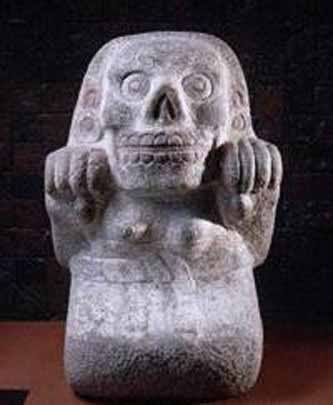
Mictecacihuatl
By contrast, in several Roman Catholic national traditions, the Feast of All Souls has taken on a much greater significance than elsewhere. This is especially the case in Mexico, where the holiday is celebrated as Día de los Muertos or Day of the Dead. A Day of the Dead had preceded Christianity by centuries in Mexico, with evidence of some practice of a related holiday dating back over 2000 years. When the Spanish arrived in Mexico, they found that their Feast of All Souls corresponded with the worship among Aztecs and others of the goddess Mictecacihuatl who was Queen of Mictlan or the Underworld. The Roman Catholic Church syncretized the worship of Mictecacihuatl, replacing her veneration with that of the Virgin Mary, Mother of Jesus. Mictecacihuatl, known as the Sante Muerte (Saint Death) or simply the Dama de la Muerte (Lady of the Dead) is still present in some Mexican celebrations.  

In Mexico, the Día de los Muertos is major holiday on which people go to graveyards to visit the graves of their dead relatives. It should be noted that this holiday shares little if any of the North American uneasiness with death or with graveyards. Instead, the Mexican version of the holiday celebrates the unity between life and death and recognizes a strong sense of belief in the afterlife. The Día de los Muertos is a very festive time with people bringing photos and favorite foods of their deceased loved ones to the gravesites. Commonly people bring to the cemetery skulls made of sugar or marzipan with the name of the deceased one on the forehead. Other special foods include  candied pumpkins and the sweet soft bun decorated with pretend bones called pan de muerto (bread of the day). Throughout Mexico, marigolds (called Flores del Muerto or Flowers of Death) are used to decorate for the holiday (a tradition with origins in the Aztec rituals). It is also a time in which children are given toys, often with a skeleton theme (such as skeleton dolls or papier mache figures). In many homes, government offices and workplaces, people erect special altars centered around an image of the Virgin Mary with offerings to the departed placed there.

Many traditions for the Día de los Muertos are regional in nature. These involve wearing skull masks, erecting skelton sculptures, having mariachi bands play while dressed as skeletons, having weddings of skeleton marionettes or of people dress as skeletons, wearing special clothing with regional ties to the holiday and holding dances or parades.

In 2008, the UNESCO officially inscribed Día de los Muertos celebrations as an Intangible Cultural Heritage of Humanity.

Holidays similar to the Mexican Día de los Muertos are celebrated in the elsewhere in Latin America. In Guatemala, the holiday is called Día de los Difuntos (which also means Day of the Dead) and is celebrated by visiting graves, flying kites and eating a special salad called fiambre made up of up to 50 different ingredients and only eaten once a year during the holiday. Bolivia’s indigenous people celebrate Dia de los Natitas (Day of the Skulls) in which indigenous peoples bring to Church the actual (not sugar) skulls of their dead which many traditionally keep in their homes.  Similar practices (without the actual skulls) are conducted among the Quechua-speaking community in Ecuador on All Souls Day. All Souls Day is also widely celebrated in Brazil where it is also called Finados, and people visit the graves of relatives. Outside of Latin America, Day of the Dead celebrations are practiced widely in the Philippines where it is called Todos los Santos (All Saints Day) in Spanish but Araw ng mga Patay ("Day of the Dead") in Tagalog and celebrated as a two-day family with visits to the graveyard and parties for the extended family.

All Souls Day is an official public civic holiday for public employees in Angola, Belgium, Bolivia, Brazil, Ecuador, El Salvador, Haiti, Mexico and Uruguay. It is also an official holiday in the US territory of Guam.

Reformation Day

Many Protestant denominations celebrate Reformation Day on the first Sunday on or following October 31.  Reformation Day is a public civic holiday in the nation of Slovenia as well as in the five predominantly Lutheran German Länder (states) of Brandenburg, Mecklenburg-Vorpommern, Saxony, Saxony-Anhalt and Thuringia.

Martin Luther began the Reformation by nailing his 95 Theses on the door of Wittenberg Church on the Eve of All Saints Day, October 31, 1517. Reformation Day is a holiday to commemorate this event for many Protestant denominations.

For these denominations, Reformation Day was also a way of repurposing All Saints Day. These denominations are either opposed to the concept of All Saints Day, some because of its association with the Roman Catholic Church or because of their refutation of the concept of sainthood (or both). In many Protestant denominations, some of the features of All Saints Day are combined with those of All Souls Day as worshipers remember those among the faithful or among one’s local congregation who have passed away.

The first recorded Reformation Day was decreed by law in 1569 in the officially Lutheran former German Duchy of Pomerania on what had been Saint Martin’s Day (November 11), because it bore the name of Lutheranism’s founder, Martin Luther. The  practice of observing Reformation Day was taken up by several other officially Lutheran States but without consistency as to practice or even date. Some uniformity took hold on the 100th anniversary of the Reformation in 1617. In that year, Reformation Day was observed on October 31 and November 1 among all of the Lutheran nations throughout what is now Germany (Germany as a single nation did not exist until 1871).  Among Lutheran churches today, the observances are mixed. For many Lutheran churches, the observance of Reformation Sunday is on the Sunday on or before October 1, with a separate holiday of All Saints Day on the Sunday on or following November 1. Lutherans, it should be pointed out, do not generally believe in saints in the same way as do Roman Catholics, Eastern Orthodox or Anglicans. For Lutherans, therefore, All Saints Day is a lesser holiday used to remember saints both dead and living and to honor Jesus Christ.

Some Evangelical and Pentecostal Christian movements have begun to use Reformation Day as a way to repurpose the secular holiday of Halloween. For many Evangelical and Pentecostal Christians, Halloween is an offensive holiday. As the Evangelical Director of the Children’s Ministry International, Brad Winsted asks,

“For so many Halloween presents a dilemma, what do you do with a holiday with roots in the occult?”  http://www.cbn.com/spirituallife/onlinediscipleship/halloween/reformation_day.aspx

Minister Winsted’s answer is to repurpose Halloween as Reformation Day.  


Halloween, Oíche Shamhna and All Saints Eve

The secular version of All Hallows Eve or Halloween is an especially popular holiday in the English-speaking world. The secular holiday has its roots in the religious holidays of Samhain and is called Oíche Shamhna (Samhain Night) in Ireland even by those who do not practice Wicca or Neo-Paganism. The secular holiday has spread to many non-English-speaking countries beginning roughly in the 1990’s, where it has been viewed mostly as a US import.

During Colonial times, North America was largely opposed to Halloween celebrations. Celebrations of All Saints Day were banned and any suspected ties to witchcraft were highly condemned (although not all as dramatically as the Salem Witch Trials). There is no formal record of Halloween having been practiced anywhere until the mid-19th Century. Thus, Halloween was not commonly celebrated in the United States until the late 19th Century, following the Irish Famine of the 1840’s. The holiday seems to have grown out of Scottish immigration to Canada in a similar manner.

By the beginning of the 20th Century, Halloween had devolved to an evening in which teenagers played pranks including property damage and assaults, a tradition grown from the English practice of Mischief Night (still practiced in some US cities as Devil’s Night on the night of October 30). Countering movements tried to commercialize Halloween as a night of safer entertainment in which children dressed up with the first commercially produced hand-made Halloween costumes appearing in the first decade of the 20th Century. In 1912, the Boy Scouts of America became involved in ensuring the safety with a “Sane Halloween” campaign that was largely successful. It was from here that the custom of trick-or-treating from door to door had its roots in the United States and Canada. Halloween celebrants were encouraged to turn the celebration into what was called “Beggar’s Night” to request a treat in return for not carrying out a trick (e.g., property damage). This trick-or-treating grew considerably more widespread during the Depression. By the mid-1930’s, manufacturers began to sell mass-produced Halloween costumes and decorations.

Halloween served both as a stress relief for adults during the Depression as well as a source of sweets (given by those better off) for poorer children who would not otherwise be able to afford them. This pattern may be repeating itself in the current Recession. In an interview, retail analyst Doug Johnson noted that “Halloween has become more popular because of the relative low costs and the escape from daily worries and a chance to be a kid again.” http://www.wrn.com/2011/10/halloween-makes-a-killing-in-retail-sales/ 

Halloween is one of the most widely celebrated holidays in the United States. Polls by the NRF found  that 72% will celebrate the holiday in 2017, the highest percentage ever recorded.  The US National Retail Federation (NRF) estimates that sales of Halloween-related products and candy will reach $9.1 billion, easily exceeding 2016's record of $8.4 billion.  Both 2016 and 2017 exceeded the previous record high of $7.98 billion in 2012. Generally, since 2005 sales of Halloween-related products and candy have been on an upward trajectory (with downturns only in three years: in 2009, 2013 and 2015).  The NRF data indicate that US consumers plan to spend $86.13 per household, a figure second only to Christmas for per household spending on a holiday. Spending is largest on costumes ($3.48 billion), and evenly divided between candy and decorations (both at $2.78 billion). The figure is round out with just under half a billion dollars on greeting cards.


Similar growth trends exist outside the United States as well. For example, market research analyst Mintel estimates that sales in the United Kingdom for 2017 sales to reach £353 million ($418 million). And while this is still short of 2012's record of  £353 million, it still reflects a nearly 30-fold increase 2001's £12 million in 2001. This makes Halloween a major retail sales event.  These figures, too, do not reflect Scottish and Northern Irish celebrations of Samhain. Mintel indicates that most of the growth in the popularity of Halloween in the UK rests with the millennials, reporting that 60% of that age group spent on Halloween in 2016.
Religious-Based Objections to Secular Halloween

Despite its overall popularity as a holiday, some Evangelical and Pentecostal Protestant groups are strongly opposed to Halloween as a holiday. For example, the Evangelical Christian preacher Pat Robertson said on the September 27 episode of his 700 Club television show that, “Halloween is Satan’s night, it’s the night for the devil.”  To see the video of this please click on http://www.youtube.com/watch?v=UaFiQfta6SM

Similarly, some Muslims also find Halloween offensive. The Islam.com website on About.com has devotes a page to Islam and Halloween in which it advises avoiding Halloween participation: “Virtually all Halloween traditions are based either in ancient pagan culture, or in Christianity. From an Islamic point of view, they all are forms of idolatry (shirk). As Muslims, our celebrations should be ones that honor and uphold our faith and beliefs. How can we worship only Allah, the Creator, if we participate in activities that are based in pagan rituals, divination, and the spirit world?” http://islam.about.com/od/otherdays/a/halloween.htm  As the blog “Stand Up 4 Islam” puts it, “If there’s a festival that must be so obviously un-Islamic, it’s got to be Halloween.” http://standup4islam.wordpress.com/ 


Some Evangelical and Pentecostal Christians have tried to strike a balance.  For example, the website The Hem of His Garment Bible Study at  http://www.hem-of-his-garment-bible-study.org/Christian-Halloween-alternatives.html suggests several "Christian Halloween alternatives" or, failing that it advises that "If your kids are just determined to go door to door on October 31st, do something a bit different.
*Dress up as Bible Heroes
*Politely refuse any candy offered to you.
*Instead, give out candy wrapped in the witnessing stickers to every home that you visit."


The Influence of Samhain on All Saints Day and Halloween

It is not accidental that Samhain coincides with Halloween. This is because the secular celebration of Halloween actually has its root in the ancient Celtic holiday of Samhain. That said, it should be noted that within Wicca and many Neo-Pagan traditions, Samhain is a serious holiday and should not be lumped together in the same lighthearted attitude given toward Halloween.

It is also not coincidental that the Roman Catholic Church set the holidays of All Saints Day and All Souls Day on Samhain. At some point during the papacy of Pope Gregory III (731-741), All Saints Day was moved from the first Sunday after Pentecost to November 1. It should be noted that in the Eastern Orthodox Churches, All Saints Day continues to be celebrated on the first Sunday after Pentecost.

Even the setting of the earlier date of the first Sunday after Pentecost had ties to pagan observances as this coincided with the Roman pagan holiday of Lemuria. Practices related to Lemuria were still widely celebrated even after Christianity became Rome’s state religion and paganism was officially suppressed. Before the conversion of Rome to Christianity, the ancient Romans believed that Lemures (also call Larvae) were vampire-like ghosts who haunted those relatives who were still alive. To protect against the Lemures, the male head of the household had to rise in the midnight and, after ritually washing their hands, throw black beans outside for the Lemures to collect. The head of the household then entreated the spirits to keep from harming his family. It is from Lemuria, in part, that the tradition of vampires and the spirits of the dead walking the earth derive.  

By declaring the observance of All Saints Day Eve roughly at the time of Lemuria, the early Church was able to Christianize the pagan practice. This absorption of the pagan practices into All Saints Day Eve effectively worked in gradually eliminating Lemuria from memory altogether.

Pomona
That said, practices tied to yet another pagan holiday – Pomona Day—remained strongly in place on and around October 31. In an historical irony, the pre-Christian celebration of Pomona Day was itself a direct influence of the Celtic Samhain. During Rome’s 1st Century BCE Roman of the Celtic lands of northwest France, Britain and Ireland, Roman troops became acquainted with the Celtic observances of Samhain. As these soldiers returned back home, they took with them many of the rites of Samhain.

To Romanize Samhain, the Pagan Roman authorities merged these Celtic Samhain rites with the veneration of the Roman Pagan harvest goddess Pomona. Pomona’s harvest symbol was the cornucopia or horn of plenty and her worship included the sharing of apples and nuts (from which arguably the tradition of giving of treats derived).
Pope Gregory III

One argument as to why Gregory III moved All Saints Day from the first Sunday after Pentecost to November 1 may have been to absorb the vestiges of Pomona Day into the holiday just as the Church had absorbed those rites earlier associated with Lemuria into the holiday. In other words, by moving the date, Pope Gregory III effectively made the Italian Pomona Day pagan rites a part of Church-sanctioned practices. All Saints Day, however, was practiced only in Rome itself where the All Saints Chapel in Saint Peter’s served as a pilgrimage destination. As a result, while the Pomona Day rites became Christianized in Italy, the  Pagan and druidic practices continued to have a hold on the former Celtic lands, especially in Ireland, Brittany and Scotland and people still continued to celebrate Samhain even though they were officially Roman Catholic. In 835, Pope Gregory IV extended the All Saints Day to include all Christians wherever they were and extended the Day to honor all saints (not just Saint John the Baptists and the early Church martyrs). In extending All Hallowmas beyond Rome, the Church was able to syncretize the continuing Samhain practices in the traditionally Celtic lands, making them part of the Church’s acceptable practices just as it had done for the Pomona Day practices in Italy.

In moving All Saints Day to November 1, Pope Gregory III dedicated a chapel in Saint Peter’s in Rome. Pope Gregory III ostensibly moved the date to November 1 to benefit from the harvest in Rome as a means to accommodate pilgrims who would come to Rome to observe All Saints Day. It seems at least arguable that (just as with the earlier dating of the holiday to coincide with Lemuria), Pope Gregory III may also have chosen to move All Saints Day to November 1 to make sacred the continuing pagan practices.


Pope Gregory IV

It is interesting to note how persistent the Samhain rites have remained. In a case of history repeating itself almost exactly, the pre-Christian Roman hierarchy had syncretized Samhain to their Pagan religious practices centuries before Popes Gregory III would syncretized the Roman Pagan rites of Pomona Day that were themselves syncretized from Samhain. 

Pope Gregory IV would then do the same for the continuing practices in Great Britain, Ireland and Brittany. Lutherans and other Protestants would then do the same by repurposing as Reformation Day the Roman Catholic All Saints Day which itself was a repurposed Pomona Day which was itself a repurposed of the original Samhain. In the holiday of Halloween, the holiday has been repurposed once more to reflect a more secular society’s approach to the same rites. That said, the practices in the United States and Canada continue to incorporate the original Samhain imagery of harvest (pumpkins, apple bobbing, sharing treats with others), the souls of the dead walking the earth (haunted houses, ghosts, and later vampires and zombies), and witchcraft practices (use of familiars such as black cats).

As with all of these messages, these observations represent my own understanding of these holidays, and are not meant to take a position on religious practice in any way. I welcome all feedback for corrections or to say that you appreciated this summary.


Want to read more?

On Wiccan and Neo-Pagan Samhain holiday


On Roman Catholic All Saints Day and All Souls Day


On Protestant Practices of All Saints Day and Reformation Day


http://www.abpnews.com/content/view/5818/9/ (this Associated Baptist Press opinion piece reflects some of the debate among Baptists regarding the holiday)

http://www.cbn.com/spirituallife/onlinediscipleship/halloween/reformation_day.aspx (Christian Broadcasting Networking calling for the repurposing of Halloween as Reformation Day)

On Day of the Dead


On Halloween as a Secular Holiday (including sales figures)


https://uk.reuters.com/article/us-halloween-day-britain/from-trick-to-treat-after-years-of-antipathy-britain-embraces-halloween-idUKKBN1CZ1TL


On Opposition to Halloween Celebrations

The Pat Robertson episode http://www.youtube.com/watch?v=UaFiQfta6SM


On the Intertwined History of Samhain, Pomona Day, All Saints Day and Hallowe’en


Clip Art Sources


The Samhain greeting is from
http://www.squidoo.com/samhain_halloween

The Samhain altar is from http://paganwiccan.about.com/od/samhainoctober31/ig/Samhain-Altar-Gallery/
The image of soul cakes is at http://allrecipes.co.uk/recipe/8607/soul-cakes.aspx

The image for All Saints Day comes from
http://www.topnews.in/pope-celebrates-all-saints-day-282531

The site about.com provides a wide assortment of holiday images for free. the Happy Halloween clip art is at http://0.tqn.com/d/desktoppub/1/0/l/h/3/01GhostCard2-Publisher2010.PNG
while the cornucopia at the same site is at
http://desktoppub.about.com/library/holidays/pdh001.gif

The picture of trick or treaters comes from the Hem of His Garment Bible Study page suggesting Christian Halloween alternatives at http://www.hem-of-his-garment-bible-study.org/Christian-Halloween-alternatives.html

The charts for Halloween sales is from the National Retail Federation US Halloween Sales 2006-2013

The photo of a Swedish cemetery on All Souls Day is taken from  http://jinge.se/dagens-bild/de-hadangangnas-dag-dagens-bild.htm

Thw image of Pomona is from the Wilson Almanac blog at  http://wilsonsalmanac.blogspot.com/2005/09/month-of-september.html

The image of Pope Gregory III is from the history site Mindserpent.com at
http://www.mindserpent.com/American_History/introduction/intro_010.html

The image of Pope Gregory IV is from the Gregory IV page of the Cultural Catholic website at http://www.culturalcatholic.com/PopeGregoryVII.htm

The image of St. Odilo of Cluny is from the Saints SPQN website at http://saints.sqpn.com/saint-odilo-of-cluny/

The statue of Mictecacihuatl is taken from http://media.photobucket.com/image/mictecacihuatl/fatalignorance/Spanish%203/mictecacihuatl.jpg?o=1

The guitar-playing skeleton is from the free clip art collection Picture This at http://leehansen.blogspot.com/2008/10/day-of-dead-skeleton-musician.html
  • Dress up as Bible Heroes
  • Politely refuse any candy offered to you.
  • Instead, give out candy wrapped in the witnessing stickers to every home that you visit."

Wednesday, October 26, 2011

Devali

As part of my ongoing announcements on religious observances, I want to bring to your attention that the Hindu celebration of Devali begins in 2014 on October 23 and runs through October 27.

The festival of Devali  (also called as Diwali, Deepavali, Divali, Diwali and -- in Nepal -- Tihar or Swanti) is the most important holiday in the Hindu calendar. It is also an important holiday for Jains and Sikhs.

The holiday should not affect class or work attendance, but may be observed by many students who practice one of these three religions.
 Diwali Traditions


Devali marks the last day of the Hindu calendar.  The holiday can last up to five days and celebrates (at least in part) the victory of light over darkness and good over evil. In much of India (and especially in the North), the business community starts their financial new year with the holiday, and it is the beginning of the fiscal year.

Devali is celebrated throughout the Hindu world, regardless of region (which is not always the case for other holidays).  Divali is an official holiday not only in India and Nepal which both of majority Hindu populations, but also in Singapore, Sri Lanka, Trinidad & Tobago, Malaysia, Guyana, Mauritius and Fiji.

Diya
Various traditions for celebrating Devali include lighting of oil lamps (diyas or jyothis), setting off of fire crackers, exchanging and eating decorated sweets, gathering at people's holiday-decorated homes in celebration and visiting Temples.   In different parts of India, the holiday is marked by the giving of gifts of new utensils (especially cooking utensils), wearing of new clothes and/or the cleaning and painting of homes or workplaces. Many cities and towns also hold Devali melas or open-air fairs during Devali. 

Laxmi's footprints
For most Hindu traditions, Laxmi (or Lakshmi), the goddess of prosperity is especially revered on Divali. With homes with children, people often leave female footprints on the floor after the children have gone to sleep so that when they wake up they will see that the goddess Laxmi has visited the home in the night.


Devali Foods

Gulab jaman
Special foods are often eaten. Some of these are widely eaten throughout India. For instance, regardless of region, it is customary to eat things that are sweet such as gulab jaman, which is usually made of milk dough soaked in rosemary, sugar syrup and cardamom. A recipe for gulab jaman can be found at:

http://www.cooks.com/rec/view/0,1613,158184-243192,00.html

Also, specialties made with cashews or pistachios are also widely eaten for Divali. In much of India, delicacies are made from Lord Krishna’s favorite food Poha (also called Foav or Pauva) which is pounded semi-cooked sweetened rice and eaten on the second day of the festival.

Mawa Kachori
Other Divali food specialties are more regional.  For example, in much of the north of India, people eat patandas made of flour, unprocessed sugar cane and ghee as well as poodas (or mal poohas) made of flour and sugar syrup and eaten with chutney. In the far south of India, many sweets are eaten leading up to Diwali and into the first day, notably those made from honey and unprocessed sugar cane.In Maharashtra a special mix of cane sugar and coriander seeds is customarily eaten on the first day. In Rajasthan, many people traditionally begin the holiday by eating Mawa Kachori, a puffed pastry made with sweetened evaporated milk (mawa) and nuts. A recipe for Mawa Kachori can be found at:

http://www.manjulaskitchen.com/2011/10/15/mawa-kachori-puffed-pastry/

Devali's Three Main Associated Stories


Devali has three religious stories attached to it.  First (and especially in South India), the holiday commemorates the victory of Lord Krishna over the demon king Narakasura, and so the victory of good over evil.

Second (and especially in North India), Devali celebrates the return after 14 years of exile of King Rama and his wife Sita and brother Lakshmana after a war in which King Rama killed the demon Ravana.  Because it was dark as they returned, people lit oil lamps to light their way and thus the link of light over darkness.

Third, in Bhavishyottara and Bramhavaivarta Purana holy writings, Devali is associated with Daitya king Bali, who is allowed to return to earth once a year.


For Hindus, each of the five days carries a different significance. The first day throughout India is customarily dedicated to honoring Dhanavantri (also called Dhanvantar), the physician of the gods and the source of the Ayurveda (in Sanskrit, “the complete knowledge for long life”). Because of its association with Dhanavantri, the first day of Divali is often known as Dhanteras and includes the ritual lighting of oil lamps and veneration of the goddess Laxmi in her owl form. As with most pujas, Lord Ganesha – the deity who removes obstacles – is given honor at the opening of the holiday.

In many Hindu traditions, the first day of Devali includes the ritual of Deepdaan in which worshipers light oil lamps for each member of their family and for often for their ancestors then set them afloat (usually) in a river or pond. Another Hindu tradition practiced in much of India is the giving of gold and jewelry gifts to bring about prosperity, making Devali a major day for jewelers.  In northern India and Gujarat, many Hindus celebrate Yamadeepdaan in which lamps are dedicated to the god of death Yamraj (or Yam) and kept lit all night long. In the far south of India, many Hindus celebrate the days leading up to Divali as Asweyuja Bahula Thrayodasi, dedicated to the god of finance Lord Kubera in which shopowners whitewash their business, recite a special mantra to Lord Kubera and give coins to honor the goddess Laxmi. In West Bengal, Divali coincides with the Puja Kali. While the rest of India honors Laxmi on this day, in West Bengal, Hindus honor Kali the Destroyer goddess of time and change.


For many Hindu traditions, the second day of Devali often begins with ritual bathing before the sun comes up, with an anointing of oil and scrubbing of the body with ubtan (a mixture of fragrances with grains or rough flour). In West Bengal, as part of the Puja Kali celebrations, the second day is observed as the day the goddess Kali destroyed the demon Raktavija. Regardless of tradition, this is the traditional day for cracking open crackers (of the sort used in Britain on Christmas Day) and for setting off of firecrackers.

The third day of Devali for most Hindu traditions centers on the veneration of Laxmi. This also marks the anniversary of the death in 1883 of the founder of the Arya Samaj Hindu Reform Movement Swami Dayananda Saraswati.  The followers of the Arya Samaj therefore often mark the day as a day of remembrance for him.

The fourth day of Devali is celebrated in many Hindu traditions with a special Govardhan Puja. This puja commemorates Lord Krishna’s defeat of the rain god Lord Indra by lifting Govardhan Mountain (shown at left). Some interpretations (there are many variations) explain that Lord Krishna needed to defeat the Lord Indra because the rain god had become to arrogant and filled with self-pride. In doing so Lord Krishna taught worshipers to pray to more than just the rains by embracing the whole of nature. This celebration is also called Annakut (literally meaning “pile of grain”) because people in many parts of India decorate a mountain of grain symbolizing Govardhan Mountain.

On the fifth Day of Devali comes the Bhai Duj or Bhai Teeka, a final day of celebration. On this day traditionally, brothers visit the houses of their sisters to honor them and bring gifts. Sisters in turn feed their brothers special delicacies. The celebration commemorates the visit on this day of the death god Lord Yama to his twin sister Yami (also called Yamuna or Yamini), the first woman. Lord Yama gave his sister a special gift that whoever visited her on this day would be cleared of sins.

As mentioned earlier, Devali is not only practiced by Hindus. It is also a holiday for Jains and Sikhs. 

Lord Mahavira
In Jainism, Devali is of particular significance. Jains, like Hindus, celebrate the holiday not only as the beginning of their New Year and as a time for a fresh start. Importantly, though, Jains also celebrate the holiday as the anniversary of Moksha (the attaining of nirvana) of Lord Mahavira, the founder of the religion.

For Sikhs, Diwali is recognized as commemorating the release from prison of the sixth guru, Guru Hargobind, and 52 other princes with him, in 1619. Guru Hargobind had been imprisoned in 1617 by the intolerant Moghul Shah Jahan, who saw the Guru and his followers as a threat to Islamic rule.

Whatever your tradition,  Happy Devali!


Want to learn more? 

For Hindu traditions, you may wish to look at


For Sikh tradtions and the story of Guru Hargobind, turn to


For Jain traditions, turn to

The opening clipart in this post comes from

The gulab jaman photo is from

The clipart of Lord Krishna lifting Gorvardhan is from

The clipart of Lord Mahavina is from

The clipart of Guru Hargobind Singh can be found at

The closing clipart is from

Tunisia's Elections

In an interview in Deutsche Welle with human rights advocate Sihem Bensedrine on the Tunisian elections, Tunisia's "Iron Lady of the Tunisian Opposition" comments on the victory of the (admittedly moderate) Islamist  party Ennahda in the Arab Spring's first free election, saying "Tunisians have spoken and we must all respect that."  I agree with her, but I have to admit that the Ennahda victory makes me uneasy.  http://www.dw-world.de/dw/article/0,,15488046,00.html 

Ennahda means "Renaissance" in Arabic. I hope that the party maintains the open mind of the European Renaissance. In any case, I trust Bensedrine who was herself a former political prisoner of the Zine El Abidine Ben Ali dictatorship. As she points out, Ennahda won just over 30% of the vote, not an outright majority. She goes on to argue that to ignore Ennahda's win would be to ignore the rule of democracy. That too is true, even if the choice of the people is disappointing from other people's perspective, it is indeed the voice of the people. Finally, Bensedrine goes on to say "If, as winners, Ennahda do not keep their promises and pledges - if they don't respect the rule of law, human rights and our hard-won democracy - then the people who brought them to power can topple them in the next elections." As one of the strongest voices in bringing down the ben Ali dictatorship, Bensedrine is someone whose position I respect. For now, then, her view will be my view on this subject.

What are your thoughts?

Monday, October 24, 2011

How Far Is Too Far In Teaching Ethics and Strategy?

"Ariff Kachra, who teaches strategy at the Richard Ivey School of Business, collected about $500 from students over about 2½ weeks. But he was not soliciting bribes."

Got your attention? This certainly got mine.

This is from the opening of Rita Trucher's excellent article in the Toronto Globe and Mail at http://www.theglobeandmail.com/report-on-business/careers/business-education/mba-students-get-a-lesson-they-wont-forget/article2207251/

How far is too far to teach experiential learning in an MBA classroom? This article certainly made me think. I can only imagine how much being in Dr. Kachra classroom would have made me think!  So... what are YOUR thoughts?

Wednesday, October 12, 2011

SUKKOT, HOSHANAH RABAH, SHEMINI ATZERET AND SIMCHAT TORAH 2014

From sunset Wednesday, October 8, through sunset on Friday, October 17 is a string of Jewish holidays including Sukkot, Shimini Atzeret and Simchat Torah.

Sukkot, the Festival of Booths or Tabernacles, is a major holiday in Judaism, celebrating the harvest. 

The major festival days of Shemini Atzeret and Simchat Torah come at the close of the festival (although technically they are separate holidays).


WHAT DATES ARE AFFECTED? THE QUICK VERSION

Jews of all denominations may spend either the first morning (or the first two mornings for Orthodox and most Conservative Jews) of Sukkot at synagogue or temple services.  They may also do so on Hoshanah Rabbah, Shemini Atzeret and Simchat Torah. Many Jews of all denominations (especially those with children) may also attend celebrations and services at the synagogue or temple on the eve of Simchat Torah.  

For general purposes, we can view the week as having major celebrations at the beginning and end of the festival period. The breakdown for all of these dates is a bit complicated, so I have set these down in bullet points as follows:
  • Sukkot: Sunset Wednesday October 8 continuing through sunset on Wednesday  October 15
  • Hoshanah Rabah Sunset Wednesday October 8 continuing through sunset Wednesday October 15
  •  Shemini Atzeret: Sunset Wednesday October 15  continuing through sunset on Thursday  October 16
  •  Simchat Torah: Sunset  Thursday October 16  continuing through sunset on Friday October 17
Because the holiday of Sukkot continues for 8 days, throughout the week of Sukkot, evenings are often spent visiting the booths in other people’s houses. For planning purposes for those trying to accommodate employees or students, this should not interfere with evening schedules during the week, but might affect them on the key holidays noted below.

One should be careful not to assume that because one Jewish student or employee is not observing the holiday that this is the same with all of Jewish students and employees. While levels of observance vary on an individual basis, the fact that some Jews may not attend services does not diminish its importance as a holiday to those Jews who do observe the holiday.

For a more comprehensive discussion of the variations in practice see the “A More In-Depth Explanation” below.

A NOTE ON PRONUNCIATION

There are several names for the holiday, which may be a bit confusing. In Sephardic Hebrew, Sukkot is pronounced “sue-COAT.” In Ashkenazic Hebrew, it is pronounced “sue-KOSE” (to rhyme with “two dose”). In Yiddish, the holiday is called Sukkos (to rhyme with “book us”). 

The spelling may also vary as the words are in Hebrew letters rather than Roman ones. Thus, some people may spell the same holiday Succot, Succos or Sukkes.

WHAT IS SUKKOT?

Sukkot is the Jewish Festival of Booths (or Tabernacles). The Bible  indicates that Jews should dwell in booths during Sukkot:
“You will dwell in booths for seven days; all natives of Israel shall dwell in booths.”           -- Leviticus 23:42

This practice is meant to recall the “sukkot” (Hebrew for temporary shelters or booths; singular “sukkah”) that the Israelites used during the Exodus from Egypt during their wandering in the desert on their way to the Land of Israel.  It also is meant in some interpretations to affirm the transitory nature of life as well as to instill a respect for the environment.

This is one of the three major pilgrimage festivals of Judaism (when in the days of the Temple, Jews were required to make pilgrimage to Jerusalem). The holiday is especially closely associated with the Temple in Jerusalem as King Solomon dedicated the Temple on Sukkot.

Traditionally, Jews build their own sukkah outside their homes, temples and synagogues. The sukkah must be a non-permanent structure (so that it is a “temporary shelter”) and must have four walls at least part of which must include “schach” (plant material grown from the ground, such as branches, corn stalks, etc. with the requirement that the material not smell bad). It is also very common to decorate the sukkah (often with children’s artwork). Jews then spend all or part of their days in their Sukkot, and eat all or some of their meals in them.

Sukkot is a very festive and happy holiday, unlike the somber nature of the Jewish High Holidays which precede it. The holiday is a time for visiting friends in each other’s Sukkot, and many congregations have “sukkah hops” where people go from one sukkah to another over the course of one or more evenings during the holiday week.

At religious services in the synagogue or temple, Jews hold daily processions called “Hoshanot” in which they recite prayers for a good harvest while ritually shaking a lulav and etrog which make up the “four species” of plants. The lulav is comprised of three of these four plants: one palm branch, two willow branches and three myrtle branches that are bond together. The etrog is a specific type of yellow citrus fruit (Citrus medica) often called in English a citron. In Ashkenazic Hebrew, the fruit is called an esrog and in Yiddish, an esrig. Not all of these fruits are of equal value, and a perfect etrog is something many Jews highly value. There are many specifications on the nature of what is and is not a kosher etrog, and among those what does and does not constitute a perfect etrog. The use of the four species has a symbolic meaning as a way to rejoice in the harvest. The specific species themselves are symbolic of the whole person carrying them: the palm represents the spine;  the myrtle, the eyes (they have eye-shaped leaves), the willow the mouth (its leaves are thought to be mouth-shaped), and the etrog, the heart.

For a more comprehensive discussion of the variations in practice see the “A More In-Depth Explanation” below.


WHAT IS HOSHANAH RABAH

The seventh day of Sukkot is called Hoshanah Rabah (literally, the “Great Hosannah”).  This last day of Sukkot has special prayers with a procession around the synagogue or temple that circles seven times followed by the beating of the willow branches of the lulav on the ground. Because of the special prayers, some Jews who may not have attended services on the interim days of Sukkot may attend on Hoshanah Rabah.

WHAT IS SHEMINI ATZERET?

The day immediately following Hoshanah Rabah is a separate holiday called Shemini Atzeret (or Shemini Atzeres). This is the eighth day of Sukkot and the Shemini Atzeret actually means “eighth day of assembly). On this day, people leave their sukkot and eat in their houses again. This holiday also includes the prayer for rain Tefillat Geshrem. One of the four annual Yizkor services said by Jews to remember the dead are also said on Shemini Atzeret.

WHAT IS SIMCHAT TORAH?

Literally meaning “rejoicing in the Torah,” Simchat Torah is one of the most joyous celebrations in Judaism. Traditionally, Jews read the first five books of the Bible (the Torah) from beginning to end in portions throughout the year.  This is the day that the end of the Torah is read and the beginning of the Torah is begun again.  It is a day of festive singing and dancing to honor the Torah.

Simchat Torah is celebrated with having as many people reading sentences from the end and beginning of the Torah scrolls and with singing and dancing with the Torah scrolls. In many cities, the celebrations are carried on with dancing and singing in the streets while holding the Torah scrolls. 

In Israel itself, Simchat Torah is combined with Shimeni Atzeret on the same day. Outside of Israel, the two holidays are celebrated separately one after the other.

THE MORE IN-DEPTH VERSION

In response to feedback from earlier holiday messages, I was asked to share that for all Jewish holidays, observance among the main Jewish religious movements varies both in level of practice and in interpretation of how long the main observance opening part of the holiday lasts. Generally speaking, though, the first day of Sukkot is a major festival day for all Jewish movements. I want to emphasize that, as with all of these religious postings and regardless of the religion involved, I am not passing judgment or suggesting as either correct or incorrect any practice of observance. The purpose of these religious observance posts is simply to give a bit of general background on our religiously diverse campus and to inform those who may not be aware of them so that can accommodate faculty, staff and students who wish to observe them. 

Regarding the differing stances for Sukkot, I will try to summarize some (though not all) of the major differences in observance.

For Orthodox Jews and Conservative Jews, the first two days of Sukkot are observed as one long day (as with Rosh HaShanah). For most (although not all) Reform and Reconstructionist Jews, the first day last one day only. For Orthodox Jews and many Conservative Jews, no manner of work can be done on the holiday.

It should be noted that within the Orthodox community, length and manner of observance is not seen as a point of personal interpretation. For most Reform and Reconstructionist Jews, length and manner of observance, by contrast, does reflect personal interpretation. For many Conservative Jews, the length and manner of observance similarly are not seen as subject to individual interpretation, but considerable allowance is made for the actual (vs. the ideal) practice of observance.   

Most Orthodox and Conservative and some Reform and Reconstructionist Jews build their own personal sukkah by their home. Some Orthodox Jews interpret the commandment to dwell in booths literally and may actually spend all or much of the week in their sukkah, even sleeping in them  (barring inclement weather).  Many other Jews who build their own sukkot have one or more of their family meals there and spend as much time in them.

It should be noted that many Reform and Reconstructionist Jews do not build their own sukkot, instead using the sukkah build at their temple or synagogue. This is the case too for Jews of all religious streams who can not build a sukkah where they live for one reason or another. At many college campuses, for example, the local Hillel Jewish Student Association builds a sukkah for students living on campus.


SUKKOT RECIPES
Sukkot centers on eating something within the sukkah itself. As a result, several traditions have developed around special Sukkot meals.

Sukkot is a harvest festival. As a result, the foods eaten often reflect fruits and vegetables of some sort to symbolize the harvest. In particular, stuffed vegetables or main dishes and desserts made with fruit are common for the holiday.

 Holishkes
Among the most common dishes of Eastern European origin are holishkes or meat-stuffed pepper. Holishkes are appropriate for two reasons. First, they make use of harvest vegetables. Second, when two holishkes are placed side by side, they look like the Torah scroll. A recipe for holishkes can be found on the Eastern European About.com site at  


Bourekas

Among Turkish Jews, it is customary to eat bourekas, or oil-crisped pastry pockets stuffed with harvest vegetables. A particularly common version of this dish for Sukkot is bourekas stuffed with sweetened squash or pumpkin. A recipe for Turkish Jewish pumpkin-stuffed bourekas can be found at:

http://www.myjewishlearning.com/culture/2/Food/Ashkenazic_Cuisine/Israel/borekas.shtml

Etrog jam
Among Syrian Jews, the etrog is made into jam. Many Jews of Syrian origin still maintain this custom even after persecution and expulsion in the latter half of the 20th Century. Sadly, of the roughly 200,000 Jews who lived in Syria for 500 years from the time of the Spanish expulsion (1492) until the founding of the State of Israel (1948), only an estimated 80 Jews remain in Syria. Still, the thriving Syrian Jewish communities of New York (80,000), Israel (70,000) and Panama (10,000) carry on the customs of this venerable Jewish community. Indeed, within Israel, the use of etrog jam is becoming common throughout the country for many non-Syrian Jews as well.  A recipe


for etrog jam can be found on the Mideast Feast website at:


Sukkot apple cake
A common Sukkot dessert among Jews is apple cake as the apples represent the harvest. In fact, eating apples themselves is also fairly common.  A recipe for traditional Sukkot apple cake can be found on the About.com Kosher Food site at:


CONCLUSION
As with all of the religious summaries provided in thes posts, I do not intend to indicate what is or is not a proper way to observe this or any other holiday. The intention here is merely to be superficially informative.
Chag Sameach! Happy Sukkot!
Happy Sukkot!
Happy Sukkot!


WANT TO KNOW MORE?

Sukkot on the Net

Judaism 101

About Judaism,com:
and

Union of Reform Judaism
and

Chabad .org
and

Board of Jewish Education (Australia).org


 NOTE ON THE CLIPART

The clipart used here (unless otherwise noted)  is free to download. You can find it at

Amazing Animations

and at
FREE-Bitsela.com at

The opening "Happy Sukkot" clipart is from Thornhill Shul: http://www.thornhillshul.com/wp-content/uploads/2012/08/su_happy.gif

Sunday, October 9, 2011

Reykjavik Peace Tower lighting

In a few minutes (8 PM Reykjavik time), Yoko Ono will turn on the Imagine Peace Tower. She lights it every year on his birthday and it is turned off each year on December 8 (the anniversary of his murder).  My daughters and I took the ferry from Reykjavik to Viðey Island to visit the site. We had the island almost to ourselves as we biked around it. Although we visited when the beam was not on,  even without the light, the tower is inspiring with its symbolism and with the word PEACE written on the sides in 24 languages.

As for today, I made my own wish on the site (we are all asked to do so if we can... please do so too). My wish? That the memory of John Lennon will inspire us all to reach out to one another. IMAGINE PEACE TOWER – live feed http://imaginepeacetower.com/

Sunday, October 2, 2011

Durga Puja 2017

For 2017, beginning Tuesday September 26 and concluding on Saturday September 30 is the Hindu festival of Durga Puja (or Maayer Pujo).

The holiday centers on the worship of the goddess Durga. Durga Puja in many parts of India is included within the nine-day festival of Navratri which devotes a day of worship to each of the nine incarnations of the goddess Durga.

The Goddess Durga
Durga in Hindu theology is usually seen as the Mother of the Universe, although she is described as ultimately unknowable (“Durga” in Sanskrit can be translated as "She who is incomprehensible or unreachable.").  

The Society for the Confluence of Festivals in India explains the nature of the Goddess Durga as a form of the Mother Goddess Sakti “worshiped for her gracious as well as terrifying aspect. Mother of the Universe, she represents the infinite power of the universe and is a symbol of a female dynamism. The manifestation of Goddess Durga is said to emerge from Her formless essence and the two are inseparable.”  http://www.durga-puja.org/about-goddess-durga.html

Worshipers celebrating Durga Puja
While Durga is an important as a diety for Hindus throughout the world, the holiday of Durga Puja is of particular importance in the Indian states of West Bengal and Tripura as well as among Hindus in Bangladesh (which is bordered on two sides by these Indian states). In this region, Durga Puja represents the largest religious gathering of the year, and especially in Kolkata (Calcutta), where worshippers and tourists converge for the holiday. For example, this year The Indian Express indicates that over 3 million people are expected to come to Kolkata for the holiday.    

Although West Bengal and Tripura are the major centers of Durga Puja, the worship of the goddess is not limited to those two states alone. Although the worship of the goddess on Durga Puja has been practiced in some form for centuries, its popularity as a festive holiday has grown extensively in recent decades and spread beyond West Bengal and Tripura.  The holiday is, for example, widely celebrated among the Hindu population of Bangladesh, where it is by far the largest Hindu festival in that nation.

As with all previous postings on religion over the last few years, these overviews represent my (often limited) understanding and interpretation. I welcome your comments in correcting any errors or adding additional information. 

Happy Durga Puja!

Want to Learn More?


For coverage of this year’s events India, you may want to look at the dedicated site for the major festivals at http://www.durga-puja.org/

For an editorial on the meaning of Durga Puja and the impact of the September 2009 terrorist bombings, see the Times of India http://timesofindia.indiatimes.com/Opinion/Columnists/This_Puja_pray_to_fight_evil/articleshow/3561135.cms


The photo of the Goddess Durga is from http://riappyayan.blogspot.com/2010/10/significance-of-saptami-durga-puja-and.html

Durga Puja celebrations is from Hinduism.com at http://hinduism.about.com/od/durgapuja/ig/Durga-Puja-Gallery/durgapuja9.htm